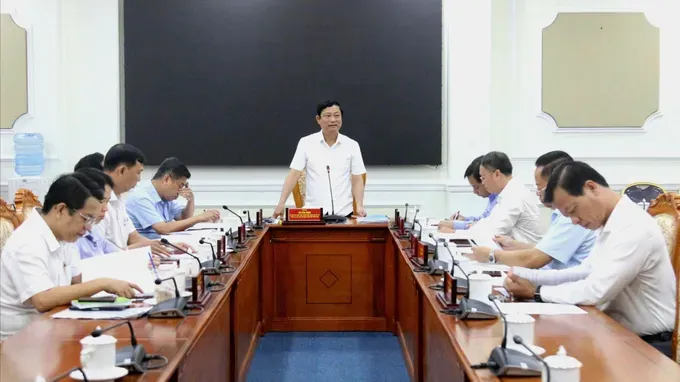
At the meeting, the Department of Agriculture and Environment reported on the implementation of public investment projects in the field of environmental protection during the 2021-2025 period, while also proposing a list of priority projects for the 2026-2030 period.
During the 2021-2025 period, Ho Chi Minh City implemented three projects with a total investment capital of more than VND308 billion (US$11.7 million), focusing on the construction of a safe waste landfill area at the Northwest Waste Treatment Complex; investment in the Environmental Monitoring and Analysis Center; and expansion of the environmental monitoring system, data-sharing platform, and environmental management system to support smart urban development. These projects will be carried forward into the 2026-2030 period.
For the 2026-2030 period, Ho Chi Minh City is expected to implement 68 public investment projects in the field of environmental protection, focusing on key project groups related to environmental monitoring, solid waste treatment, completion of technical infrastructure at waste treatment complexes, and investment in modern waste transfer stations. Among them, four urgent projects have been identified for immediate prioritization under the Action Program of the Municipal Party Committee to implement the Resolution of the 2025-2030 Ho Chi Minh City Party Congress.
The Department of Agriculture and Environment proposed a project to enhance environmental monitoring capacity in Ho Chi Minh City, aimed at developing a synchronized monitoring system for air quality, surface water, groundwater, and land subsidence using automatic and continuous 24/7 technology, thereby contributing to early pollution warning and strengthening urban environmental management capacity.
Ho Chi Minh City also proposed the implementation of a project to cap landfill cells No. 1, 1A, and 2 at the Northwest Solid Waste Treatment Complex to comprehensively address environmental pollution, reduce the spread of odors and leachate, and improve the surrounding landscape.
Two large-scale projects—the investment in completing technical infrastructure at the Northwest Solid Waste Treatment Complex and the Da Phuoc Solid Waste Treatment and Cemetery Complex—have been identified as key projects of strategic significance in waste treatment, circular economy development, and the move toward a green and sustainable urban model.
Concluding the meeting, Chairman of the Ho Chi Minh City People’s Council Vo Van Minh stressed that environmental protection is not only an urgent immediate requirement but also a long-term strategic task directly linked to growth quality, competitiveness, and the quality of life of residents.
The Chairman of the Ho Chi Minh City People’s Council requested the Ho Chi Minh City People’s Committee to direct departments and agencies to continue thoroughly reviewing the project portfolio and clearly determine priorities, with a focus on truly urgent works, including projects on canal pollution treatment, water environment rehabilitation, wastewater collection, and treatment.
He noted that pollution treatment efforts should be integrated with urban revitalization and the effective exploitation of river, canal, and streamfront spaces in order to create landscapes, public spaces, and momentum for sustainable urban development.
He emphasized that capital allocation must be focused and targeted, with careful review of funding sources from the Ho Chi Minh City budget, ODA (Official Development Assistance) capital, PPP (Public-Private Partnerships) models, and other social resources. On that basis, authorities should clearly identify which projects require public investment and which can mobilize non-budget funding sources.
Ho Chi Minh City has set a target that by the end of 2028, more than 90 percent of municipal solid waste will be treated using recycling technology, waste-to-energy incineration, and other advanced technologies, gradually replacing traditional landfill methods. The city will also invest in a synchronized system of technical infrastructure, transfer stations, and modern waste treatment facilities in order to reduce pressure on the urban environment and enhance climate change adaptation.


)