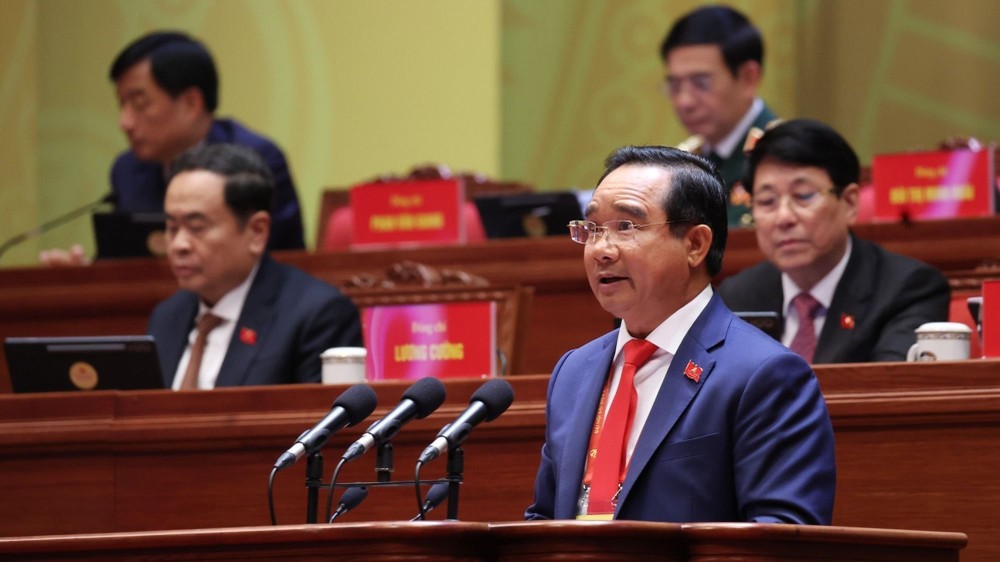
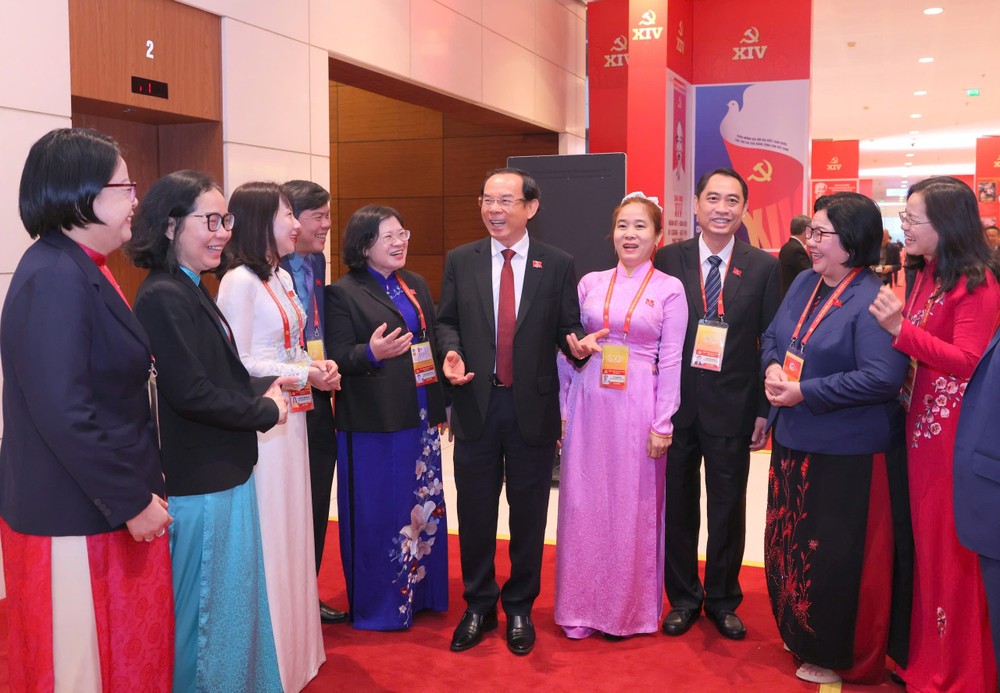
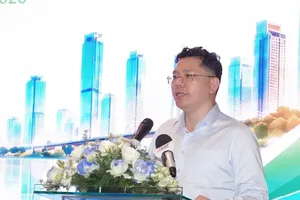
The 14th National Party Congress entered its third working day on the morning of January 21, during which Mr. Nguyen Van Duoc, Deputy Secretary of the HCMC Party Committee and Chairman of the HCMC People’s Committee, delivered a keynote presentation on leveraging the city’s locomotive role to develop HCMC into an international hub for science, technology, and innovation, generating spillover momentum nationwide.
HCMC cannot afford to follow a worn path
According to Mr. Nguyen Van Duoc, HCMC is entering a new phase of development—one in which the city can no longer rely solely on its proud history, dynamic traditions, and well-established pioneering spirit. More than ever, it must be deeply aware of its responsibility in meeting national expectations. Over the past several decades, HCMC has consistently served as one of Vietnam’s primary engines of growth, innovation, and international integration.
Those contributions are undeniable. Yet amid rapidly evolving domestic and global conditions, past successes have also set a higher bar for the city in the current period. HCMC, he stressed, cannot continue developing along a familiar trajectory. Instead, it must proactively reinvent itself in a deeper, more differentiated manner, guided by long-term vision, strategic depth, and sustainability.
This renewal is not merely about reaffirming the city’s role as an economic locomotive. It is about living up to the trust and responsibility entrusted to HCMC by the Party, the State, and people nationwide as the country enters a new stage of development.
HCMC’s ambitions aligned with national goals
The HCMC Chairman emphasized that the city’s development aspirations for 2030 must be aligned with a broader national vision. Vietnam’s overarching goal is to become a high-income, developed country with a firm position on the global stage by 2045—the centenary of the nation's founding. Within this strategic context, the central leadership has placed particularly high expectations on HCMC: not only to grow faster, but to grow differently; not only to move ahead, but to pioneer new paths; and not only to succeed on its own, but to generate momentum that benefits the entire country.
HCMC is expected to serve as a testing ground for new mechanisms and policies, a magnet for science, technology, and innovation, and a model of urban governance for the new era. This role, Mr. Nguyen Van Duoc noted, is both an honor and a strategic national commitment. It requires unified awareness, strong political resolve, breakthrough thinking, internal solidarity, and consistent, determined action.
Three pillars for a substantive breakthrough
To realize these expectations, HCMC has identified three key pillars as the foundation for a genuine breakthrough.
First, institutional reform is a prerequisite. Institutional bottlenecks remain the “bottleneck of bottlenecks,” yet they also represent the most powerful lever if addressed in the right direction and at the right time. On behalf of the Party organization and people of HCMC, Mr. Nguyen Van Duoc expressed gratitude to the Central Party Committee, the Politburo, the Government, ministries, and particularly the National Assembly for recently passing Resolution No.260/2025/QH15 which amends and supplements Resolution No.98/2023/QH15 on piloting special mechanisms and policies for HCMC’s development, paving the way for stronger growth—potentially double-digit expansion in 2026 and subsequent years.
Beyond this, the city needs to be granted—and to proactively exercise—more flexible mechanisms commensurate with its role, scale, and contributions. This includes piloting new governance models, streamlining administrative procedures, and expanding policy space for innovation and the healthy development of the private sector. Institutional reform in HCMC is not solely about improving the city’s own efficiency, but about generating practical models that can be replicated nationwide.
Second, science, technology, and high-quality human resources must become the core growth drivers. If HCMC continues to rely primarily on capital accumulation, land expansion, and low-cost labor, it will soon hit a growth ceiling. Recent years have already illustrated this risk, as the city’s GRDP growth has slowed markedly. Sustainable development, Mr. Nguyen Van Duoc emphasized, can only be built on knowledge, technology, and people.
HCMC enjoys rare and significant advantages: a dense network of universities and research institutes; a dynamic and adaptive business community; and a young, creative workforce with strong aspirations. The core challenge lies not in resource availability, but in organization and connectivity, how to mobilize these assets through the “triple helix” model linking the State, academia, and enterprises. Research must be tied to market demand; training must align with development strategies; businesses must truly sit at the center of the innovation ecosystem; and the State must act as both a buyer of solutions and an enabler of development.
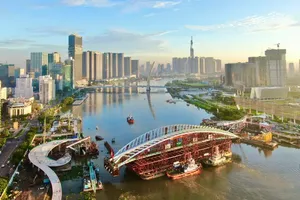
Third, infrastructure development must move ahead and move fast to go far. Infrastructure should not only meet immediate needs, but also serve long-term development goals. HCMC’s infrastructure must be viewed as part of the national strategic infrastructure, encompassing transport, logistics, digital platforms, regional connectivity, and knowledge-based economic systems.
On this foundation, the city aims to reposition its geo-economic role around three strategic spearheads: high-quality financial and commercial services; high-tech industry; and logistics linked to regional and global value chains.
Regional connectivity, Mr. Nguyen Van Duoc stressed, is an inevitable development space and a prerequisite for sustainability. HCMC cannot—and should not—develop in isolation. Sustainable growth can only be achieved when the regional economic space is rationally organized, value chains are appropriately distributed, and each locality’s role is clearly defined within an integrated whole.
Within this structure, HCMC is expected to act as the “chief architect” and coordinating hub of regional development—a center for finance, technology, and high-end services; a nexus where production, logistics, and high-tech agriculture converge and radiate outward; and a place where value added is distributed harmoniously to support shared prosperity.
Retaining talent, nurturing creativity, strengthening social trust
The HCMC Chairman also highlighted social development as the foundation of “soft power.” Economic growth ultimately must serve people. HCMC aspires to become a livable global city where growth goes hand in hand with progress and equity; innovation with inclusiveness; and integration with cultural identity. A livable city, he noted, is measured not only by economic scale, but by quality of life, social cohesion, and public trust.
In this context, retaining talent, nurturing creativity, and strengthening societal trust form the bedrock of sustainable development and long-term competitiveness.
The HCMC Chairman concluded that the city stands at a historic opportunity to reaffirm itself—not through rhetoric, but through concrete actions, substantive reforms, and a profound sense of responsibility to the nation. The path ahead is one of growth driven by science and technology, innovation, the circular economy, and green development, gradually building durable competitiveness and positioning HCMC as a regional and international hub of economic vitality and innovation.
With the highest level of political determination and a strong spirit of contribution, HCMC, he affirmed, is committed to working alongside the entire country to realize the vision of a developed, self-reliant, prosperous, civilized, and happy Vietnam—deeply integrated into the global community and enjoying an ever-higher international standing.

)