Procedures designed to serve citizens
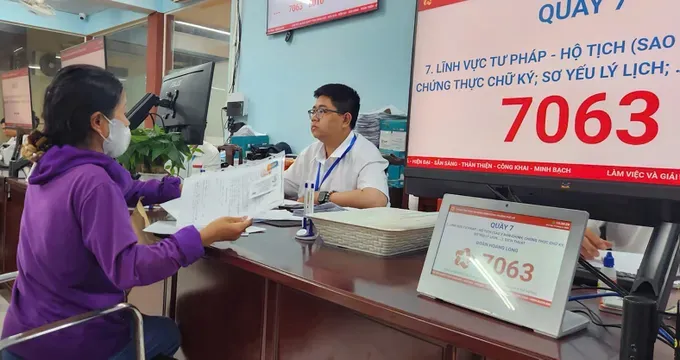
On a typical Monday morning in the Tan Son Hoa Ward Public Administration Service Center, several militia members are on duty; some are directing parking, while others are inquiring about residents’ needs to provide quick guidance on necessary procedures.
Inside, the headquarters isn’t large but is neatly organized. Every counter features a civil servant’s nameplate, accompanied by a contact phone number. The center even publicly displays the phone numbers of the director and deputy director so that citizens can provide direct feedback if necessary.
In mid-April, Tan Son Hoa Ward launched the “One Destination – Multi-Utility” model for household businesses. Alongside specialized officials, bank staff now assist with account openings and registration procedures. Consequently, tasks once requiring multiple visits are now centralized. Furthermore, residents receive consultations on tax obligations and digital signatures. These previously foreign concepts are explained directly, ensuring that starting a business is no longer a daunting hurdle.
For 34-year-old Do Van Tuan, a local resident, the new system has simplified his apartment business registration. This was his first time performing this procedure. “I previously thought it’d take one or two days and requires visiting many places to finish. Today, doing it all in one spot is much more convenient,” Mr. Tuan explained.
Deputy Director Vo Pham Y Nhi of the Tan Son Hoa Ward Public Administration Service Center noted: “On average, the ward receives about 30-50 business registration dossiers per month. Now, citizens can complete nearly the entire process at a single point, instead of traveling to multiple agencies as before.”
From small changes in one locality, it’s evident that administration reform doesn’t need to be something overly grand; it simply requires a shift in service delivery so that citizens don’t have to “chase after procedures.”
Trusting in a people-centric government
In another locality, grassroots authorities are also proactively bringing public services closer to the people.
For 57-year-old Tu Lien, a resident of Tay Nam Ward, the shift toward digital governance reportedly required a bit of a learning curve. He meticulously organized documents for his family’s 1,400-square-meter plot before seeking assistance at the Dong Soi Neighborhood office.
Intending to divide the land for his children, he found the facility equipped with essential electronics and staffed by the Community Digital Transformation Team. Mr. Lien admitted he isn’t tech-savvy, having never navigated online portals. Patient officials demonstrated how to scan documents and utilize the VNeID application despite his initial clumsiness.
Ultimately, after receiving further aid from Youth Union volunteers, he successfully finalized his dossier. “Elderly people like me aren’t quick with technology, but thanks to the youngsters’ patience in teaching every little thing, I know how to do it now. Officials today are enthusiastic and very close to the people.”
Ms. Ly Thanh Phuong and her daughter also visited the center to adjust information on a birth certificate. After waiting only a few minutes, the procedure was finished. The speed and the welcoming attitude of the processing officials left her pleasantly surprised. Once hesitant about technology, she has gradually grown accustomed to online submissions and increasingly trusts the people-centric working style of grassroots authorities.
According to Chairwoman Nguyen Ngoc Phuong Lien of the Tay Nam Ward People’s Committee, her ward’s “No Appointment Day” every Thursday significantly enhances convenience. Permanently stationed volunteers facilitate both in-person and online National Public Service Portal procedures. This model enables same-day processing for 16 procedures regardless of boundaries. Consequently, it bolsters transparency and reduces travel, signaling a definitive shift from management toward service.
Reflecting on the past half-century, HCMC has evolved from an elementary administrative mechanism into a hub of nationwide technological leadership. By 2026, the city had consolidated its service portals into a seamless “digital highway” within the National Public Service system.
Consequently, “Digital Citizen Stations” and guiding robots are now commonplace, alleviating pressure on civil servants while bolstering data accuracy. However, dedicated officials maintain that even the smartest robots can’t replace the necessity of a kind heart and professional responsibility. Beyond high online processing rates, the vital presence of “blue-shirt” volunteers ensuring timely support for residents remains indispensable.
Ultimately, HCMC’s administrative reforms demonstrate a desire for global stature while preserving sentimental roots. Digital transformation isn’t intended to replace humans but to liberate them from cumbersome procedures, allowing more time for genuine listening and mutual understanding.
Administration reform as central driver of growth
Recently, the HCMC People’s Committee issued the 2026 Administration Reform Plan, focusing on the synchronized implementation of 92 specific tasks across six fields. The HCMC Department of Home Affairs stated that, given new development requirements, HCMC identifies administration reform not as an isolated task but as the central driver of growth and sustainable development.
Administration reform combined with building a digital government is a core task, taking people and businesses as the center and satisfaction levels as the yardstick for evaluating service quality. In 2026, HCMC aims for its administration reform indices to be among the top 10 leading localities nationwide, with satisfaction levels from citizens and businesses reaching 96 percent or higher.
Outstanding administration reform results in HCMC
- Announcing 2,231 administrative procedures, including 2,066 that aren’t dependent on administrative boundaries;
- Completing the consolidation of different systems, providing 2,066 administrative procedures electronically;
- Reviewing and proposing the reduction and simplification of over 500 procedures;
- Implementing “Digital Citizen Station” and self-service kiosk models as well as intelligent robots at public administration service centers;
- Implementing a groundbreaking model for “receiving dossiers regardless of administrative boundaries.”






)