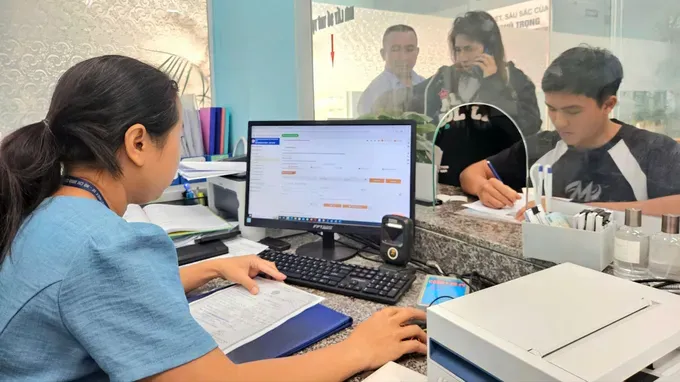
It’s just before 9:00 a.m. on a Monday, and Nguyen Thi Ha has arrived at the Public Administration Service Center in Ben Thanh Ward to submit some paperwork. It’s peak hour, and the center is packed. With no room inside, Ha is forced to wait by the doorway, occasionally pressing herself against the wall to let others pass.
The “one-stop shop” area of the Ben Thanh Ward Public Administration Service Center is a mere 45m2, crammed with a long desk for seven civil servants who handle public inquiries. The little remaining space is filled with a handful of chairs.
According to the center’s Deputy Director Mac Hong Linh, the entire building was originally designed for 30-40 staff members. Today, it houses over 80, creating severe overcrowding. The service center’s 17 employees and its public reception area are squeezed into less than 70m2, despite serving around 150 citizens daily. At peak times, there simply isn’t enough room for people to sit.
The situation is similar at the Phu Thuan Ward Public Administration Service Center, located on the ground floor of the ward's Party Committee – People’s Council – People’s Committee headquarters. The 70-square-meter space is often so full that residents have to stand outside, waiting for their number to be called.
“The center is on a main road, but the space is so narrow, and there’s no parking,” complained local resident Tran Minh An, who had to park his motorbike at a nearby military post.
Over at An Phu Dong Ward, the one-stop shop station, which processes 300-500 files for hundreds of residents each day, faces the same challenge. Citizens report that the cramped space lacks basic amenities like information kiosks or dedicated areas for online service support.
Local authorities are aware of the problems and are implementing stopgap measures while pushing for long-term solutions.
Deputy Director Nguyen Ngoc An of the An Phu Dong Public Administration Service Center explained that they have expanded from five to nine service counters and temporarily repurposed an adjacent area to add eight more for utility service providers, post offices, as well as reserve counters for receiving and processing administrative procedures regardless of administrative boundaries. They’ve also placed benches outside for extra seating and have formally requested funds for new equipment.
On the digital front, the ward is integrating online and cashless payment systems, using national ID card QR codes to digitize records, and deploying youth volunteers to help residents navigate online applications smoothly and conveniently.
Vice Chairman Nguyen Tuan Khai of Phu Thuan Ward acknowledged that both his main service center and the public service point at the local police station are inadequate. In response, the ward has officially proposed that the city invest in a new, larger government headquarters; simultaneously, it suggested repairing and arranging the citizen reception point of the ward police to ensure area and facilities to serve the people.
“While we wait for a new building,” he said, “we are heavily promoting online services and having documents delivered by post to reduce foot traffic.”
A common thread across many wards is the issue of outdated equipment. Old computers, scanners, and unstable network infrastructure are hampering efficiency.
This widespread problem has caught the attention of city leadership. At recent meetings, Chairman Nguyen Van Duoc of the HCMC People’s Committee has called for the continued stabilization and improvement of the local government apparatus.
He specifically demanded “fundamental and methodical investment” in the city’s public administration service centers, particularly the 38 key hubs that handle procedures regardless of administrative boundaries.
The Chairman was unequivocal: “There must be foundational investment in all aspects of infrastructure, from software and terminals to transmission lines and network equipment, to better serve our people and businesses.”











)