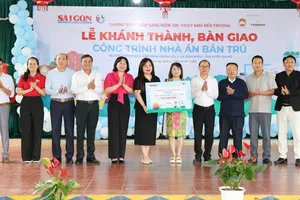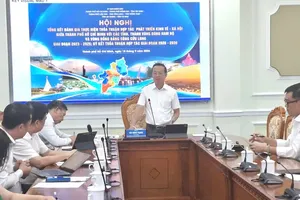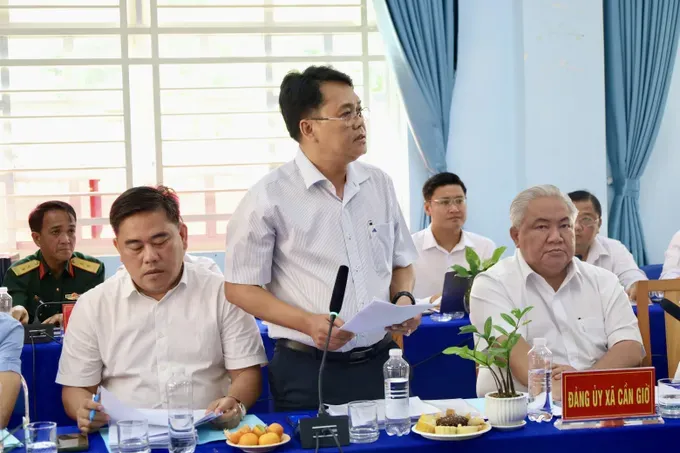
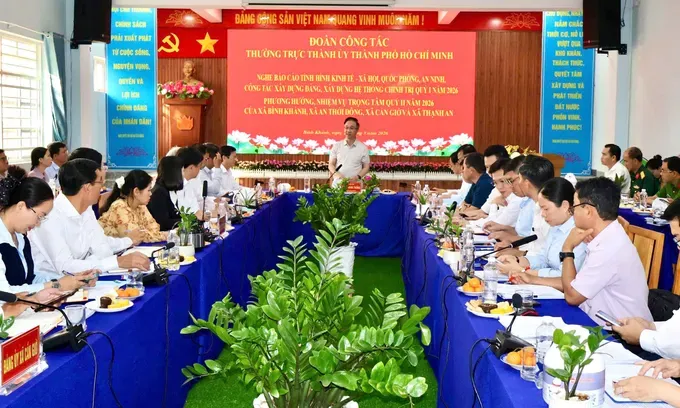
The delegation led by Mr. Dang Minh Thong, Deputy Secretary of the Municipal Party Committee, worked with the communes of Binh Khanh, Can Gio, An Thoi Dong, and Thanh An on the implementation of socio-economic development tasks, national defense and security, Party-building efforts, and the strengthening of the political system in 2026.
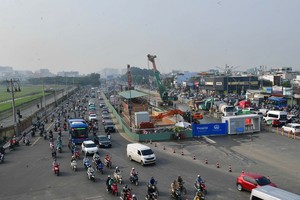
Discussions also focused on key orientations and priority tasks for the second quarter, including measures to accelerate land clearance in order to fast-track major infrastructure projects such as the Ben Thanh – Can Gio metro line and Can Gio Bridge.
Leaders of the communes reported that the socio-economic situation has remained stable, while national defense and security have been firmly maintained. However, several localities continue to face challenges due to specific geographical conditions, infrastructure limitations, human resource constraints, and the impact of rising fuel prices.
In Thanh An Commune, key targets and tasks for 2026 have generally been implemented in line with the planned schedule, with a number of indicators achieving positive results. Nevertheless, the increase in gasoline and oil prices has directly affected residents’ livelihoods and income sources.
For the second quarter of 2026, the commune has set key priorities of maintaining stability, improving governance quality, and promoting the development of the marine economy and community-based tourism. At the same time, it will closely monitor the situation and propose measures to support the livelihoods of residents affected by fuel price fluctuations.
In An Thoi Dong Commune, the political system has remained largely stable and operates smoothly, while technical infrastructure and information systems have met the requirements of administrative reform. However, trade, services, and tourism are still developing on a small scale, lacking connectivity and distinctive products, mainly due to infrastructure limitations and insufficient attractiveness to draw business investment.
Meanwhile, in Can Gio Commune, the economy has continued to maintain stable growth, with a positive shift in economic structure toward trade and services, which account for 63.5 percent. Cultural, sports, and tourism activities have been vibrant, while efforts to combat illegal, unreported, and unregulated (IUU) fishing have been implemented in a focused and rigorous manner.
In Binh Khanh Commune, during the first quarter, the locality stepped up digital transformation efforts, establishing a Digital Transformation Steering Committee and deploying community digital technology teams across all 19 hamlets. The “Digital Family” model has been introduced, alongside the implementation of document management software at the hamlet level.
The commune is also rolling out an information technology equipment package to serve the two-tier local government model. In addition, it has coordinated the deployment of various digital applications, including the “Binh Khanh Digital” platform, an AI virtual assistant, an electronic meeting system (E-Meeting), and an intelligent operations dashboard (i-Dashboard).
Concluding the working session, Deputy Secretary of the Ho Chi Minh City Party Committee, Dang Minh Thong, commended the proactive spirit and efforts of local authorities in overcoming difficulties. He emphasized that the Standing Boards of the Party Committees of the four communes should focus on thoroughly analyzing existing shortcomings and limitations and propose effective solutions to ensure the efficient operation of the two-tier local government model.
In the time ahead, localities are required to strengthen leadership and direction in a decisive and results-oriented manner, ensuring that tasks are carried through to completion with tangible outcomes. Responsibilities must be clearly assigned, with specific individuals, tasks, timelines, results, and authority, closely linked to substantive and performance-based evaluation of officials.
In addition, efforts should be made to consolidate and streamline the organizational apparatus while strengthening mass mobilization work, proactively monitoring public opinion, and promptly addressing citizens’ petitions and concerns. Additionally, localities are required to accelerate compensation and site clearance for key projects, including the Ben Thanh – Can Gio metro line, Can Gio Bridge, and other major developments.
Local authorities should also review and adjust planning schemes, clearly define the development orientation of each commune, and actively contribute feedback to the city’s master planning process, thereby supporting the goal of achieving double-digit growth.
Furthermore, particular attention must be paid to the disbursement of public investment capital, with effective measures to ensure sustainable poverty reduction. Procurement of equipment should be carried out transparently and rigorously, strictly aligned with requirements on anti-corruption and the prevention of negative practices.