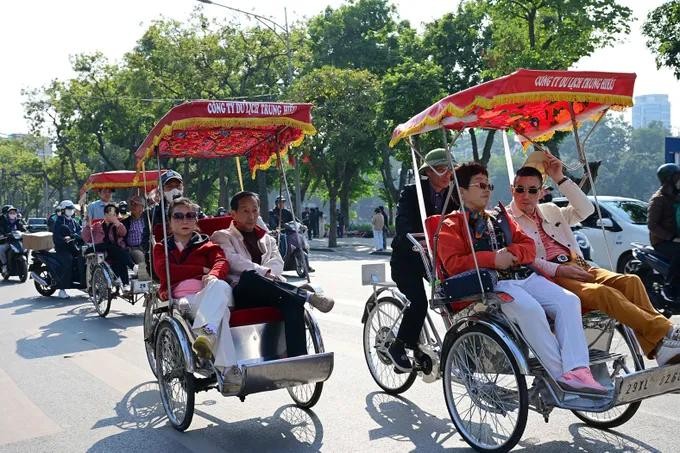
The cyclo, a three-wheeled bicycle taxi, has long been a symbol of Hanoi’s urban memory, evoking the city’s slower pace of life and offering tourists a unique way to experience its streets. Yet as the capital advances toward green transportation and modern urban management, the future of this cultural icon is under scrutiny.
A slow ride through Hanoi’s urban memory
For decades, cyclos have been woven into Hanoi’s urban memory, closely associated with the Old Quarter, a slower rhythm of life, and a distinctive tourism experience. For many international visitors, a cyclo ride offers a rare opportunity to slow down, observe street life, and absorb the city through sound and motion. Yet behind this nostalgic image lies the daily struggle of cyclo drivers to earn a living.
Tran Van Tue, who has worked as a cyclo driver around Hoan Kiem Lake and the Old Quarter for nearly 25 years, said most of his customers are foreign tourists traveling in pairs. While regulations allow only one passenger per cyclo, he explained that carrying a single person makes it increasingly difficult to earn enough income amid rising living costs. This has left many drivers caught between compliance with safety rules and economic survival.
For cyclo drivers, the vehicle is not merely a tourism product or a symbol of the past, but a livelihood built over decades of physical labor. For tourists, however, it represents a moment of calm in a fast-moving city. That contrast has fueled debate over whether the experience remains sustainable for both sides.
Sam Kupriyanov, a Russian content creator living in Vietnam, said he felt uncomfortable riding a cyclo on hot days, particularly when he saw drivers strain to pedal. While he supports preserving cyclos as part of Hanoi’s traditional life and a source of jobs, he believes improvements are needed to make the work more humane and less physically demanding.
In response to economic pressures, some cyclos have been fitted with motorized assistance to increase speed and reduce physical strain, allowing drivers to serve more customers. The move, however, has sparked controversy, with critics warning that higher speeds undermine the leisurely character of cyclo rides and increase safety risks in the narrow streets of the Old Quarter.
Preservation vs. Innovation
According to Tran Trung Hieu, Deputy Director of the Hanoi Department of Tourism, recent criticism of cyclos stems largely from violations such as overloading and non-compliance with traffic laws. Each cyclo is permitted to carry only one passenger, and exceeding this limit not only poses safety risks but also damages Hanoi’s tourism image.
He emphasized that cyclos remain a unique tourism product and frequently appear in international promotion campaigns. Preservation, he said, does not mean lax management, as unregulated operations could ultimately undermine the city’s brand.
Deputy Director Tran Trung Hieu added that any proposal to motorize cyclos must be considered within Hanoi’s broader transition toward green transportation. Such changes require careful study of technical design, safety, and legal frameworks, and cannot be rushed.
The Department of Construction is currently seeking qualified units to propose cyclo designs aligned with this direction. The process remains in the research and consultation phase, with no final decision yet made. Until then, cyclos are expected to operate under existing regulations while improving service quality.
From a cultural perspective, Nguyen Quang Thieu, President of the Vietnam Writers Association, argues that cyclos should be viewed first and foremost as a cultural element of Hanoi. In many major cities worldwide, traditional practices are preserved and integrated into modern life through clear regulation rather than eliminated.
He warned that the slow pace and quiet presence of cyclos are central to their cultural value. Motorization, he said, would strip cyclos of their essence, turning them into a hybrid form of transport disconnected from Hanoi’s spirit.
This view is shared by tourism businesses. Nguyen Cong Hoan, General Director of Flamingo Redtours, said cyclos should be preserved as a distinctive cultural asset, similar to horse-drawn carriages or rickshaws in other countries. Preservation, he added, must go hand in hand with standardization in design, routes, capacity, and driver qualifications.
As Hanoi continues to modernize, its cyclos face a delicate balancing act between heritage and progress, memory and regulation. Many believe the answer lies not in choosing one over the other, but in defining a thoughtful, well-managed place for cyclos in the city’s contemporary urban life.