During the early days of September 2026, a task force from the Thu Duc Ward Public Security Division visited every household, manufacturing facility, plus commercial enterprise across the locality to actively disseminate vital regulations on fire prevention safety.
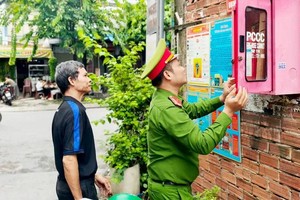
At an apparel store situated on Vo Van Ngan Street, Captain Pham Trung Truc meticulously inspected the merchandise layout, entryways, alongside on-site firefighting equipment. Captain Truc pointed out potential fire hazards, instructing 58-year-old store owner Nguyen Van Thang on how to pragmatically rearrange items.
Concurrently, he firmly mandated the store to be fully equipped with portable extinguishers and smoke alarms. He also provided hands-on guidance regarding initial emergency responses upon discovering a blaze, emphasizing that escape routes must constantly remain unobstructed.
For Mr. Nguyen Van Thang, proactive policing is a familiar sight. “This isn’t the first time the ward police have visited my facility to advocate for fire safety,” he noted. Following each session, he acquires firefighting equipment and reminds his staff to meticulously master necessary survival skills. Upon spotting a fire, the absolute priority is cutting off the power supply, swiftly evacuating, coordinating initial suppression efforts, then dialing functional forces.
Working in tandem with police, local mass organizations are actively stepping up. The Women’s Union branch of Neighborhood 30 in Thu Duc Ward formed task forces to “scan every alley, knock on every door,” instructing residents to thoroughly check electrical grids, gas stoves, or worship altars. Furthermore, they mobilize citizens to self-equip fire extinguishers and forge secondary escape routes, striving toward establishing “Fire-Safe Families.”
For 60-year-old Le Thi Mai Hoa of Neighborhood 30, a family’s proactiveness acts as the absolute linchpin in fire prevention. Before leaving the house, everyone ought to double-check their lights, fans, as well as electrical appliances. When heading to bed, people are advised against leaving their phones charging on pillows or mattresses.
“Never boil water or cook food then wander off to do other chores; you might think you’ll return quickly, but once you step outside you might just forget entirely,” Ms. Hoa elaborated.
Besides that, equipping residential clusters with public firefighting cabinets is remarkably practical, especially in cramped alleys teeming with boarding houses. When a blaze erupts, locals can immediately utilize extinguishers and demolition pliers housed inside to tackle the inferno right from the initial minutes, heavily mitigating damages well before professional squads arrive.
HCMC is currently orchestrating the urban embellishment of several older neighborhoods, systematically reorganizing living spaces to be significantly more synchronized and secure. The comprehensive renovation projects encompassing the Ma Lang area plus the Ga – Gao Market serve as stark examples.
For long-standing communities plagued by cramped housing and severely degraded infrastructure, merely mobilizing individual households to self-renovate only scratches the surface. Fundamentally reorganizing the urban spatial layout while synchronously investing in infrastructure alongside novel community-serving facilities is the true solution; it guarantees uncompromised safety while elevating residents’ living standards.
Alongside vigorous advocacy, HCMC functional forces are comprehensively scrutinizing high-risk fire facilities, strictly demanding immediate remedial actions.
For Lieutenant Colonel Le Tan Chau, Deputy Head of the Fire Prevention, Fighting and Rescue Police Division under the HCMC Public Security Department, the current urban landscape presents formidable challenges.
He pointed out that high-risk structures explicitly include crowded boarding houses severely lacking viable escape routes, combined residential-commercial homes stockpiling combustible merchandise, edifices with “tiger-cage-like” barricading exits, plus small-scale production hubs intricately interwoven into residential clusters.
For these vulnerable cohorts, the division seamlessly coordinates with commune-level police to ramp up inspections under a strict motto of “clear personnel, clear tasks, clear responsibilities, clear deadlines.” The main objective is to aid owners in promptly eliminating glaring safety hazards. If establishments stubbornly refuse to comply, they aren’t shown leniency; functional forces resolutely impose stringent penalties.
Post-inspection, authorities mandate household heads to sign binding commitments regarding remedial timeframes. To date, over 95 percent of households reportedly executed the recommended directives. For serious violations posing direct fire threats, authorities aggressively apply severe punitive measures, including operational suspensions.
The HCMC Department of Public Security are determined to systematically roll out synchronized solutions, ranging from rigorous territorial management to strictly penalizing infractions.
According to Lieutenant Colonel Le Tan Chau, commune-level administrations practically serve as the indispensable backbone for managing fire safety. They ought to routinely examine, painstakingly update, and meticulously categorize combined properties to prioritize targeted inspections.
Local authorities must also sustainably maintain militia forces, inject capital into public firefighting hubs, while ramping up periodic training to holistically elevate comprehensive response capabilities.
Furthermore, grassroots management need to connect repairmen with struggling households to support renovations and carve out vital escape routes. Once citizens genuinely realize such renovations are entirely feasible and reasonably priced, the model shift will inevitably become much more durable.
Alongside screening risks, grassroots fire prevention protocols must explicitly delineate legal liabilities whenever infractions occur. For Lawyer Tran Van Gioi, current legislation is unequivocally clear. He highlighted that it explicitly stipulates harsh sanctions against infringing behaviors.
Accordingly, randomly renovating structures normally requiring fire safety appraisals without formal approval can incur hefty fines ranging from VND15 - 20 million (US$580 - $780). Hoarding combustible goods without guaranteeing safety yields fines of VND3 - 50 million ($115 - $1,900), while unsafely charging electric vehicles leads to penalties of VND6 - 50 million ($230 - $1,900). If flouting protocols directly results in fatalities, severe injuries, or property devastation valued at VND100 million ($3,800) upwards, violators can absolutely face relentless criminal prosecution.



)