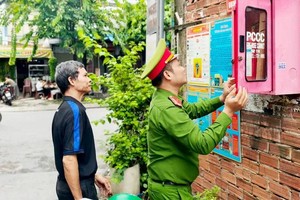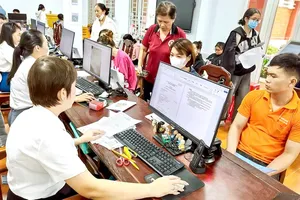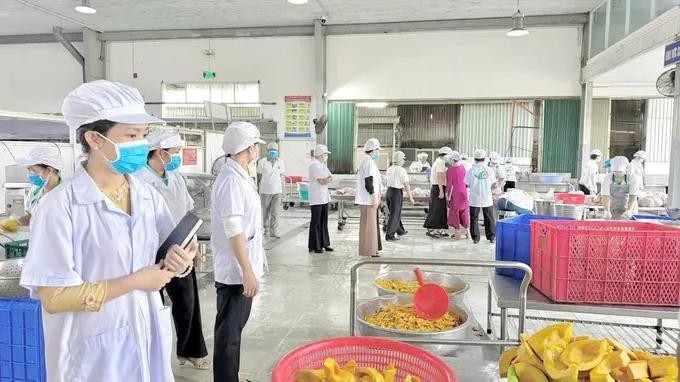
On September 14, a task force from the Tam Thang Ward People’s Committee conducted an inspection of Tran Phu Junior High School’s boarding organization.
At the meal service area, task force members directly scrutinized rice and soup containers. They demanded serving staff divide portions to cross-reference against the publicly announced menu, concurrently checking exact dish quantification. They also inspected the food sample retention zone. Following this, the school was highly advised to lock the area or install surveillance cameras overseeing sample cabinets to dramatically bolster central control.
For Head Hoang Dinh Ke of the Socio-Cultural Affairs Office under the Tam Thang Ward People’s Committee, maintaining strict oversight is crucial. He noted they’ll continue organizing both periodic and unannounced inspections. If a catering unit has glaring, unrectified issues despite warnings, it’ll be unequivocally forced to terminate its contracts.
Beyond rigorously monitoring the multifaceted stages of receiving, cooking, and preserving food, Le Thi Rieng Primary School heavily prioritizes the feedback loop. They actively listen to direct opinions from students alongside parents to promptly rectify emerging issues, elevating boarding meal quality. Principal Nguyen Thi Hai informed that following an educational merger, the school boasts a main campus with 342 registered boarding students alongside a branch catering to 72 pupils.
At the main campus, the kitchen strictly adheres to a one-way culinary process, hiring personnel from a meal service company to cook directly on-site. Meanwhile, because the branch hasn’t established an on-site kitchen yet, they receive portions cooked at a neighboring primary school, transported via specialized vehicles. Although management models differ, both campuses invariably share the exact same meal provider.
The school actively maintains a system where parents can register for unannounced inspections, joining boarding meals alongside their children on any day. Furthermore, every month, they organize an “Open Meal” for parents aiming to genuinely listen to constructive contributions.
Across HCMC, there are currently 399 industrial meal providers, 2,525 school kitchens, 752 collective kitchens, alongside over 13,000 food business establishments. The HCMC Food Safety Department is coordinating to thoroughly review all collective kitchens in all educational facilities; they’re comprehensively evaluating personnel, infrastructure, and equipment, while inspecting businesses supplying meals to these schools.
Principal Nguyen Thi Hai noted that under Directive 33/CT-TTg, issued by the Prime Minister regarding the enhancement of food safety in educational institutions, the commune-level People’s Committee is wholly responsible for appraising dossiers, legal status, and food quality, alongside selecting the units providing food and meals for local schools.
“Shifting the responsibility of appraising dossiers and selecting food suppliers from the schools in previous academic years over to the commune-level People’s Committee this year effectively helps schools gain an additional monitoring channel and a vastly more secure legal foundation,” she expressed.
Accordingly, the school proactively proposes a meal provider, while the locality bears the absolute responsibility to appraise, approve, and concurrently inspect and supervise the execution process. To persistently elevate the quality of managing and organizing boarding meals, the school strongly recommended integrating further coordinated supervision from parents.
Sharing this sentiment, for Principal Tran Thi Tuong Giao of Truc Xanh Kindergarten in Rach Dua Ward, transparency is key. She posited that publicizing supplier information to parents via the Parent-Teacher Association and the school’s official information channels is utterly essential. Within this framework, fresh produce must strictly guarantee top-tier quality before being accepted, while packaged foods specifically must feature explicit information regarding the manufacturer, expiration dates, and preservation conditions.
The school has also strategically arranged a display fridge in the waiting lobby to showcase the children’s daily meals so parents can easily observe them during drop-offs and pick-ups; this creates favorable conditions for parents to inspect the food whenever they feel the need, fully guided by management staff or the school’s medical personnel.
For Dr Lam Quoc Hung from the National Institute of Nutrition (NIN) under the Ministry of Health, enhancing self-monitoring capacity is absolutely essential. Currently, boarding meal fees across several localities remain relatively low compared to prevailing market prices. When financial resources are severely constrained, catering units run the glaring risk of slashing ingredient quality standards or utilizing cheap, untraceable foodstuff.
This omnipresent concern could drastically impact the nutritional quality and food safety of school meals. The inherent difficulty in monitoring on-campus meals stems from predominantly executing it via sensory evaluation like color, smell, or taste rather than rigorous laboratory testing or precise nutritional evaluations. Therefore, schools desperately need their technical skills elevated to autonomously inspect food safety.
A handful of methods involve equipping rapid test kits to instantly check safety indicators, such as borax, pesticide residues, or E.coli bacteria, right at the exact moment of receiving raw ingredients. Besides that, authorities should continuously organize periodic training courses focusing on nutrition for school management teams, cooking staff, alongside parents to heavily amplify the efficacy of self-monitoring.
)