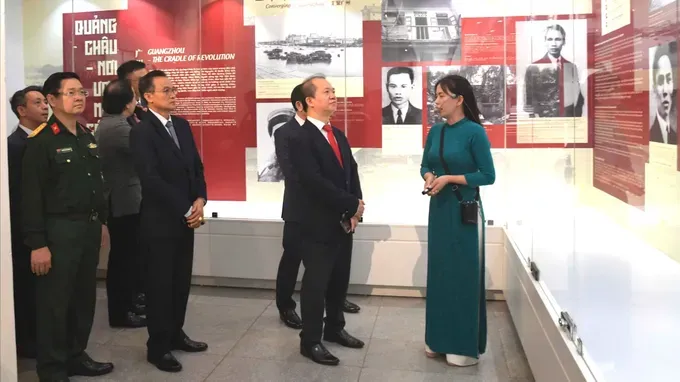
An exhibition titled “Revolutionary Solidarity—Vietnamese Comrades in the Guangzhou Uprising” opened at the Ho Chi Minh Museum in Hanoi on the morning of October 28, featuring more than 100 photographs, documents, and artifacts about Vietnamese revolutionaries who fought alongside Chinese forces and people.
The exhibition is jointly organized by the Department of Political Theory under the Party Central Committee’s Commission for Information and Education, the Ho Chi Minh Museum, and the Guangdong Museum of Revolutionary History. It marks the 102nd anniversary of Vietnamese patriot Nguyen Ai Quoc’s arrival in Guangzhou to pursue revolutionary activities (November 11, 1924–November 11, 2026) and the 99th anniversary of the Guangzhou Uprising (December 11, 1927–December 11, 2026). The exhibition will remain open to the public until February 28, 2027.
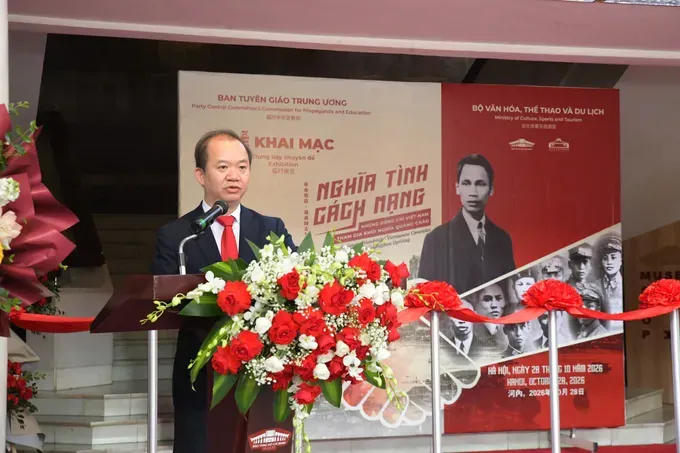
Speaking at the opening ceremony, Associate Professor and Dr. Bui Hoai Son, Deputy Head of the Party Central Committee’s Commission for Information and Education, said that nearly a century has passed. Yet, the stories told in this exhibition continue to move people deeply. Behind every photograph, every page of documentation, and every artifact is a person, a choice, and a life devoted to an ideal.
Associate Professor and Dr. Bui Hoai Son noted that Guangzhou holds a special place in President Ho Chi Minh’s revolutionary journey and the history of Vietnam’s revolution. There, Vietnamese patriot Nguyen Ai Quoc organized political training classes, founded the Vietnam Revolutionary Youth League, trained cadres, and laid the political, ideological, and organizational groundwork for the establishment of the Communist Party of Vietnam.
Vietnamese revolutionaries also received assistance and protection from their Chinese comrades and the Chinese people.
He expressed his hope that members of the public, particularly young people, would explore the historical materials and reflect on the choices made by earlier generations, thereby strengthening their sense of responsibility and carrying forward the friendship between the two peoples.
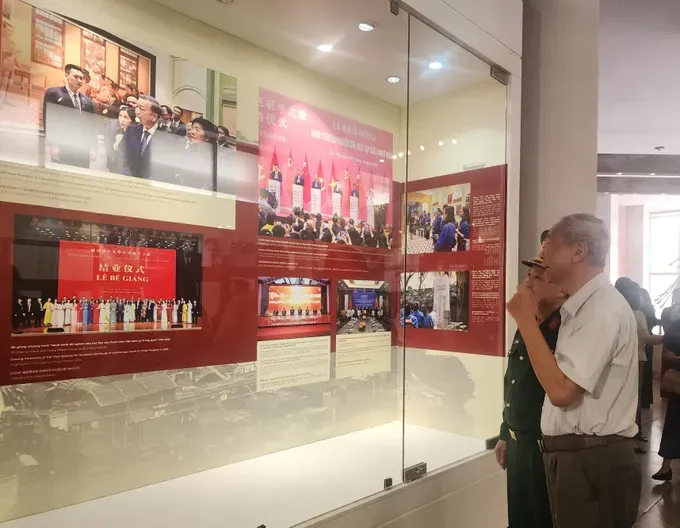
The exhibition is divided into three sections.
The first, “Guangzhou – A Cradle of Revolution,” traces Vietnamese patriot Nguyen Ai Quoc’s efforts to build revolutionary organizations, train cadres, and disseminate Marxism-Leninism in China. In 1925, he founded the Vietnamese Revolutionary Youth League in Guangzhou and launched the Thanh Nien (Young People) newspaper.
The second section, “Taking Part in the Guangzhou Uprising,” recreates the context and course of the uprising on December 11, 1927, and the participation of Vietnamese revolutionaries. Dozens of Vietnamese, including Nguyen Son (Hong Thuy), Ho Tung Mau, and Le Hong Son, fought alongside their Chinese comrades.
The third section, “Continuing the Epic Struggle,” highlights the activities of Vietnamese revolutionaries after the uprising and their contributions to national liberation and the development of Vietnam-China friendship.
The exhibition is organized under a 2024-2028 cooperation agreement between the Ho Chi Minh Museum and the Guangdong Museum of Revolutionary History. It aims to strengthen people-to-people exchanges, promote education about the traditional friendship between the two countries, and foster greater mutual understanding among younger generations.