Ho Chi Minh City’s rapid development is putting many valuable architectural spaces and structures at risk of alteration, degradation, or even total disappearance from urban life. Consequently, preservation has become an imperative—not merely to retain individual buildings, but to safeguard the spaces, landscapes, and collective memories tied to these places.
Urban preservation mindset shifts
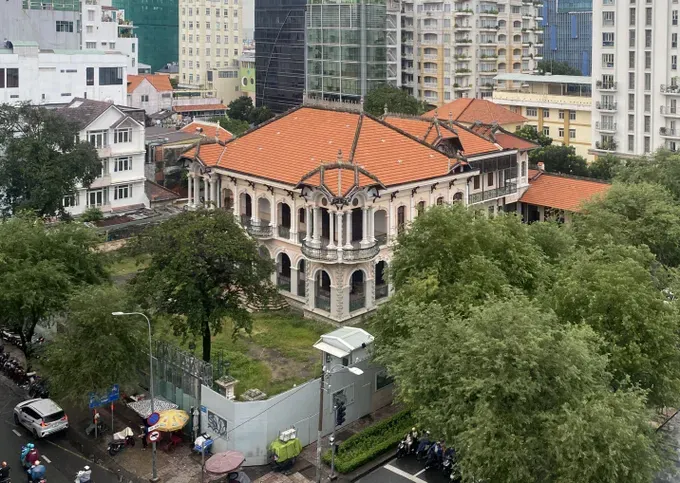
From ancient trees, streets, and sidewalks to old quarters, villas, traditional shophouses, and waterfront spaces, each element contributes to shaping the appearance and memory of Ho Chi Minh City.
According to many cultural and architectural experts, the urban preservation mindset has shifted from protecting individual structures to viewing heritage in relation to architectural ensembles, cultural landscapes, and community life.
For Ho Chi Minh City, this approach is all the more essential because its urban history was formed through multiple layers—intertwined with waterways, merchant ports, trade, industry, and traditional residential areas.
Dr. Arch. Hoang Anh Tu from Ho Chi Minh City University of Architecture noted that the threat to urban heritage is not limited to the disappearance of individual buildings but also stems from the disruption of spatial connections, the fracturing of sightlines and skylines, and the loss of community life associated with a place.
Preservation, therefore, does not hinder development or "museumify" the city but requires determining appropriate levels of transformation so that the city retains its identity within new contexts.
Reality in Ho Chi Minh City shows that this pressure is becoming increasingly pronounced. Areas once tied to port operations, warehousing, and riverside industrial activities are facing a powerful transformation process. At the same time, historic villas and traditional shop-houses are under pressure from real estate values, commercial demands, and the need to improve living conditions.
However, according to Dr. Arch. Hoang Anh Tu, landscape preservation cannot stop at individual buildings. Uncontrolled installation of signage and advertisement pillars at or near heritage sites can block sightlines, reducing landscape value and heritage recognition. Therefore, urban management must simultaneously comply with the law, ensure aesthetic appeal, and honor the values that have defined the city’s identity.
Preservation hand in hand with creating new vitality
One of the most pressing bottlenecks today is the relationship between preservation and development needs.
For privately owned structures, heritage preservation requirements can become a burden on owners if supporting mechanisms are lacking. Conversely, if renovation and conversion are allowed to occur without restriction, distinctive values will quickly be erased.
Preserving and promoting heritage values in Ho Chi Minh City requires harmoniously resolving four key elements, including heritage value, the owner’s usage needs, the building's adaptability, and economic feasibility. Meeting these factors will ensure that preservation and promotion are sustainable, contributing to the city's overall development in the new era, Dr. Vo Thanh Tuyen from the University of Social Sciences and Humanities, Vietnam National University-Ho Chi Minh City, said.
According to a 2024 report by the Ho Chi Minh City Department of Planning and Architecture, the entire city has approximately 595 historic villas subject to management classification under the Housing Law. Among these, Group 3—managed under standard construction and planning regulations—faces the greatest pressure for demolition and replacement.
Several villas with high real estate values are also under pressure for transfer and functional conversion. A case in point is the villa at 43 Nguyen Dinh Chieu Street in Saigon Ward which, after approval for conversion, was redeveloped into a serviced apartment building—illustrating how rapidly heritage transformation can occur.
From these practical realities, Ho Chi Minh City is formulating the Program for the Protection and Promotion of Cultural Heritage Values for the 2026–2030 period, aiming to harmoniously combine heritage and ecological preservation with urban development.
The program encourages and supports organizations and individuals in restoring, protecting, and promoting areas of cultural and historical value, as well as valuable architectural structures. It establishes priority principles for preserving original elements, authenticity, and integrity, while harmoniously balancing the interests of the State, the community, and property owners.
The program is also expected to provide support ranging from surveys, inventories, scientific dossier creation, planning, and urban design to infrastructure improvements directly serving the protection and promotion of regional values.
Emphasizing the principle of holistic preservation of cultural space and landscape, the program additionally requires the participation and consensus of relevant local communities.