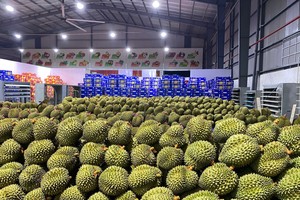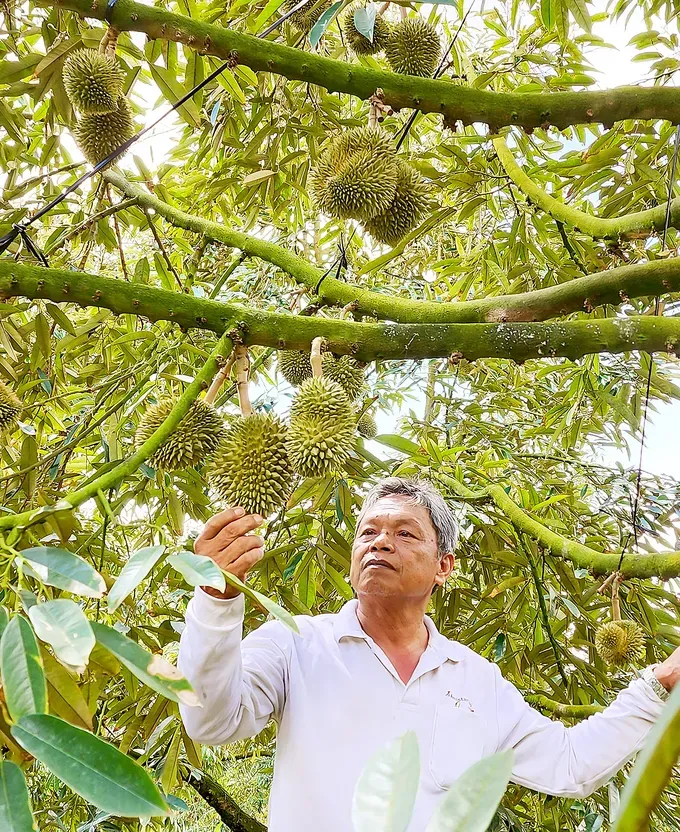
Weighing durians for traders, veteran farmer Tam Dong from Tan Lap Commune of Tay Ninh Province boasted: “This year, durian is a big win. Every year at this time, the price of Monthong durians is only around VND115,000/kg (US$4.41), but we have to transport them to the depot to sell. This year, it has increased to VND150,000 ($5.75) per kg, and traders come right into the orchard to buy. Similarly, the price of Ri6 durians has now jumped to VND82,000 ($3.14) per kg, compared to only about VND55,000 ($2.11) per kg last year. This is the highest price level in the past 3 years.”
According to Mr. Tam Dong, with the above prices, after deducting production costs, he and durian farming households in the Dong Thap Muoi region make a profit of VND35,000-50,000 ($1.72) per kg of durian. In the early 2026 durian crop, his family harvested nearly 12 tonnes of Monthong durians, earning a profit of over VND500 million ($19,155). Similarly, since the Lunar New Year, an atmosphere of excitement has filled thousands of durian farming households across the provinces and cities of the Mekong Delta.
Explaining the reason for the sharp increase in durian prices after Tet, Chairman Vo Tan Loi of the Dong Thap Province Durian Association said that at this time, the harvested durian output is very limited. Not only are domestic durians entering the off-season phase, but in Thailand, a major regional supplier, there is also almost no or very little supply hitting the market. This is an important factor causing durian prices to rise and supply to become more strained.
Tran My Ngoc, owner of a durian purchasing depot in Cai Be Commune of Dong Thap Province, added that even in key areas like Cai Lay of Dong Thap Province or Cho Lach of Vinh Long Province, the actual durian output has decreased by about 30 percent compared to the same period in 2025. This stems from prolonged heavy rains last year, causing root rot or weakened roots in many durian growing areas and resulting in low yields. This reality has created a local supply gap, pushing the value of Mekong Delta durians higher.
Despite high prices, many export enterprises are still struggling to find durians to buy due to low supply. Deputy Director Vo Tan Minh of Phuong Ngoc Cai Be Co. Ltd. (sited in Dong Thap Province) stated: “It’s extremely challenging to fill a container of 20 tonnes because the quantity of durians is not large and is scattered across many provinces. Enterprises have to spend a lot of time and money on purchasing and transportation. To get enough goods, many traders have pushed durian prices up, making the supply even more strained,” he said.
Chairman Vo Tan Loi warned that early in the year, many enterprises scramble to buy to “open up shop for good luck,” while consumption demand in China remains at normal levels. Therefore, durian export enterprises, especially small and medium-sized ones, need to be cautious and alert, avoiding chasing purchases at excessively high prices or gathering poor-quality goods just to fulfill orders.
Meanwhile, representatives of the Departments of Agriculture and Environment of Tay Ninh, Dong Thap provinces, and Can Tho City stated that they have requested the agricultural sector to coordinate with localities to tighten the supervision of planting area code implementation, as well as the durian harvesting activities of farmers, orchard owners, and traders.
"It’s advisable against harvesting when the fruit is not mature enough just to take advantage of high prices, which often come with significant risks. Unstable quality in this produce will affect the prestige of the entire industry,” a leader of the Dong Thap Department of Agriculture and Environment emphasized. They also added that they will coordinate with relevant agencies and units to establish sufficiently strong sanctions against cases of quality fraud, protecting the Vietnamese durian brand.
The Dong Thap Province Durian Association also warned that high durian prices can easily trigger a wave of crop conversion. Right now, localities in the Mekong Delta should conduct statistics, provide orientation, specifically plan planting areas for durian trees, strictly supervise the implementation of planting area planning, and resolutely handle cases of expanding durian areas outside the planned zones to avoid a rush of massive planting that leads to oversupply and undesirably low prices despite good harvests.
Rising durian prices are a positive signal in the short term, but in the long term, the durian industry still faces risks due to rapid area expansion, the risk of supply-demand imbalance, and quality pressure from import markets. Therefore, the key solution to maintaining growth momentum and sustainable development is to control planning and enhancing production-consumption linkages.
Director Vo Huu Thoai of the Southern Fruit Research Institute stated that regarding off-season durians, Dong Thap Province is leading the Mekong Delta, with 70 percent of the area applying off-season treatment. Vietnam’s long-term advantage lies in the fact that off-season techniques have been scientificized and no longer rely solely on folk experience.
During the 2018-2021 period, the Southern Fruit Research Institute perfected the process for treating durians to flower out of season, which was recognized by the Department of Crop Production as a technical advancement applicable in Southern provinces, creating a foundation to help Vietnamese durians develop more solidly compared to many countries in the region.