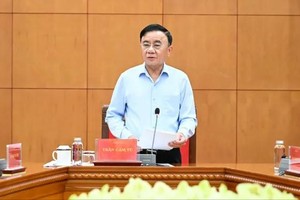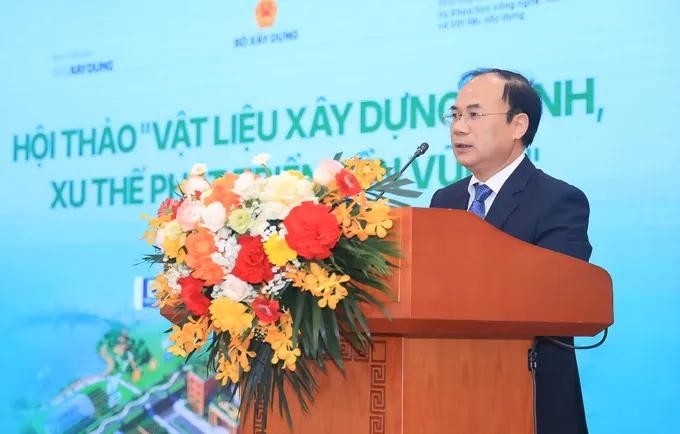
Addressing the seminar titled "Green Building Materials - A Sustainable Development Trend” held on May 5 in Hanoi, Deputy Minister of Construction Nguyen Van Sinh said that the country has approximately 2,900 production facilities for non-fired building materials with a total design capacity of 12.4 billion standard bricks per year, accounting for 40 percent of the total design capacity for building materials.
He added that in 2025, production output reached over 7.2 billion units, with consumption at 6.7 billion units. This product group helps reduce the use of fired clay, saves agricultural land, decreases fossil fuel consumption, limits emissions, and contributes to the processing and use of ash, slag, and gypsum from industrial sectors as production raw materials.
Additionally, several lines of energy-saving materials have been researched, produced, and applied, notably heat-reducing glass products that limit solar radiation. Simultaneously, many enterprises have utilized ash, slag, gypsum, blast furnace slag, and industrial waste as raw materials for the production of cement, concrete, and other materials.
Furthermore, many domestic building material products are gradually approaching green certification systems, environmental certifications, and high technical requirements of domestic, regional, and international markets.
However, the green transition process of the building materials industry is facing numerous difficulties and obstacles, such as high pressure regarding initial investment costs for technological innovation, increasing competitive pressure, weak market absorption for green materials and incomplete systems of standards and technical regulations for certain new types of materials.
In particular, mechanisms to encourage and promote the development of green materials are currently not strong enough. Accessing green credit, investment incentives, tax incentives, and financial tools to support the green transition remain major concerns for many businesses.
According to Deputy Minister Nguyen Van Sinh, the Ministry of Construction is continuing to refine legal documents related to the green transition, focusing on building a management framework and developing building materials associated with green transformation, digital transformation, the circular economy, resource and energy conservation, emission reduction, and improving the effectiveness of state management.
This will serve as an important foundation to create a more transparent and stable legal environment for businesses to invest in technological innovation, develop new materials, recycled materials, and green materials, and expand the market for building material products with higher quality and environmental responsibility.
In addition, close coordination between management agencies, scientists, businesses, investors, designers, construction units, professional associations, and consumers will contribute to promoting the use of green materials in practice. It is expected that a circular on energy labeling for building materials will be issued in the fourth quarter of 2026.
Vietnam is facing a rapidly increasing volume of construction solid waste, accounting for about 10 percent -12 percent of total urban waste (approximately 60,000 tons per day), and reaching up to 20 percent -25 percent in major cities. The volume of construction solid waste increased from 1.9 million tons in 2010 to about 9.6 million tons in 2025, indicating great potential for recycling and reuse as building materials.