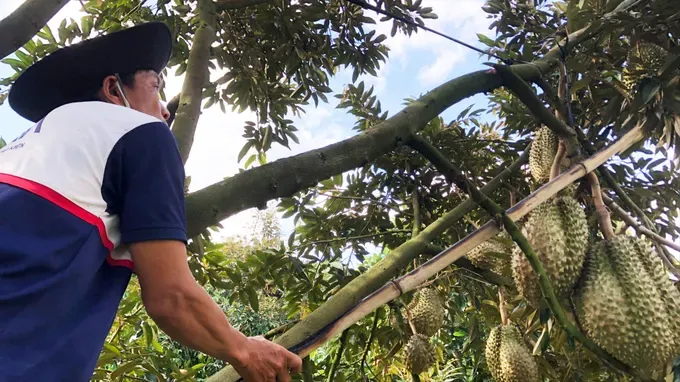
In early December 2025, numerous durian growers in Vinh Long commenced the harvest of off-season durian with a sense of unease. The prices of durian had significantly decreased in comparison to the same time frame last year, while the growers had dedicated substantial effort and resources to promote off-season flowering and fruiting.
In Tan Phu Commune of Vinh Long Province, farmer Nguyen Van Tam, who has over 15 years of experience growing Ri6 durian, said that his two acres of durian trees yielded more than 6 tons of fruit. However, the price traders were buying them at was only VND55,000-VND60,000 a kg, more than half the VND110,000 a kg of 2024.
Growing off-season durian is extremely difficult; the costs of fertilizer, electricity, water, and pesticides have all increased. Selling at this price means there's no profit, farmer Nguyen Van Tam said.
A similar situation also occurred in Cho Lach and Vinh Thanh communes.
Farmer Phan Thanh Binh, who owns 20 acres of durian trees, said his family spent over VND200 million (US$7,593) to cultivate off-season fruit. The cost of off-season fruiting is double that of regular season fruiting.
According to Duong Van Huyen, Director of Cai Mon Durian Cooperative located in Vinh Long Province’s Vinh Thanh Commune, the cost of off-season durian has significantly decreased owing to sluggish purchasing power, a restricted quantity of fruits that meet export criteria, and feeble domestic demand.
In addition, durian production in some Mekong Delta provinces has increased, while exports face difficulties due to stricter technical requirements. Vinh Long Province's growing areas are still fragmented, and the planting area codes and production processes are not uniform, resulting in many shipments not meeting standards.
Despite low prices, many farmers remain hopeful as some export businesses have begun re-evaluating the market, predicting a potential recovery by the end of the first quarter of 2026 as demand increases.