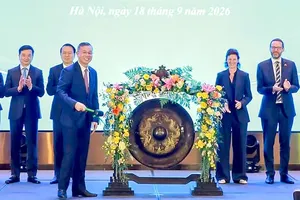
Vietnam International Financial Center (VIFC) is drawing strong interest not only from global corporations and financial institutions but also from a growing number of domestic players, positioning itself as an emerging hub for capital and innovation.
Wave of subsidiaries approved at Vietnam IFC

This year’s annual general meeting season has seen a wave of companies and banks identifying VIFC as a gateway to new opportunities. At its annual general meeting on April 28, Loc Phat Vietnam Commercial Joint Stock Bank (LPBank) approved a plan to establish a wholly owned subsidiary operating within VIFC.
Bank leaders said participation in VIFC would enhance competitiveness and enable access to medium- and long-term funding from international strategic partners at optimized costs.
Earlier, on April 24, Tien Phong Commercial Joint Stock Bank (TPBank) also approved the establishment of a 100 percent-owned subsidiary headquartered in Ho Chi Minh City within VIFC. The subsidiary’s charter capital will comply with the legal minimum requirement of VND3 trillion (US$113.96 million).
In its proposal to shareholders, TPBank said the move would provide competitive advantages and allow the bank to benefit from preferential mechanisms and policies not available under the traditional banking model. Other banks, including HDBank, Nam A Bank and Vietcombank, have similarly approved plans to set up subsidiaries at VIFC.
The trend extends beyond banking. Securities firms are also stepping up their presence. Ho Chi Minh City Securities Corporation (HSC) recently approved the establishment of a wholly owned subsidiary within VIFC-HCMC, with charter capital of around VND800 billion.
The move is expected to help HSC expand access to capital, clients and international partners while leveraging preferential policies. Similarly, DNSE Securities approved a plan to establish a single-member limited liability securities company in VIFC.
According to lecturer Chau Dinh Linh at the Ho Chi Minh City University of Banking, participation in VIFC could generate new growth drivers for financial institutions. Within this ecosystem, firms can benefit from incentives while testing new products under a regulatory sandbox framework and acting as intermediaries in cross-border transactions and international payments worth billions of dollars.
The platform also offers domestic institutions an opportunity to position themselves ahead of foreign capital inflows under more flexible policy frameworks. Participation in VIFC can further strengthen brand credibility, he said, noting that early entrants often gain an advantage in establishing market presence in a new environment.
However, experts caution that pioneering institutions will face significant challenges, including the need for high-quality human resources, advanced technology systems and robust risk management. The competitive landscape will involve major global financial institutions operating under international standards and transparent rules, making Vietnam an attractive destination for sophisticated capital flows.
Huynh Thanh Dien, a lecturer at Nguyen Tat Thanh University, said Vietnam’s strong economic growth continues to draw the attention of foreign investors, naturally driving capital inflows as interest increases.
Nguyen Huu Huan, Vice Chairman of the executive board of VIFC-HCMC, said the center aims to attract around US$10 billion in real capital in 2026, contributing to the economy’s funding needs. Plans to establish an international stock exchange within VIFC-HCMC are also gradually taking shape.
More recently, VIFC-HCMC launched a Fintech Hub, a sandbox environment for testing new financial models and one of the center’s four key pillars. The hub is expected to serve as a platform connecting banks, investors and businesses.
Meanwhile, the Vietnam International Financial Center (VIFC) in Da Nang is also attracting attention from both domestic and international financial institutions. The Da Nang center is focused on financial technology and green finance, positioning itself as a testing ground for future financial models.