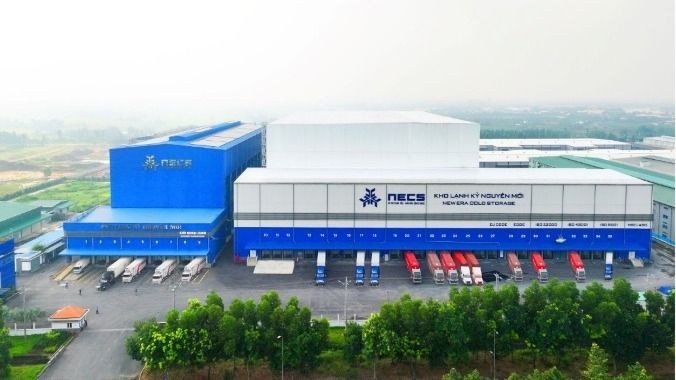
The New Era Cold Storage (NECS) facility was inaugurated in Tay Ninh Province on December 12. It is one of Southeast Asia’s largest smart bonded cold warehouses, offering integrated finance–logistics solutions for import–export enterprises. It is also the first digital bonded cold-storage facility approved by the General Department of Customs, enabling rapid, cost-efficient bonded services directly on site. The model marks a shift from high-tech cold storage toward a comprehensive logistics ecosystem supporting Vietnam’s food and seafood supply chains.
Vietnam’s agricultural and seafood sectors are undergoing rapid transformation, yet modern cold-chain infrastructure remains a persistent bottleneck. Amid global trade tension and shifting tariffs, the country aims for total agricultural exports of US$65–70 billion in 2025, including more than $10 billion from seafood—up 12.9 percent from 2024. However, most firms still lack standard-compliant cold storage, end-to-end logistics services, sufficient working-capital solutions, and an integrated operating ecosystem. NECS was launched to address these gaps, built on a green, high-tech, internationally aligned operating framework.
The warehouse operates fully autonomously in deep-freeze conditions, utilizing robotics, smart racking, and data-driven optimization algorithms. All core functions—from slot booking and cargo handling to temperature management, inventory tracking, and traceability—are digitized and AI-integrated. The model aligns with Vietnam’s National Digital Transformation Strategy through 2025 with a vision to 2030, while meeting global expectations for greener supply chains.
A standout feature is NECS’s partnership with banks to deploy a goods-collateral management model that lets businesses borrow against the inventories stored in the facility. Its digital management system provides real-time, transparent data to financial institutions, reducing risk, accelerating loan disbursement, and supporting continuous production—consistent with emerging green-finance and agri-finance frameworks.
According to Chairman Nguyen Thanh Tung, the new warehousing model is specifically designed to ease working-capital constraints for export–import firms, especially seafood companies, which often struggle to secure loans due to insufficient collateral. Although many wish to pledge stored goods, banks have historically been reluctant because they lack the manpower and systems to monitor continuously rotating frozen inventories.
To resolve this, NECS has digitized its entire cargo-management workflow, enabling banks to remotely supervise pledged goods. Cargo can only be released upon the bank’s authorization, once the borrower has settled the corresponding loan amount.
“This three-party mechanism—linking banks, exporters, and warehouse operators through a unified digital system—creates an efficient capital-circulation model,” Mr. Nguyen Thanh Tung said. “It provides businesses with easier access to financing while allowing banks to manage risk far more effectively.”