In an interview with Sai Gon Giai Phong (SGGP) Newspaper marking the 79th anniversary of War Invalids and Martyrs' Day and looking ahead to the 80th anniversary next year, Deputy Prime Minister Pham Thi Thanh Tra outlined the Government's priorities in honoring those who sacrificed for the nation.
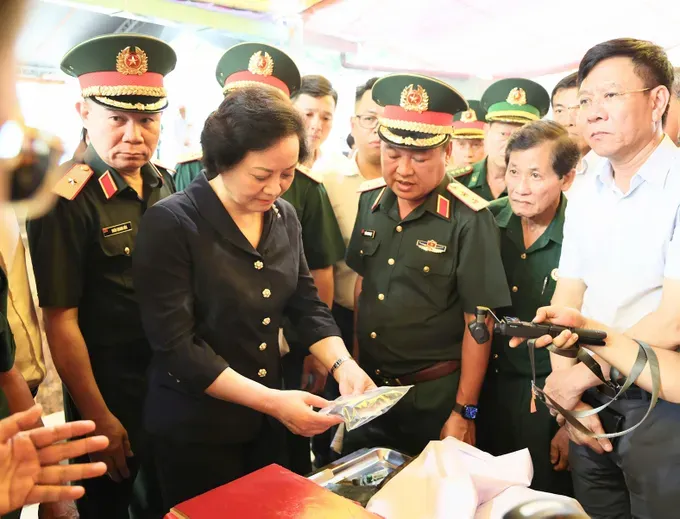
She said that commemorative activities must be practical and meaningful, transforming gratitude into concrete actions rather than symbolic gestures. The Government has directed authorities to strengthen patriotic education, particularly among younger generations, while promoting the values of remembrance and gratitude as enduring responsibilities shared by society.
The Deputy Prime Minister emphasized the need to intensify efforts to search for, recover and identify the remains of missing martyrs through the application of science, technology, digital transformation and DNA analysis, alongside the completion of a synchronized national database on people with meritorious services and martyrs.
She also highlighted the importance of improving policies and living conditions for people with meritorious services, including upgrading care centers and national martyrs' cemeteries, and prioritizing housing, healthcare and social welfare. She stressed that caring for people with meritorious services should be a continuous responsibility, not just an annual commemorative effort.
According to the Deputy Prime Minister, Vietnam still has about 175,000 missing martyrs whose remains have yet to be recovered, while more than 300,000 martyrs' graves remain unidentified.
She said the task has become increasingly difficult due to incomplete wartime records, changing terrain, dwindling witnesses, unexploded ordnance and the deterioration of remains over time. In many cases, direct relatives are no longer available for DNA comparison, while forensic DNA testing capacity remains limited.
To address these challenges, the Government plans to complete a synchronized national database on martyrs, graves and cemeteries by integrating data from ministries, localities, the military and police into a unified digital platform.
It will also expand the national gene bank by collecting more DNA samples from martyrs' relatives, standardizing genetic data management and investing in modern laboratories and DNA testing capabilities.
In addition, authorities will increase the use of artificial intelligence, big data, geographic information systems and other digital technologies to analyze records, verify information and improve the efficiency of search and identification efforts.
The Deputy Prime Minister said the Government's 500-day campaign aims to recover 7,000 sets of martyrs' remains and identify approximately 18,000 remains samples by the 80th anniversary of War Invalids and Martyrs' Day in 2027.
Deputy Prime Minister Pham Thi Thanh Tra stressed that the campaign's success will depend on strong leadership, broad public participation, greater application of science and technology, sufficient resources, and expanded international cooperation to access historical records and information from foreign archives, organizations, veterans and witnesses.