More than half a century after national reunification, many mothers are still waiting in vain for their sons, many children, now with graying hair, continue searching for their fathers, and countless wives have spent a lifetime hoping to one day welcome their husbands home.
Carried out with the conviction that "there can be no delay," the campaign represents a nationwide effort to fulfill a sacred mission owed to history in the lead-up to the 80th anniversary of War Invalids and Martyrs Day (July 27, 1947 – July 27, 2027).
Carried out with the conviction that "there can be no delay," the campaign represents a nationwide effort to fulfill a sacred mission owed to history in the lead-up to the 80th anniversary of War Invalids and Martyrs Day (July 27, 1947 – July 27, 2027).
To date, the remains of more than 175,000 fallen soldiers across the country have yet to be recovered, while over 300,000 martyrs' graves remain unidentified. Behind these figures lie the enduring grief and hope of millions of family members, even as time is running out for many aging mothers, wives, and relatives who have spent decades awaiting answers.
The 500-day-and-night campaign has become a focal point for compassion, responsibility, expertise, and technology, bringing together countless individual efforts into a coordinated national initiative to reunite the nation's fallen heroes with their hometowns and loved ones. It also stands as a powerful affirmation of the Vietnamese people's tradition of "When drinking water, remember its source" and honoring those who sacrificed for the nation.
A responsibility to history
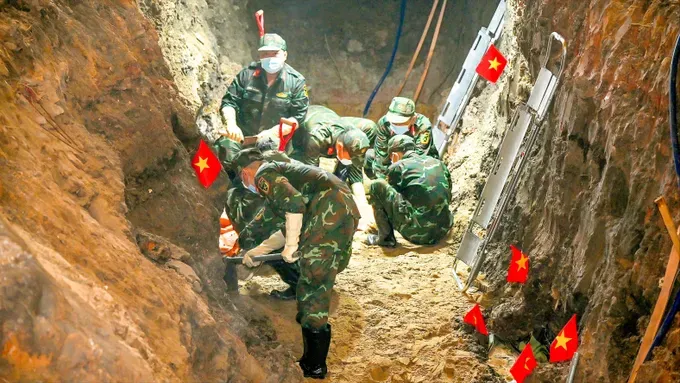
The campaign was launched by the National Steering Committee for the Search, Recovery, and Identification of Fallen Soldiers' Remains at a time when the entire Party, the people, the armed forces, and the political system are intensifying activities to honor those who sacrificed for the nation in the lead-up to the 80th anniversary of War Invalids and Martyrs Day (July 27, 1947 – July 27, 2027).
The campaign aims to create a breakthrough in the search, recovery, and identification of fallen soldiers' remains, with a series of specific targets. These include recovering approximately 7,000 sets of remains; collecting samples from around 230,000 unidentified martyrs' graves; conducting DNA analysis on about 18,000 sets of remains; developing, completing, and operationalizing a genetic database of relatives of unidentified fallen soldiers; and completing the clearance of landmines and unexploded ordnance in key and core search areas, including Vi Xuyen in Tuyen Quang Province, as well as Lao Cai and Lang Son provinces, to facilitate search and recovery operations. The campaign runs from March 15, 2026, to July 27, 2027.
At the launch ceremony for the nationwide DNA collection drive for relatives of fallen soldiers, held in Hanoi in June 2026, Deputy Prime Minister Pham Thi Thanh Tra affirmed that the campaign had entered a decisive stage in achieving its objectives. She stressed that this sacred mission is driven not only by a responsibility to history but also by the urgency of a race against time.
Many of the fallen soldiers' closest relatives are now elderly and in declining health, while countless others spent their entire lives hoping to find their loved ones before passing away. With each passing day, another opportunity may be lost, leaving yet another chapter of history waiting to be completed.
After more than four months of implementation, the campaign has completed roughly one-third of its planned duration, achieving encouraging progress. To build on these initial results and accelerate implementation in the remaining months, Prime Minister Le Minh Hung on July 8, 2026, issued Official Dispatch No. 45/CD-TTg, directing ministries, sectors, localities, and steering committees at all levels to strengthen leadership and coordination in carrying out the objectives, tasks, and measures of the 500-Day-and-Night Campaign in a determined, synchronized, and effective manner. The dispatch also called for enhanced inter-agency cooperation, the prompt removal of obstacles, and resolute efforts to fulfill all targets set for the campaign.
The strong determination behind the campaign reflects the profound significance of the mission to search for, recover, and identify the remains of fallen soldiers. Beyond helping to heal the wounds of war, the effort embodies the nation's enduring responsibility and moral obligation to those who sacrificed their lives for the Fatherland.
During a visit to encourage personnel engaged in the search and recovery of fallen soldiers' remains at Le Thi Rieng Park in Ho Chi Minh City on July 18, Party General Secretary and State President To Lam affirmed that, for the Party, the State, and the people, the search for, recovery, and identification of fallen soldiers' remains is a sacred responsibility to the nation and the people, as well as a moral imperative and the heartfelt aspiration of every Vietnamese.
General Secretary and State President To Lam emphasized that every set of fallen soldiers' remains recovered today is not merely the result of professional work. It represents the return of a son to his homeland and his family; the restoration of a part of the history; and a powerful affirmation of Vietnam's sacred traditions of remembering those who came before and honoring those who sacrificed for the nation.
Cherishing every clue to keep hope alive
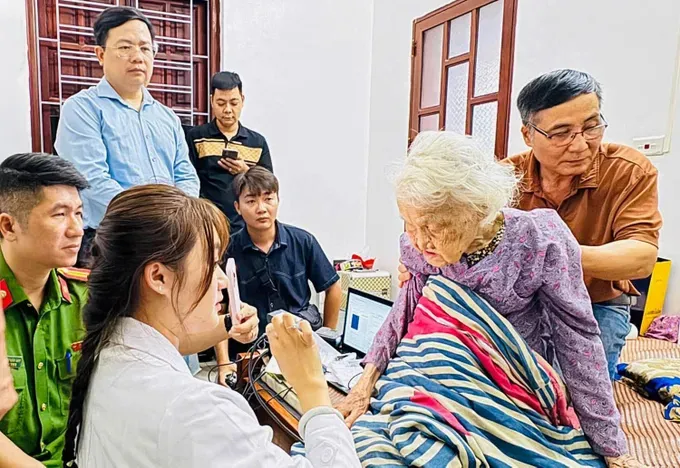
More than half a century has passed. Time may fade almost everything, but not the grief or longing of Mrs. Pham Thi Chap, a 114-year-old mother of a fallen soldier from Van Phuc Hamlet 2, Nam Phu Commune, Hanoi. Her pain remains as vivid as the day her son bid her farewell before leaving for the battlefield.
For decades, Mrs. Chap and her family have lived in anxious anticipation, never giving up hope that they would one day receive news of martyr Nguyen Van Ngoc, 79. At the remarkable age of 114, with her strength nearly gone and no longer able to walk on her own, it seemed that her hope of finding her son was gradually slipping away.
Understanding her circumstances and lifelong longing, officers from the Social Order Administrative Management Police Division under the Hanoi Department of Pubic Security brought specialized equipment to her bedside to collect her DNA sample.
Every step of the sampling process was carried out with the utmost care, gentleness, and respect. At that moment, Mrs. Pham Thi Chap's cells became the only remaining biological link between the past and the present. They carried not only the hope of identifying the remains of Nguyen Van Ngoc but also the family's unwavering belief that, after decades of waiting, a miracle might finally happen. Yet that miracle, and the nation's profound gratitude, is not reserved for Mrs. Pham Thi Chap's family alone.
During the recent nationwide campaign, the Hanoi Police, in coordination with the Department for Administrative Management of Social Order under the Ministry of Public Security, collected and uploaded more than 15,000 DNA samples to the national system.
Each DNA sample collected represents a renewed spark of hope, helping advance the sacred mission of identifying fallen soldiers' remains. Every successful identification brings families closer to long-awaited answers, eases decades of grief, and helps reunite the nation's fallen heroes with the warm embrace of their loved ones and their homeland.
After nearly 30 years of following every lead, Mr. Nguyen Van Hung, 70, from Lam Son Commune, Thanh Hoa Province, has yet to find the grave of his father, who bravely sacrificed his life on the Quang Tri battlefield. Despite his advancing age and declining health, he has never given up hope of one day bringing his father home.
Under the scorching early-July sun, Mr. Hung returned once again to the Road 9 National Martyrs' Cemetery to offer incense in tribute to the nation's fallen heroes after spending nearly two weeks tirelessly searching for traces of his father's grave, that of fallen soldier Nguyen Van Phuong.
In 1997, Mr. Hung began his decades-long journey to find his father's grave, traveling across the country in pursuit of every possible lead, no matter how small. Nearly three decades later, that journey has yet to bring the answer he has long sought.
"My mother passed away before her lifelong wish of bringing my father home could be fulfilled. Now my siblings and I are carrying on that search. We hope the campaign will help recover and identify as many fallen soldiers' remains as possible, as quickly as possible. Above all, we hope my father's remains will be found so that we can finally bring him home to his native village," Mr. Hung said.
According to the National Steering Committee for the Search, Recovery, and Identification of Fallen Soldiers' Remains, as of July 18, after more than four months of implementation, the campaign had recovered and repatriated more than 1,400 sets of fallen soldiers' remains and seven mass graves. It had also cleared 8,000 hectares of land contaminated by landmines and unexploded ordnance, essentially completing mine-clearance operations in the core search area of Vi Xuyen in Tuyen Quang Province.
Localities have collected more than 232,000 biological samples from relatives of fallen soldiers, with 53,000 DNA profiles already uploaded to the national database. In addition, specialized teams have collected over 63,400 samples from the remains of unidentified fallen soldiers to support DNA identification efforts.
These days, Le Thi Rieng Park in Hoa Hung Ward, Ho Chi Minh City, has welcomed a steady stream of visitors who come to offer incense and follow the ongoing search and recovery of fallen soldiers' remains. Among them is Tran Thi Le Thu, 67, the daughter of fallen soldier Tran Van Kieu.
For nearly seven decades, Mrs. Thu has carried with her an unfulfilled hope—to one day find her father's remains. Her memories of him are as faint as the flickering light that once illuminated the Cu Chi Tunnels. Because her father operated undercover in the heart of Saigon, the few times her mother took her to visit him, the young girl was instructed to address him only as "Uncle Hai" to protect his identity.
At the age of nine, Mrs. Thu lost her father forever when he was killed in action in the early hours of the second day of the Lunar New Year Offensive (Tet Offensive) in 1968.
Mrs. Tran Thi Le Thu recalled that after the country's reunification, her family was informed by the Ho Chi Minh City Party Committee and the Ho Chi Minh City Federation of Labor that the former caretaker of Do Thanh Cemetery had said the bodies of her father, fallen soldier Tran Van Kieu, and fallen soldier Le Thi Rieng had been transported to the cemetery, the site that is now Le Thi Rieng Park.
Based on this information, the city erected a memorial stele dedicated to the two fallen soldiers. Since then, on her father's death anniversary, during the Lunar New Year, and on major national commemorative occasions, Mrs. Thu's family has returned to the memorial site to offer incense in tribute to him and to the nation's fallen heroes.
The ongoing search and recovery operation at Le Thi Rieng Park has rekindled Mrs. Tran Thi Le Thu's hope once again. Her family has submitted DNA samples and information to the relevant authorities and now waits each day for news from the search effort.
As the daughter of a fallen soldier whose remains have never been found and of a mother who endured imprisonment for her revolutionary activities, Mrs. Thu understands better than most the profound significance of the mission underway.
"I believe it is not only my family but countless other families of fallen soldiers who are waiting. We simply hope that our fathers and uncles will soon be reunited with their loved ones and finally return to their homeland," she said.