Relentless journeys
Fifty-four years after his sacrifice, and following decades of his family's tireless search, martyr Nguyen Trong Cat was finally identified through DNA analysis. It marked the end of a decades-long journey to fulfil a cherished family wish.
Inside a modest house at the foot of a mountain in Minh Thanh Hamlet, Hop Tien Commune, Thanh Hoa Province, Nguyen Trong Bay, 66, carefully leafs through folders containing documents about his elder brother, martyr Nguyen Trong Cat, 74. Their pages, yellowed with age, preserve the story of a search that spanned more than half a century.
The family had six siblings, five brothers and one sister. Among them was martyr Nguyen Trong Khanh, who fell in 1972 in the former Le Thuy District, Quang Binh Province (now part of Quang Tri Province), and whose remains were previously recovered by the family. His older brother, martyr Nguyen Trong Cat, also made the ultimate sacrifice in 1972; however, it was not until 54 years later that his final resting place was identified.
Speaking to Sai Gon Giai Phong Newspaper, Mr. Bay paused, visibly moved, as he recalled his older brother. Nguyen Trong Cat enlisted in 1971, and on October 20, 1972, the family received notification of his death on the Southern Front. For decades, the family traveled tirelessly in search of any leads, but to no avail. In 2023, through a veterans' liaison committee, they learned that Nguyen Trong Cat’s remains were likely located at the Nga Bay-Phung Hiep Fallen Soldiers' Cemetery in Can Tho City. However, without scientific confirmation, the search had to continue.
Between 2023 and 2025, Mr. Nguyen Trong Bay provided DNA samples twice. After months of anxious waiting, on June 20, 2026, the family officially received confirmation that the remains in Grave No. 52 at the Nga Bay - Phung Hiep Cemetery belonged to the fallen soldier Nguyen Trong Cat—bringing a close to a heart-wrenching wait that spanned over half a century.
The Road 9 National Fallen Soldiers' Cemetery in Quang Tri Province is the final resting place of more than 10,900 heroes who fought, served, and sacrificed their lives on the Road 9 Front, the Quang Tri battlefield, and in neighboring Laos. Among them, over 5,900 graves remain unidentified or lack complete information.
Lieutenant Colonel Ngo Thanh Liem, commander of Team 584 under the Political Department of the Quang Tri Provincial Military Command, stated that the unit is coordinating with relevant forces to collect samples for DNA testing to identify the unknown remains.
“Every DNA sample rekindles hope, not only for the deceased but also for the living,” Lieutenant Colonel Liem shared. “When a fallen soldier is identified, it is not merely a name carved onto a tombstone—it is a mother, a sibling, a family, a lineage, and an entire hometown finally being able to bring closure to a grueling, decades-long search.”
At the Road 9 National Martyrs' Cemetery, the scorching mid-July sun alternates with sudden downpours. Yet officers and soldiers of Recovery Team 584 continue their work in quiet dedication.
To reach the remains, the team carefully opens each grave, with every step carried out meticulously and with the utmost reverence. According to Major Nguyen Thang Long, an officer of Team 584, the unit has independently designed and built a mobile pulley system equipped with wheels to help lift grave structures. The innovation reduces physical strain while ensuring that excavation is conducted safely and efficiently.
Once the excavation is completed, the remains are transferred to a designated sampling area, where suitable teeth or bone fragments are collected for DNA analysis. Every stage of the process—from excavation to the restoration of the grave—is documented with 16 photographs to create a digital record for each burial site. The DNA samples are then sent to the National Institute of Forensic Medicine under the Ministry of Health for identification.
Technological breakthroughs in identifying fallen soldiers
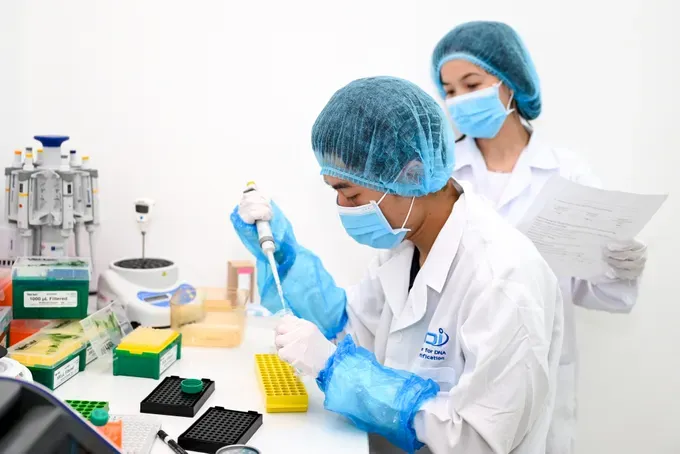
At the DNA Identification Center under the Institute of Biotechnology at the Vietnam Academy of Science and Technology, operations have reached an unprecedented pace. The center receives DNA samples submitted from eight provinces and cities, though extracting viable genetic material from every specimen remains a challenge. Since the launch of the campaign, the unit has processed over 10,000 samples.
Dr. Tran Trung Thanh, Director of the DNA Identification Center, noted that scientists face immense challenges when remains are recovered due to severe sample degradation. A breakthrough occurred in 2022 when the Ministry of Foreign Affairs and the Ministry of Defense sent 100 remains samples of Vietnamese fallen soldiers to the United States for study by international experts. The program aimed to identify the best, most comprehensive technological solutions tailored to the unique conditions of Vietnamese remains. International specialists evaluated more than 12 different methodologies before selecting the two most effective protocols for sample preservation, storage, and DNA analysis optimized for Vietnam’s specific context.
Serving as the focal agency receiving the U.S. government's ODA project, the Vietnam Academy of Science and Technology, alongside experts from the DNA Identification Center, collaborated with the International Commission on Missing Persons (ICMP) to optimize the extraction process for both nuclear and mitochondrial DNA. Applying these two approaches simultaneously—targeting both nuclear and mitochondrial genes—has yielded maximum efficiency. This partnership has raised the successful DNA extraction rate from severely degraded remains from roughly 22 percent to over 80 percent.
Dr. Tran Trung Thanh explained that human cells contain two distinct genomes: mitochondrial DNA and nuclear DNA. The mitochondrial genome is small, circular, and present in multiple copies per cell, enabling it to endure harsh environmental conditions far longer. However, because mitochondrial DNA is strictly maternally inherited, the likelihood of matching non-unique profiles is extremely high. Conversely, the nuclear genome is vastly larger but highly susceptible to degradation. After resting underground for 40 to 50 years, nuclear DNA fragments into extremely short strands—making conventional amplification technologies (which rely on short tandem repeats, or STRs) virtually impossible.
Faced with what once seemed to be insurmountable limitations of mitochondrial DNA technology, next-generation sequencing combined with single nucleotide polymorphism (NGS-SNP) analysis has emerged as a groundbreaking advancement, marking a historic breakthrough in the identification of martyrs' remains.
According to Dr. Tran Trung Thanh, unlike mitochondrial DNA—which is inherited through the maternal lineage and has a high likelihood of producing identical profiles when applied to large-scale comparisons—NGS-SNP technology focuses on detecting individual genetic variations, enabling the precise identification of each person.
This breakthrough allows scientists to simultaneously analyze thousands of genetic markers, even from skeletal remains that have undergone extremely severe decomposition, significantly enhancing the accuracy and success rate of DNA identification.
In Ho Chi Minh City, the Steering Committee for the Search, Repatriation, and Identification of Fallen Soldiers’ Remains for Ho Chi Minh City and Military Region 7 has comprehensively deployed search and identification operations across various localities, integrating traditional methods with modern scientific advancements. Between now and May 2027, the city aims to complete sample collection from unidentified graves across 18 fallen soldiers’ cemeteries for DNA testing and data digitization. The Ho Chi Minh City High Command has assigned a 37-member task force of officers and soldiers to lead the search and recovery efforts. Simultaneously, the city has established 12 teams comprising over 400 officers, soldiers, and specialists dedicated to sampling and digitizing records at the cemeteries.
To date, with the assistance of ICMP experts, the DNA Identification Center and Vietnamese scientists have fully mastered next-generation DNA identification technologies. Despite these technological breakthroughs, scientists are facing immense pressure regarding machinery capacity and investment costs. At the DNA Identification Center, the mitochondrial DNA testing pipeline operates at a capacity of approximately 4,000 samples per year, while the nuclear DNA project handles between 1,000 and 2,000 samples annually. Even when operating equipment at peak capacity, these figures remain modest compared to the vast backlog of hundreds of thousands of remains samples awaiting analysis. Dr. Tran Trung Thanh emphasized that substantial investment is essential, noting that new technologies must be backed by a fully synchronized infrastructure and equipment system.