These days, at Le Thi Rieng Park in Ho Chi Minh City, officers, soldiers, and medical personnel are working urgently to collect even the smallest traces of the remains of fallen soldiers that have been recovered. Behind every DNA sample may lie the identity of a fallen serviceman and the hope of a long-awaited family reunion—one that many families have been yearning for for nearly 60 years.
Every DNA sample carries a family's hope
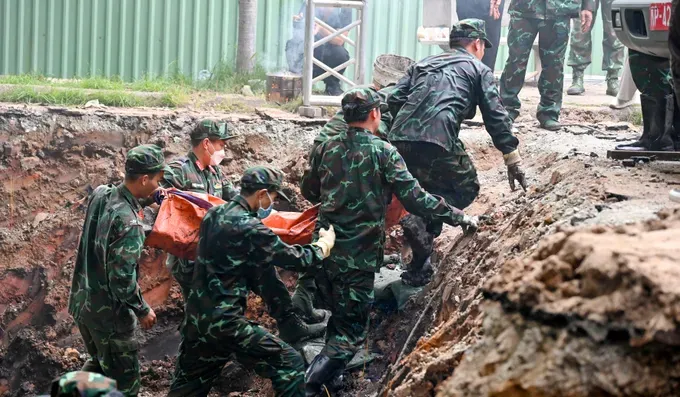
Beneath temporary shelters erected at Le Thi Rieng Park, the search and recovery of fallen soldiers' remains by K Teams continues uninterrupted from morning until evening. At the excavation site, officers and soldiers painstakingly remove layer after layer of soil, carefully sifting through every handful in search of the remaining fragments of human remains.
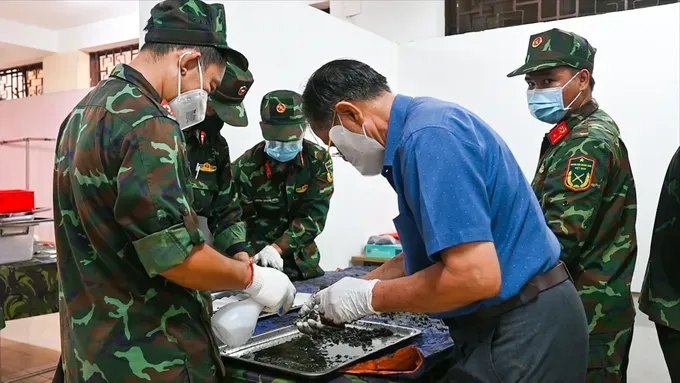
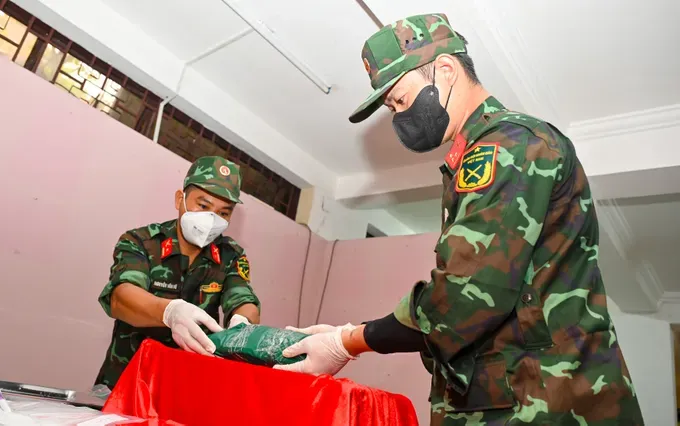
Not far away, the eight-member sampling and digitalization team works tirelessly behind the scenes on a task that is crucial to the mission of identifying fallen soldiers. Each set of remains, after undergoing preliminary processing and being transferred from the excavation site, is meticulously examined and classified. The team determines which samples are still suitable for DNA extraction and which are not, identifies which bone fragments belong to the same individual, and distinguishes those that have become commingled with others. Every step requires the highest level of precision, concentration, and care.
Lieutenant Colonel Dang Quang Nhut, Head of the Medical Service Division under the Ho Chi Minh City High Command and leader of the sampling and digitalization team, said the team consists of eight members, including three forensic specialists from the Ho Chi Minh City Forensic Center, three military medical personnel from the Ho Chi Minh City High Command, and two staff members responsible for digitalization.
Once the remains are transferred from the excavation site, the team works together to assess each case individually. Their work typically begins in the morning and continues until the field recovery teams complete their operations for the day. The team's top priority is to prevent any mix-up between samples. After processing each set of remains and collecting bone samples for DNA analysis, all tools and equipment are thoroughly cleaned to eliminate any risk of cross-contamination.
Lieutenant Colonel Dang Quang Nhut recently completed the collection of DNA samples from fallen soldiers' remains at the Ho Chi Minh City Martyrs' Cemetery as part of the 500-Day Campaign to Accelerate the Search, Recovery, and Identification of Fallen Soldiers' Remains. However, he noted that the work at Le Thi Rieng Park is considerably more challenging due to the unique nature of the site.
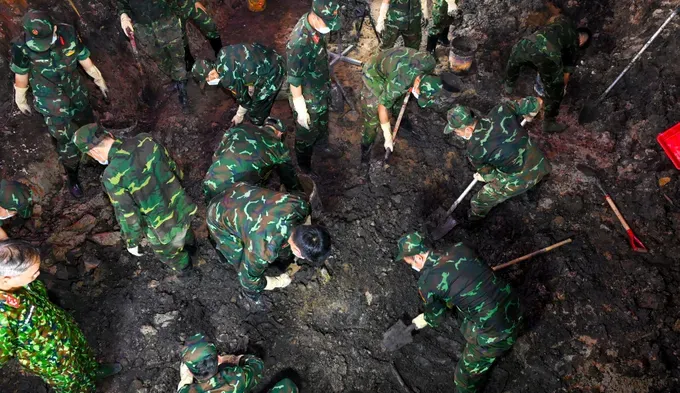
The remains recovered there have just been unearthed, and many are severely decomposed. In numerous cases, they were buried in mass graves, with bone fragments from different individuals commingled over time. For remains that have deteriorated beyond the point where DNA samples can be collected, the team can only ensure they are carefully preserved and respectfully reinterred. Every decision must be made with the utmost accuracy and care.
"Our team is determined to collect every sample that is still viable for DNA analysis so that they can contribute to the forensic identification of fallen soldiers," Lieutenant Colonel Dang Quang Nhut said.
Standing beside the newly processed remains, Dr. Vuong Gia Bao of the Ho Chi Minh City Forensic Center recalled his feelings when he was first assigned to the mission. There was a sense of anxiety and pressure, he said, but even greater was the honor and pride of being able to apply his professional expertise to a campaign of profound significance.
The Ho Chi Minh City Forensic Center regularly conducts forensic examinations and collects samples from human remains. However, according to Dr. Bao, the remains recovered at Le Thi Rieng Park are far more than routine forensic specimens. Each sample carries with it a fragment of history—a life cut short amid the hardships of war.
“Every tooth and every bone sample can be regarded as a piece of history. It may also be the final key to unlocking the door that allows these fallen soldiers to return to their families after decades of hope and waiting,” Dr. Vuong Gia Bao said emotionally.
He noted that the greatest challenge lies in distinguishing remains recovered from mass graves. The task requires unwavering dedication, meticulous attention to detail, and a high level of professional expertise to accurately determine which bone fragments belong to a single individual and which belong to multiple individuals. Only then can the team select samples of sufficient quality and with the highest likelihood of yielding usable DNA for profiling and long-term preservation in the national DNA database.
A promise to those yet to return home
Among the officers, soldiers, and medical personnel carrying out their mission at Le Thi Rieng Park is an 82-year-old man who hopes to be there every day. He is Dr. Tran Van Ban, who has spent nearly four decades traveling across former battlefields in search of the remains of his fallen comrades.
Wearing a pair of gloves, Dr. Ban sits beside the remains that have just been brought in from the excavation site, carefully identifying and arranging each bone fragment. As a physician with many years of firsthand experience in the search and recovery of fallen soldiers' remains, he has shared his expertise with younger servicemen, guiding them on how to correctly identify and arrange the skeletal remains.
Dr. Ban was born in Hai Phong and enlisted in the military in 1967. He served with Battalion 2, Regiment 268, Military Subregion 1 of Saigon–Gia Dinh, fighting in the "Iron Triangle" area spanning Cu Chi, Ben Cat, and Trang Bang. The brutal battlefield left him with enduring memories of comrades who fell in combat but have yet to return to their hometowns.
He recalled that after national reunification, deeply moved by the immense sacrifices of their fallen comrades, the surviving veterans reunited and returned to the former battlefields carrying shovels and picks, determined to search for those who had never made it home.
Year after year, the search missions continued. At some sites, he and his fellow veterans searched for more than a decade. At others, they returned to excavate as many as 20 times, yet still found no trace of their fallen comrades. The unfulfilled mission has remained a lifelong burden on his heart.
That is why, upon arriving at Le Thi Rieng Park, Dr. Ban simply asked for a pair of gloves and quietly joined the work. As they sorted the recovered remains together, he would often ask the young servicemen to identify different bones and explain where each belonged in the human skeleton. Most answered correctly.
The elderly veteran said it filled him with quiet joy, because he knew the young soldiers were doing far more than carrying out an assigned task. They had learned, remembered, and were carrying out the mission with wholehearted dedication.
At the age of 82, although his health is no longer what it once was, Dr. Ban still hopes to come to Le Thi Rieng Park every day. Simply being able to sit alongside the young soldiers and contribute his experience in identifying and arranging the remains of his fallen comrades brings him comfort and a sense of fulfillment.
"I hope to share my experience to help the younger generation speed up the process of identifying and arranging the remains. I don't feel tired at all," Dr. Ban said.
Meanwhile, at the excavation site, teams continue to carefully remove layer after layer of soil in the search for more remains. Inside the sampling area, every DNA specimen and every fragment of information is meticulously preserved and documented. Because somewhere, aging parents, wives, children, and other loved ones are still waiting for a reunion that has been nearly 60 years in the making.
On July 15, the Ho Chi Minh City High Command's team searching for and recovering the remains of fallen soldiers at Le Thi Rieng Park continued to expand the excavation area.
After excavating more than 50 cubic meters of soil, the team recovered 19 additional sets of fallen soldiers' remains, one collective burial site containing the remains of multiple fallen soldiers, and 13 sets of personal artifacts. As of the end of July 15, a total of 93 sets of fallen soldiers' remains and two collective burial sites containing the remains of fallen soldiers had been recovered.
According to the plan, the search teams will continue expanding the excavation area on July 16 to ensure that no remaining traces are overlooked. Updated results will be provided to the media after 4:00 p.m. the same day.



)