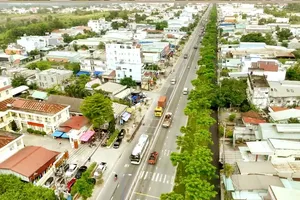
Several sections under contract packages No. 1 and No. 2 have already been completed.
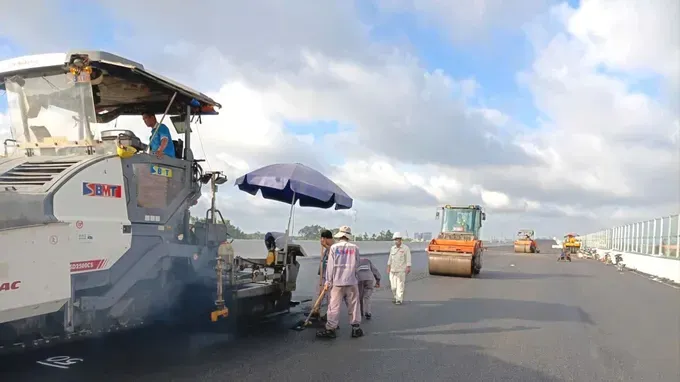
At package XL2, which covers approximately 15km of elevated roadway passing through Long Binh, Long Phuoc, and Long Truong wards, contractors are focusing on asphalt paving for the bridge deck. Asphalt pavers, road rollers, and material transport vehicles are operating continuously. Workers closely monitor every stage of the process, checking elevation, compaction, and asphalt temperature to ensure the pavement meets technical specifications. According to supervising engineer Do Ngoc Hong, several components have already exceeded 80 percent completion, creating favorable conditions for meeting the project's upcoming construction milestones.
At the Tan Van interchange, the largest and most technically complex component of the project, hundreds of engineers and workers, supported by a wide range of heavy machinery, are working around the clock across multiple construction fronts. Contractors are accelerating the remaining works to achieve the targeted technical opening to traffic on schedule.
According to the Transportation Works Construction Investment Project Management Authority of Ho Chi Minh City, the contractor consortium has deployed nearly 500 personnel, more than 120 pieces of machinery and equipment, and established 17 simultaneous construction fronts along the entire route. At bridge construction sites, multiple crews are working around the clock. Guided by the spirit of “overcoming harsh weather conditions” and “making the most of every minute,” contractors have proactively adjusted construction plans, flexibly allocated manpower and equipment, and strengthened coordination with the project owner, supervision consultants, and material suppliers to maintain construction momentum.
Contractors are currently concentrating all available resources on completing the asphalt paving of approximately 12.5km of bridge deck along the route. To date, more than 95 percent of the contract value has been completed. Several key components, including the mainline bridge pier system, have been substantially finished, paving the way for subsequent construction stages. This is a critical milestone in achieving the target of opening the Ring Road 3 section in this area to traffic by September 30, 2026, contributing to the early completion of a strategic transport corridor linking Ho Chi Minh City with neighboring provinces in the Southern Key Economic Region.
To date, 100 percent of the land clearance work has been completed. Construction progress has reached approximately 78 percent for Component Project 1 and around 70 percent for Component Project 5. Ho Chi Minh City is also finalizing investment procedures for the Tan Van interchange, incorporating Binh Goi Bridge into the project, and preparing investment for the Tan Van–Binh Chuan section.
Reviewing and assessing contractors' performance
Amid mounting schedule pressure on the Ho Chi Minh City Ring Road 3 project, relevant authorities are stepping up reviews and assessments of contractors' performance while implementing a range of measures to address bottlenecks and accelerate progress.
In the western section, the more than 32km stretch passing through the former districts of Cu Chi, Hoc Mon, and Binh Chanh has faced significant challenges due to complex geological conditions. Many contract packages have achieved only 60 percent–70 percent completion. Several sections are still undergoing surcharge embankment and soft-soil treatment, preventing the commencement of subsequent works such as crushed stone base installation, asphalt paving, and the installation of traffic safety facilities. According to contractors, soft-ground treatment typically takes six to nine months, making it a critical factor affecting the overall project schedule.
In response to these challenges, the Ho Chi Minh City Department of Construction has proposed that the municipal People's Committee report to the Prime Minister, seeking consideration of adjustments to the pricing mechanism for construction contracts amid sharp fluctuations in material and fuel prices. The proposal aims to safeguard contractors' interests while ensuring that project costs are fully and accurately reflected. The department has also recommended extending the implementation period for the component projects through 2028, with final settlement to be completed in 2029.
According to the Ho Chi Minh City Transportation Works Construction Investment Project Management Authority, the project's 10 main civil works packages have reached a cumulative implementation value of approximately VND14.645 trillion (US$557.7 million), equivalent to 73.1 percent of the total construction contract value. To ensure the project remains on schedule, the Ho Chi Minh City People's Committee has directed project owners and contractors to mobilize maximum manpower, equipment, and financial resources. It has also ordered a review of contractors' performance so that corrective measures or workload reallocation can be applied to those failing to meet project requirements.
The city has additionally established a task force to coordinate with Mekong Delta provinces to secure additional sand supplies. Dong Thap and Vinh Long provinces have already provided construction materials, while Dong Nai Province is considering increasing its supply of construction stone to support the project's final accelerated construction phase.