Ho Chi Minh City has set a goal of becoming a smart, multi-center megacity by 2030. The city is aggressively pursuing a new development model centered on science and technology, innovation, and expanded development space.
Ho Chi Minh City bets big on data centers to power AI ambitions
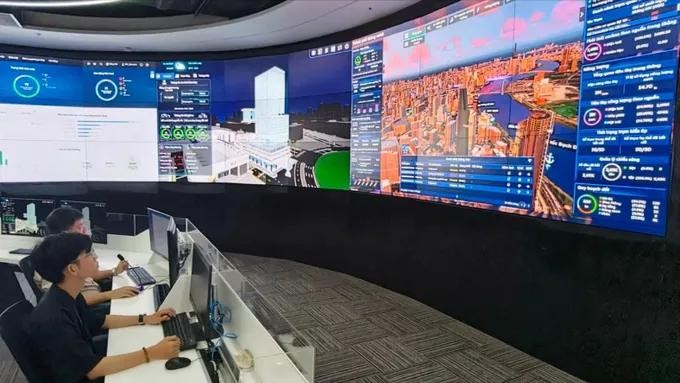
Recognizing the worldwide momentum behind cloud computing, big data, and artificial intelligence, Ho Chi Minh City has acted swiftly, channeling major investments into data centers. These facilities form the backbone of digital infrastructure, seen as indispensable for sustaining international competitiveness.
The push is more than a technological upgrade; it is a strategic move. City leaders view these investments as laying the groundwork for Ho Chi Minh City’s broader ambition: to establish itself as a leading financial hub and technology hub in Southeast Asia.
That commitment is reflected in a series of data infrastructure projects with combined investments worth billions of US dollars. One notable example is a memorandum of understanding between the Ho Chi Minh City Department of Science and Technology and Accelerated Infrastructure Capital (AIC) to develop an AI data center with an estimated investment of about US$2.1 billion.
At the same time, the city has approved two other large-scale data center projects with a combined investment of nearly US$1 billion. They include Singapore-based Evolution DC VN HCMC, valued at US$508.78 million, and the STARMASON hyperscale data center complex, with an investment of US$480.26 million.
Vietnam's technological self-reliance is also becoming increasingly evident in Ho Chi Minh City. Viettel Group is preparing to begin operations at its High-Tech Data Center and Research and Development Center in Tan Phu Trung Industrial Park.
With a designed capacity of 140 megawatts and approximately 10,000 server racks, the facility is equipped to meet future demand for high-performance computing required by advanced AI applications.
Meanwhile, the Quang Trung Software City (QTSC) has developed an innovation ecosystem comprising five innovation centers and a collaborative network linking businesses, universities, and research institutes.
QTSC has attracted 27 investors and more than 120 digital technology companies. It provides more than 650 technology products, services, and solutions for the domestic market and more than 30 countries, while playing a significant role in the digital transformation of both Ho Chi Minh City and Vietnam. QTSC ranks third among eight leading technology parks in Asia based on operational performance indicators.
Regional integration will be expanded
"In its long-term development strategy, Ho Chi Minh City is not developing in isolation but positioning itself within close cooperation with neighboring areas to create a comprehensive science and technology ecosystem," said Prof. Nguyen Van Phuoc, Chairman of the Ho Chi Minh City Union of Science and Technology Associations.
To achieve that goal, the city is shaping a multi-center urban structure. Under the plan, central Ho Chi Minh City will serve as the hub for finance, data, and innovation research; the area formerly known as Binh Duong Province will develop into a center for high-tech industry and smart manufacturing; and the area formerly known as Ba Ria-Vung Tau Province will become a hub for the marine economy, international logistics, and advanced marine environmental technology.
These three strategic areas will be closely connected through digital infrastructure, integrated data systems, and coordinated urban planning.
The strategy aligns with broader trends including the digital economy, green economy, circular economy, and clean technologies, while maximizing the city's existing digital infrastructure.
A key milestone in the city's innovation agenda came in mid-January 2026, when the Ho Chi Minh City People's Committee announced plans to develop the Northern Ho Chi Minh City Science and Technology Urban Area in Binh Duong Ward.
At the announcement ceremony, Vice Chairman of the Ho Chi Minh City People's Committee Bui Minh Thanh said, "The development of this urban area will create a new growth pole while providing additional capacity to redistribute urban, industrial, and logistics functions away from the city core. This is an important condition for Ho Chi Minh City to develop into a multi-center megacity, reduce pressure on the urban core, and improve the efficiency of land use and infrastructure."
According to Prof. Nguyen Van Phuoc, Chairman of the Ho Chi Minh City Union of Science and Technology Associations, the 2026-2030 period will be pivotal as Ho Chi Minh City transitions to a development model driven by science and technology, innovation, and digital transformation.
"If implemented effectively, Ho Chi Minh City can establish a three-pillar structure consisting of an innovation center, a smart industrial hub, and a modern marine economy," he said. "Over the longer term, the city aims to become a smart, green megacity that is resilient to climate change and highly competitive internationally."
Director Tran Quy of the Vietnam Institute for Digital Economy (VIDE) said systematic investment in digital infrastructure is expected to generate tangible economic growth.
Under the city's plan, the digital economy is projected to account for 18.5 percent of gross regional domestic product (GRDP) in 2026. The digital economy's share in each industry is expected to reach at least 13.4 percent, while e-commerce is projected to account for 13.4 percent of total retail sales.
To achieve these targets, the city is accelerating the adoption of digital platforms across a range of key sectors.
Director Tran Quy said 2026 marks an important milestone as Ho Chi Minh City enters a new planning cycle for 2026-2030, targeting double-digit GRDP growth. As traditional growth drivers reach their limits, transitioning to an innovation-driven model based on science and technology has become a strategic necessity for the city to maintain its position as Vietnam's leading economic center.