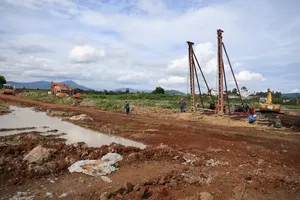
Work continues day and night on key APEC 2027 projects, with contractors under pressure to meet ambitious deadlines before the rainy season intensifies.
At the 16-hectare APEC Convention and Exhibition Center, cranes, concrete mixers and heavy machinery operate day and night as more than 2,000 engineers and workers keep the project on schedule.
Vu Manh Cuong, construction supervisor for the convention center project, said that contractors have maintained a workforce of 2,000-2,200 personnel daily over the past two months. The project's main structure, Building S3, has completed more than 90 percent of its reinforced concrete work.
Construction of the remaining facilities, however, has been slowed by shortages of finishing materials and skilled labor.
The contractor is working closely with local authorities to address these challenges and keep the project on schedule, he said.
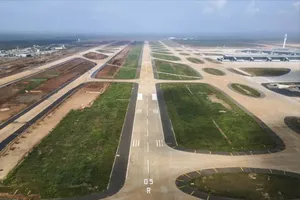
At the expansion project of Phu Quoc International Airport, nearly 4,000 workers and around 1,000 pieces of equipment have been deployed since late April 2026. Overall construction has reached nearly 60 percent.
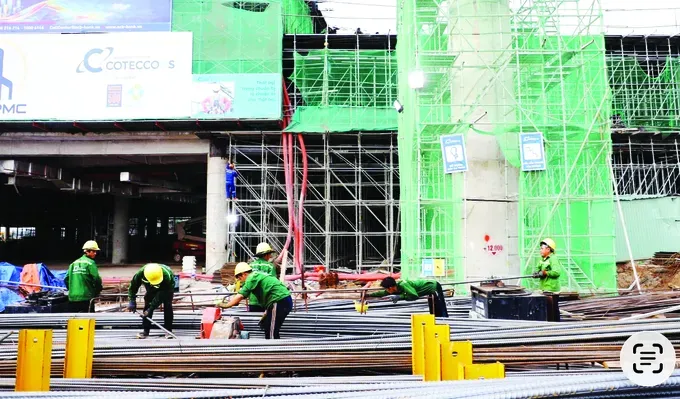
The airport's second runway is 95 percent complete and is expected to become operational in August 2026. Meanwhile, Terminal 2 has finished all structural works and about 80 percent of its steel framework, with completion scheduled by the end of 2026.
The new aircraft apron, Apron 1C has also been fully completed and is already in service.
Addressing labor shortages
Despite steady progress, project owners and contractors acknowledge that significant challenges remain, with only 10 to 12 months left before completion and four to five of those months falling during the rainy season.
Although local authorities have gradually eased bottlenecks involving land clearance, underground infrastructure and construction materials, labor shortages remain a major concern. Projects supporting APEC 2027 currently require more than 22,000 additional workers, particularly skilled technicians for tunnel construction.
Sun Group, the investor behind several APEC-related projects, said it has introduced a range of incentives to attract and retain workers. These include free accommodation in prefabricated housing, bonuses for long-term employees, airfare assistance for trips home, holiday bonuses of about VND1 million (US$38) per day for those working through public holidays and Lunar New Year, and free healthcare services. Financial support is paid directly to workers.
Accelerating land clearance
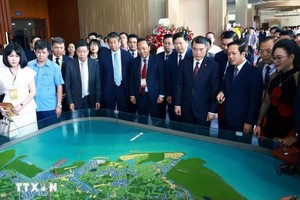
According to Tran Minh Khoa, Chairman of the People's Committee of the Phu Quoc Special Zone, 21 major infrastructure projects are currently under construction to support APEC 2027.
More than 90 percent of the required land has already been handed over to investors and contractors. However, the remaining land includes numerous illegally occupied areas that continue to affect construction progress.
Authorities have stepped up public outreach and negotiations with affected residents. Of nearly 100 cases subject to compulsory land recovery, more than 60 property owners have voluntarily dismantled unauthorized structures and returned the land.
For those who continue to refuse to comply, authorities are proceeding with compulsory enforcement, including 31 enforcement decisions in An Thoi Ward and 25 in the Rach Vem–Chuong Vich area.
Government targets early completion
An Giang Provincial People's Committee Chairman Ho Van Mung said that the province aims to complete all APEC 2027 projects three to six months ahead of schedule.
To meet that goal, contractors have been instructed to operate four continuous work shifts around the clock, while provincial departments are required to intensify inspections, promptly resolve project bottlenecks and closely monitor construction progress.
Project owners have also been directed to regularly supervise implementation and immediately report issues beyond their authority to provincial leaders to prevent delays.