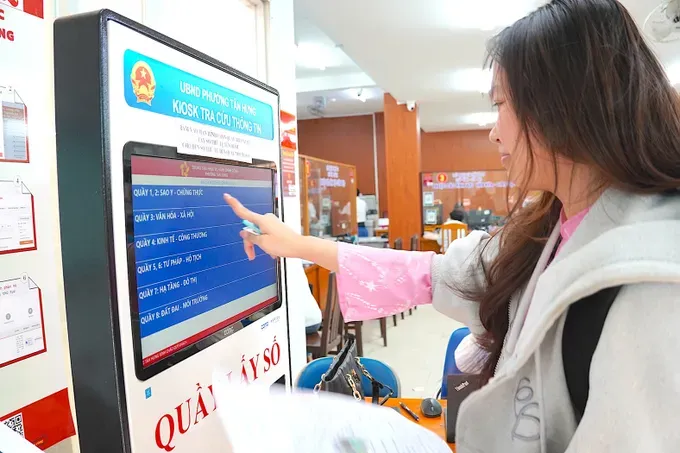
At 9:00 a.m. on January 27, the Tan Hung Ward Public Administration Service Center was bustling with citizens processing administrative procedures. Nguyen Thu Huong and her husband arrived to finalize documents for business establishment. Despite having prepared the necessary paperwork, Ms. Huong was pleasantly surprised to receive meticulous guidance from a local Ho Chi Minh Communist Youth Union member on how to verify processes and supplementary documents via the “Q&A Virtual Assistant” software built on the ChatGPT platform.
On this platform, citizens need only scan a QR code to be directed to guidance points for accessing the integrated virtual assistant. Through this interface, they can effortlessly research administrative procedures, receive answers to inquiries, and obtain rapid guidance on document preparation. “When I queried the virtual assistant regarding the business household registration dossier, I received extremely detailed and comprehensible instructions,” Ms. Huong shared.
Nguyen Thi Thanh Thao, a civil servant responsible for policies regarding meritorious persons, gender equality, religion, and ethnicity at the Tan Son Nhat Ward Public Administration Service Center, noted that the ward manages 8,316 elderly individuals and 440 persons with disabilities. Daily, Ms. Thao assists approximately 40-50 elderly citizens with procedures related to allowances and insurance.
“Elderly citizens often face limitations in utilizing technology; thus, we must guide them step-by-step in accessing the chatbot and virtual assistant. Although the workload is substantial, witnessing their joy upon completing procedures provides us with renewed motivation,” Ms. Thao stated.
In wards such as Minh Phung, Cat Lai, and Binh Trung, the application of AI models is being intensified for researching communal-level administrative procedures. The system automatically categorizes procedures by field, responsible department, and the status of online public service provision (partial or fully end-to-end), thereby facilitating rapid and accurate dossier processing.
Furthermore, numerous ward and commune Public Administration Service Centers have introduced AI-integrated robots to support operations. In Thu Duc and An Khanh wards, these robots can communicate in Vietnamese, assist with queue number issuance, scan QR codes, and even distribute complimentary water to citizens. Friendly inquiries such as “How may I assist you?” create a welcoming and comfortable atmosphere for citizens engaging with public authorities.
Vice Chairman Nguyen Thanh Danh of the Tan Son Nhat Ward People’s Committee informed that the ward’s chatbot is constructed upon an AI platform combined with a verified specialized database, ensuring the provision of accurate information. Citizens and enterprises can access https://chatbot.tansonnhat.gov.vn or scan a QR code to research administrative procedures, public services, and report arising issues.
The efficacy of this model is clearly demonstrated by the significant shift in submission methods. Prior to the virtual assistant’s deployment (from July 1 to August 31, 2025), Tan Son Nhat Ward received nearly 2,900 dossiers, yet only 798 were submitted online. Following the chatbot’s implementation (from September 1, 2025, to January 25, 2026), the total number of received dossiers exceeded 6,700, with online submissions surging to 6,592.
These results indicate that the chatbot is not merely a technical support tool but has evolved into a “digital guide officer” operating 24/7. It provides comprehensive and precise information regarding conditions, dossier components, processes, progress tracking, and result receipt. Consequently, citizens and enterprises, especially those accessing online public services for the first time, can independently execute administrative procedures from home.
The application of virtual assistants and chatbots is also being adapted by various wards to suit local conditions and demographics.
Vice Chairman Nguyen Minh Thien of the Tan Hung Ward People’s Committee noted that the post-merger population is approximately 154,000, including a significant number of foreigners, particularly from the Republic of Korea. Consequently, the “Tan Hung Ward Q&A Virtual Assistant” application integrates Korean and English languages, assisting residents in researching administrative procedures and information regarding the organizational apparatus and administrative unit arrangement policies swiftly and transparently.
Director Vo Thi Trung Trinh of the HCMC Digital Transformation Center assessed that the proactiveness of the grassroots staff has contributed to stabilizing the new apparatus and accelerating digital transformation through AI and robot application.
The city aims to establish big data, achieve 5G coverage, and complete total digitization by 2030. By the end of 2026, HCMC strives for 100 percent of eligible procedures to be executed entirely online, reducing time and costs for citizens and enterprises by at least 30 percent.