The Fallen Soldiers’ Remains Recovery Team under the Ho Chi Minh City High Command has continued its search and recovery operations at Le Thi Rieng Park. Every trace documented and every artifact uncovered may serve as a crucial link in the effort to identify the martyrs' remains and restore their names to history.
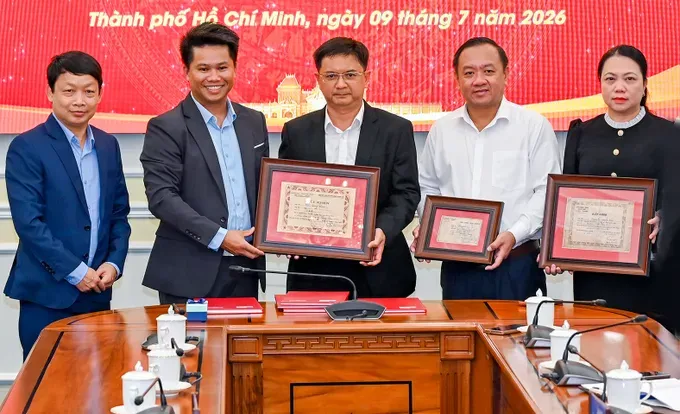
On July 9, the Ho Chi Minh City Steering Committee for the Search, Recovery, and Identification of Fallen Soldiers’ Remains received war memorabilia and burial records of martyrs donated by the research team behind the project "An Initiative to Search for Vietnamese Missing in War,” from Texas Tech University, USA.
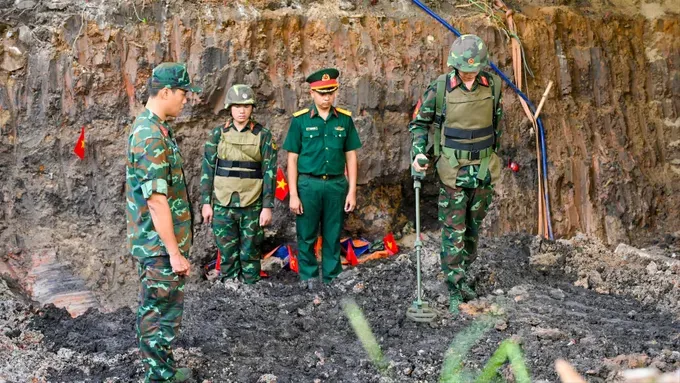
At the same time, beneath temporary shelters erected over the excavation site at Le Thi Rieng Park in Hoa Hung Ward, Ho Chi Minh City, officers and soldiers quietly continued removing the soil layer by layer in search of the remains of fallen soldiers. Every movement was carried out with great care, as the ground beneath them could still hold the last traces of servicemen who made the ultimate sacrifice nearly six decades ago.
After working continuously throughout the morning, several young soldiers took a brief rest beside the excavation site. Their uniforms were still covered with soil as they sat closely together under the canopy, waiting for their turn to resume the painstaking work.
Lieutenant Colonel Ly Minh Van, Political Commissar of Team K74 under the Ho Chi Minh City High Command, spoke with emotion: “I truly admire these young soldiers. Every one of them is dedicated, never complaining about the hardship or shying away from the task.”
Lieutenant Colonel Ly Minh Van recalled the day Private Vu Duc Tam approached him and volunteered to join the field team after initially being assigned to logistics duties. Tam expressed a strong desire to work alongside his comrades on the excavation site, directly participating in the search for and recovery of the remains of the fallen soldiers.
Before joining Team K74, Tam served with the 6th Infantry Regiment under the Ho Chi Minh City High Command. When the 500-Day Campaign for the Search, Recovery, and Identification of Unidentified Fallen Soldiers' Remains was launched, he volunteered to take part and was delighted to be assigned to the team.
Initially, Tam was tasked with logistics, helping prepare meals and ensuring the team's daily needs were taken care of. Although he understood that logistical support was an essential part of the mission, he still longed to contribute directly at the excavation site. Motivated by that desire, he took the initiative to ask his commanding officers for permission to join the search and recovery effort in the field.
At the excavation site, Tam's main responsibilities include assisting with survey work, organizing equipment, and managing supplies. "I trembled when I saw the ponchos, the pieces of fabric wrapped around the remains, and the familiar personal belongings of the soldiers," Tam said. "All I hope is that our team can recover everything they left behind."
Lieutenant Colonel Le Ngoc Ha, Commander of the Fallen Soldiers' Remains Recovery Team under the Ho Chi Minh City High Command, said the entire unit is committed to recovering every possible set of remains. Even if only a single personal artifact or the smallest fragment of remains is found, every effort must be made—with the utmost care and respect—to bring them home to their comrades and families.
A quiet reunion with fallen comrades
Major General Nguyen Thanh Trung, Political Commissar of the Ho Chi Minh City High Command, who is overseeing the operation on site, said the unit has reported to the Steering Committees for the Search, Recovery, and Identification of Fallen Soldiers' Remains of Military Region 7 and Ho Chi Minh City on adjustments to the excavation methodology.
Under the revised approach, the excavation, recovery of remains, and collection of personal artifacts are being carried out systematically, one stratigraphic layer at a time. Every trace uncovered is carefully documented and preserved to support forensic examination and the identification of the fallen soldiers, while also contributing valuable historical evidence for research into the 1968 attack.
Alongside the excavation, the Ho Chi Minh City High Command is working with the Vietnam Military History Museum to preserve and examine the documents and personal artifacts recovered from the site. The findings are expected to provide additional information to support the verification and identification of the fallen soldiers.
The Ho Chi Minh City High Command will advise the city's Steering Committee and the Military Region 7 Steering Committee to expand the search to Trenches No. 2 and No. 3. The guiding principle throughout the operation is to proceed methodically and with certainty—tackling the most accessible areas first before moving on to more challenging ones—while ensuring every step is carried out with the utmost care, scientific rigor, precision, and discipline.
For the officers and soldiers involved, this mission carries profound significance. It is, in their words, a quiet reunion between today's servicemen and the comrades who fell in battle. Every poncho, every scrap of fabric, and every small personal artifact recovered may provide another vital clue, bringing those who made the ultimate sacrifice one step closer to being identified and finally reunited with their families and homeland.