Bridging the public transport gap after 10 p.m.
According to the Ho Chi Minh City Department of Tourism, the city aims to welcome around 61 million tourist arrivals in 2026, including 11 million international visitors and 50 million domestic tourists. With such a large number of visitors traveling at different times of day, public transport operating hours also need to be reconsidered.
In reality, many food tours, performances and sightseeing activities end after bus services have stopped, causing considerable inconvenience. Extending bus services beyond 10 p.m. could therefore provide a useful solution while supporting the development of the night-time economy.
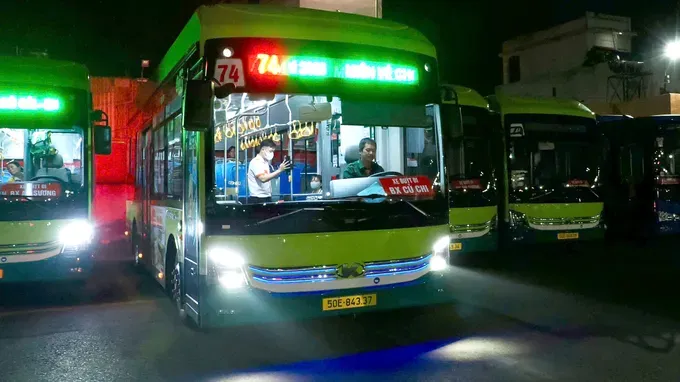
According to Pham Ngoc Dung, Director of the Ho Chi Minh City Public Transport Management Center, the 2026 bus schedule provides more services after 8 p.m. than in 2025. The number of trips between 9 p.m. and 10 p.m. has increased by 147 percent, while services operating after 10 p.m. have risen by 258 percent, indicating a clear shift toward later operating hours.
The next step is to assess passenger demand by hour and route segment, as well as the relationship between transport supply and demand-generating locations.
Ho Chi Minh City could begin by developing a dedicated origin-destination (OD) matrix for nighttime travel. Data from buses, the metro, airports, bus stations, hospitals, accommodation facilities, shopping malls, entertainment venues and tourist attractions could be integrated by location and time.
Data from ride-hailing companies and telecommunications providers could offer valuable insight into nighttime travel patterns currently overlooked by public transport. If shared in aggregated and anonymized form, the data could help Ho Chi Minh City identify priority corridors for pilot night bus services.
Seoul offers a successful example. Before expanding its night bus network, the South Korean capital analyzed around 200 million telecommunications and transport card records. The analysis identified about 342,000 people traveling between midnight and 4 a.m. and highlighted areas with strong concentrations of employment and commercial activity. The city used these real-world travel patterns to design routes and later adjusted services based on actual ridership.
Pilot individual corridors, measure route-by-route performance
Using the OD matrix, Ho Chi Minh City could identify several pilot corridors, such as routes linking the airport with the city center, metro stations with accommodation and entertainment hubs, bus stations with residential areas, hospitals with residential neighborhoods, and major employment centers where workers finish late shifts.
For each corridor, the city could determine appropriate headways, vehicle capacity and service end times.
The city should avoid setting 1 a.m. as a fixed end time for all night bus services. While demand may taper off by 11:30 p.m. in some areas, it could remain high until 1 a.m. in others. Each corridor should therefore have its own operating hours, adjusted based on real-world ridership.
Vehicle size and service frequency should also match passenger volumes. There is little justification for running 40- to 60-seat buses at daytime frequencies on routes carrying only a few passengers after midnight.
The goal should not be to maximize the number of trips, but to optimize operating costs per passenger while maintaining a minimum level of service.
Operating night buses would require additional personnel and special working arrangements, while ridership is unlikely to reach daytime levels. However, the effectiveness of a public transport route should not be measured solely by fare revenue.
Night buses can also serve shift workers, reduce reliance on private vehicles, connect passengers with the metro, and support tourism and service activities.
The city could conduct a preliminary review after three months and a full assessment after six months. For each route, at least the average number of passengers per trip, seat occupancy rate, hourly ridership, busiest boarding and alighting points, operating cost per passenger trip, metro connectivity and safety-related feedback should be made public.
Routes that perform well could have their frequency increased. For routes with low ridership, authorities should determine whether the problem stems from inappropriate operating hours, routes, vehicle types or genuinely insufficient demand. Routes failing to meet established thresholds should be adjusted or discontinued.
Instead of simply extending operating hours on a few existing routes, Ho Chi Minh City could pilot services along different nighttime transport and service corridors. Bus services should be developed together with transfer points and other supporting facilities.
Potential nighttime problems, including noise, drug-related activities and disguised prostitution, should also be addressed. This would help create a relatively integrated nighttime ecosystem and make it possible to measure the actual value generated by bus services operating after 10 p.m.

)