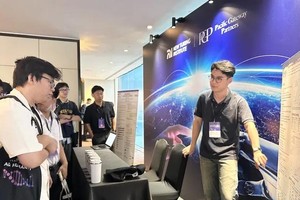
On May 16, Vietnam National University Ho Chi Minh City (VNU-HCMC) organized a conference to announce its strategic orientation for science, technology and innovation for the 2026-2030 period, along with a signing ceremony between the VNU-HCMC Innovation Center and member universities to implement joint initiatives.

Speaking at the event, Professor Dr. Nguyen Thi Thanh Mai, Director of VNU-HCMC, emphasized that science, technology and innovation should no longer be treated as isolated tasks but instead become a core theme throughout the entire university system.
She said this transformation requires changes in training programs, admission methods, research models and support ecosystems for students.
To realize its ambition of becoming one of Asia’s top 100 universities, VNU-HCMC must move beyond workforce training and concentrate on developing core technologies, strategic solutions, and innovative development models.
According to Ms. Nguyen Thi Thanh Mai, the VNU-HCMC Innovation Center will serve as an interdisciplinary coordinating hub, connecting research activities with real-world challenges faced by businesses and local authorities.
At the same time, VNU-HCMC plans to implement a “Virtual Institute” model, described as a borderless research space, allowing lecturers and scientists from different institutions to collaborate on joint research projects, share resources and build research chains capable of producing market-oriented products.
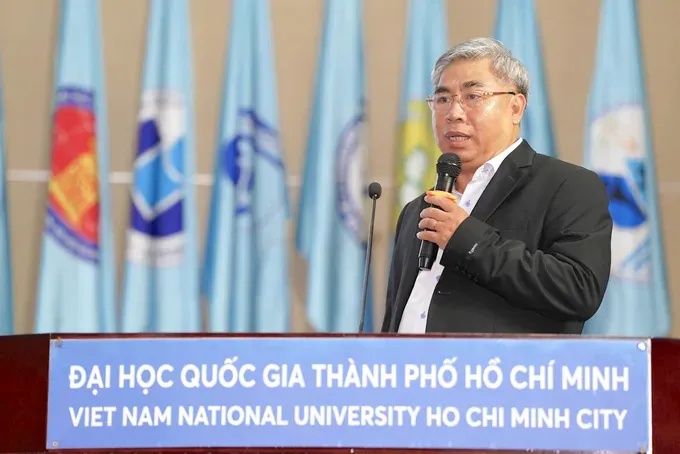
Associate Professor Dr. Lam Quang Vinh, Head of the Science and Technology Department at VNU-HCMC, said the university published around 1,500 research papers in international journals indexed in the Scopus database during the first five months of 2026.
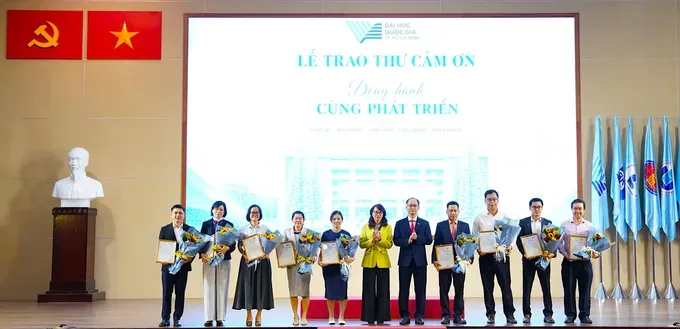
The university has also planned funding for five basic science laboratories integrated with strategic technologies, while developing three framework programs focused on strategic technology products in semiconductors, artificial intelligence and biotechnology.
In addition, VNU-HCMC is building a portfolio of 16 strategic technologies and products. Currently, 12 domestic patents and utility solutions, along with one European patent, are in the final stages of approval procedures.
Presenting the university’s strategic orientation for science, technology, innovation, and digital transformation for 2026-2030, Mr. Lam Quang Vinh said VNU-HCMC aims to shift from a traditional “research topic–evaluation” approach toward a model centered on “task chains–products–applications–commercialization–social impact.”
Under this strategy, the university will focus not only on publishing scientific findings but also on creating practical solutions, technologies, and development models capable of addressing major challenges facing Ho Chi Minh City, the Southern region and the country as a whole.
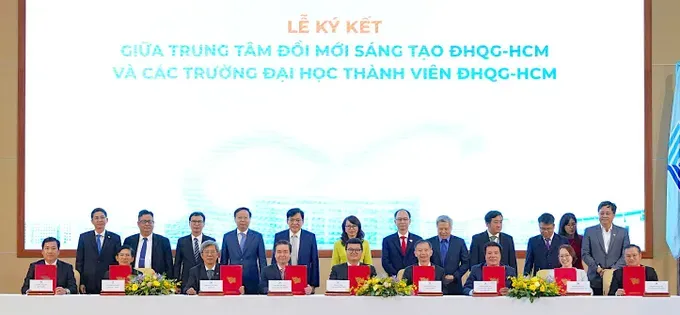
To implement the strategy, the VNU-HCMC Innovation Center and eight member universities signed a cooperation agreement for the 2026-2030 period. The partnership will focus on seven key areas, including establishing innovation coordination mechanisms, building science and technology capability databases, developing strategic technology products, commercializing research outcomes, and sharing infrastructure, laboratories and human resources across the university system.