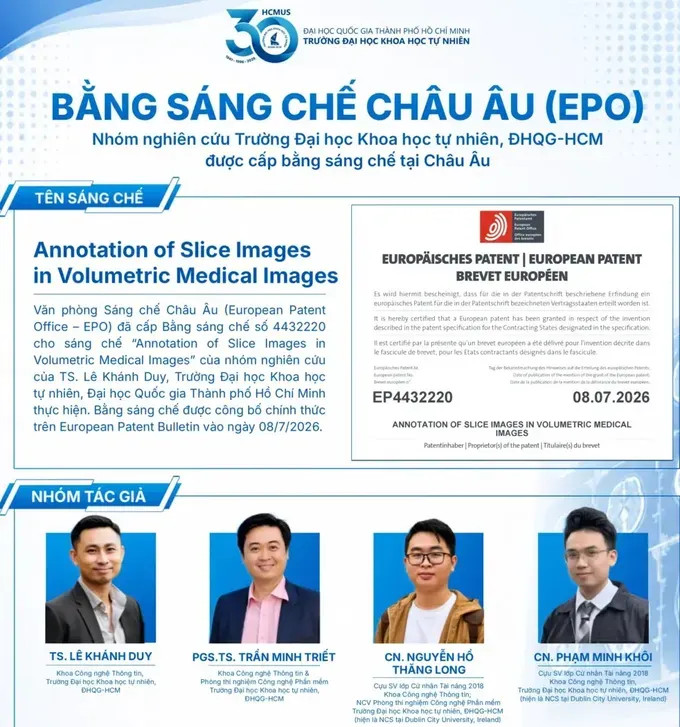
The European Patent Office (EPO) has granted European Patent No. EP4432220 to a research team from the University of Science, Vietnam National University Ho Chi Minh City (VNU-HCM), for its invention titled "Annotation of Slice Images in Volumetric Medical Images."
The patent is the first European patent awarded to both the University of Science and VNU-HCM in the field of artificial intelligence (AI) applied to medicine.
The research team was led by Dr. Le Khanh Duy, a lecturer at the Faculty of Information Technology, and included Associate Professor Tran Minh Triet, the university's vice rector, along with Nguyen Ho Thang Long and Pham Minh Khoi, both alumni of the faculty's honors bachelor's program (2018–2022) who are currently pursuing doctoral studies at Dublin City University in Ireland.
According to Dr. Le Khanh Duy, the team spent three years developing the invention after filing the patent application in 2023.
The patented technology addresses one of the most time-consuming tasks in medical AI development, the annotation of CT and MRI images used to train artificial intelligence systems. For volumetric datasets containing hundreds of image slices, medical experts must manually identify organs or lesions on each image, a process that is both labor-intensive and prone to inconsistencies across adjacent slices.
To overcome these challenges, the researchers developed a three-dimensional medical image annotation solution that combines computer vision algorithms with advanced data visualization techniques. After a user annotates or adjusts a structure on one image slice, the system automatically predicts and propagates the annotation to neighboring slices while providing confidence scores for each prediction, enabling users to verify and refine the results when necessary.
The approach significantly reduces annotation time while improving the consistency of training datasets.
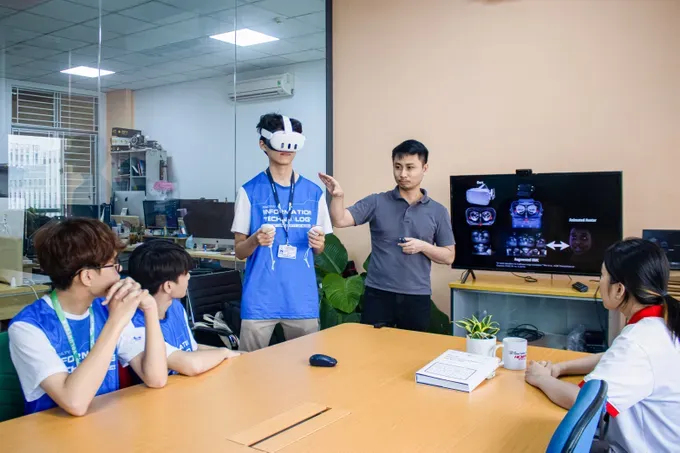
Dr. Le Khanh Duy said the invention's key innovation lies in enhancing interaction between human users and AI-assisted annotation systems. By enabling faster processing of large volumes of medical images, the technology can improve the creation of high-quality datasets for developing AI models used in medical image analysis and diagnosis.
The research team hopes that the patented solution will be integrated into medical image annotation software, contributing to the development of more accurate datasets for future AI-powered diagnostic and imaging applications.