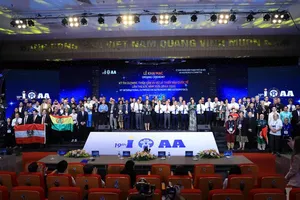
According to the Global Ranking of Academic Subjects (GRAS) 2026, Vietnam has eight higher education institutions featured, including three universities in Ho Chi Minh City across seven subject entries.
University of Economics Ho Chi Minh City (UEH) ranked in the top 101-150 globally in Finance, while Economics and Business Administration both fell in the 301-400 bracket. Ton Duc Thang University placed two subjects—Mechanical Engineering and Civil Engineering—in the 301-400 group. University of Medicine and Pharmacy at Ho Chi Minh City had the public health faculty ranked in the 201-300 bracket and clinical medicine in the 401-500 group. A key concern for many is how these internationally recognized academic strengths can contribute to Ho Chi Minh City's development goals.
Evidently, the Finance discipline ranking among the top 150 globally opens opportunities to contribute research and policy insight toward developing Vietnam's International Financial Center.
The Mechanical and Civil Engineering programs in the top 400 offer significant scope for addressing demands in transportation and industrial infrastructure, particularly as the city makes major investments in metro lines, ring roads, and industrial zones. Meanwhile, the public health and clinical medicine majors can make practical contributions to the healthcare system, especially for top-tier referral hospitals in the Southern region.
International rankings also serve as a "letter of introduction" to attract foreign lecturers, students, research partners, and foreign direct investment (FDI) enterprises seeking high-quality human resources. Behind these numbers lies immense educational capacity.
Vietnam National University Ho Chi Minh City educates over 98,000 undergraduate students and more than 10,000 postgraduate students, supplying around 15,000 highly qualified professionals annually. University of Medicine and Pharmacy at Ho Chi Minh City trains more than 15,000 learners, while Van Lang University has over 40,000 undergraduate students and nearly 3,000 international students. Alongside dozens of other institutions, they represent a vital intellectual resource for the city.
However, a gap remains between global rankings and the capacity to meet actual development demands. GRAS primarily assesses research capability through indicators such as academic staff, research achievements, quality of scientific publications, impact level, and international collaboration, without directly evaluating teaching quality or the practical application efficiency of research.
In the Academic Ranking of World Universities (ARWU) 2026, no Vietnamese representative made the top 1,000 universities. Despite differing assessment methodologies, these rankings indicate that alongside strengths in certain flagship fields, institutions still need to enhance overall research capacity and academic quality on a broader scale.
Moreover, existing strengths do not cover all of the city's development needs. Following consolidation, Ho Chi Minh City spans an area of over 6,700 square kilometers, with a population exceeding 14 million people, more than 7.5 million workers, and around 80 universities.
While university lecture halls remain in their original locations, the development space has expanded, presenting new and more complex demands for research and educational institutions. Issues such as urban flooding, traffic congestion, waste management, migration, and population aging all require interdisciplinary approaches combining engineering, economics, sociology, anthropology, law, and urban planning.
Therefore, expanding the scope of mechanisms for commissioned research is an urgent requirement. Ho Chi Minh City has already established policy frameworks for high-level human resource training, advanced materials research, and research commissioning in specific sectors; these must soon expand to urban and social issues.
Additionally, conditions should be further created to enable more higher education institutions to participate including private and foreign-invested universities while focusing on implementation to ensure research results are applied in practice.
International rankings recognize a university's research capability, but a far more vital yardstick remains the practical contributions of research activities toward the city's development and citizens' quality of life.