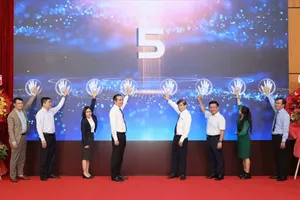
Accordingly, during the 2026-2027 academic year, the education and training sector will concentrate entirely on four distinct task groups of:
- staffing, policy regimes, and organizational apparatus;
- admissions, infrastructure, and finance;
- digital transformation, AI application, and administrative reform;
- a safe, humanistic, and joyful educational environment.
Specifically regarding the first task group, the Personnel Organization Division under the HCMC Department of Education and Training will be accountable for the review of quotas and advice on supplementing payrolls.
They’ll also propose highly flexible mechanisms for recruitment, designation, alongside visiting lecturer contracts, heavily prioritizing subjects currently experiencing shortages. The department will issue guidelines on overtime pay for educators working within public educational institutions while instructing on the implementation of regimes for managerial titles who don’t continue holding their positions following mergers.
Concurrently, the department continues advising the municipality on supportive policies tailored for medical staff, IT personnel, and teachers working far from home. It’s also devising plans to foster English proficiency for educators teaching science subjects in English.
As for the second task cluster, the Quality Management Division advises on 10th-grade admission methods geared toward profound openness, transparency, and fairness. They aim to effectively utilize information technology in allocating school placements, firmly prioritizing the geographical distance alongside the actual residence of students.
The Continuing, Vocational, and Higher Education Division is tasked with guiding vocational and continuing education centers to rapidly stabilize their organizations and operations following restructuring.
They’ll coordinate seamlessly with the Personnel Organization Division to review and replenish the teaching staff, advise on investments to elevate the quality of continuing education linked tightly to vocational training, accelerate career orientation plus post-secondary student channeling, and strengthen collaboration with higher education as well as vocational institutions regarding admission counseling alongside academic articulation.
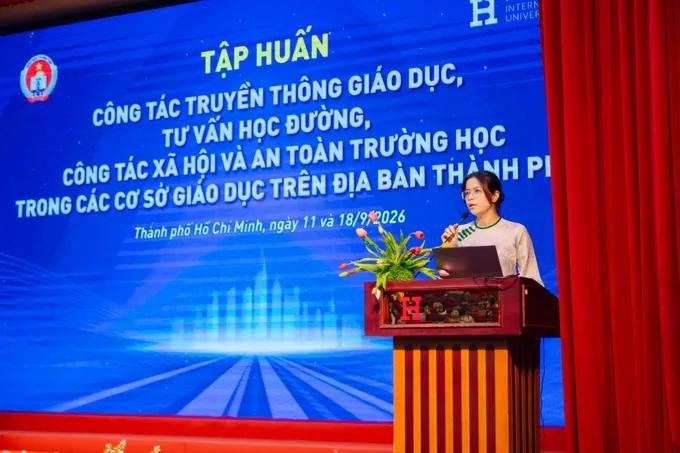
Addressing the third task group, the HCMC Department of Education and Training’s Office continues standardizing and interconnecting the sector’s database under the “enter once, use multiple times” principle.
They’re perfecting digital transcript data, researching ways to exploit and synchronize residential data with sectoral metrics, finalizing electronic class record books while expanding their rollout to vocational and continuing education centers, and slashing redundant paperwork, records, and overlapping reports.
The HCMC Education and Training Department will organize robust training sessions on operating public employee evaluation software based strictly on KPIs, subsequently issuing a standardized job portfolio framework for every single position.
The General Education Division is rolling out a guiding framework for safe and effective AI application. They’ll host AI competency training for school leaders and teachers according to the overall scheme, strictly ensuring safety and ethics without imposing any undue burdens on parents.
For the final task group targeting a safe, humanistic, and joyful educational environment, the Director of the HCMC Education and Training Department requested educational institutions to arrange their personnel flexibly while heavily emphasizing professional development.
Administrators must deeply care about the livelihoods and sentiments of public employees and other laborers in the educational sector so teachers can work with profound peace of mind. Schools desperately need to maximize the exploitation of existing infrastructure, guaranteeing adequate conditions for two-session-per-day teaching alongside physical training for students.
Furthermore, they must maintain absolute transparency regarding revenue collections, strictly preventing any overcharging or financial misconduct from occurring.
Schools bear direct responsibility for campus security and safety, meaning they must definitively resolve incidents straight from the grassroots level. They’re expected to champion the exemplary role of their staff, forging a pedagogical environment that fundamentally respects differences while profoundly inspiring learning.
Statistics from the HCMC Department of Education and Training reveal that the municipality currently lacks approximately 9,000 teachers compared to the maximum quota set by the Ministry of Education and Training. It also falls short by roughly 16,000 classrooms to successfully hit the target of 300 classrooms per 10,000 school-aged citizens.
Several high schools haven’t yet managed to organize two-session-per-day teaching, while the percentage of schools meeting national standards remains regrettably low. Conditions across various localities following restructuring aren’t exactly uniform; class sizes in certain areas remain bloated, and teachers for several specialized subjects are still in short supply.
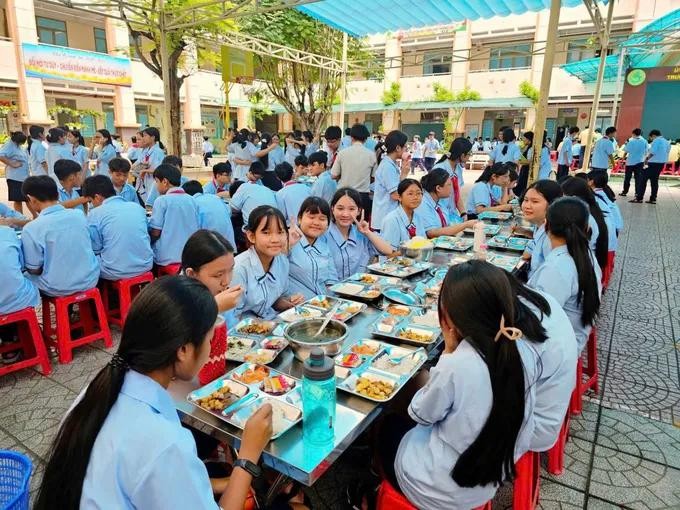
Food safety within boarding organizations still harbors underlying risks, particularly in the supplier control phase. Meanwhile, meal quality hasn’t yet matched the collected fees. Due to glaring infrastructure shortages, some schools find it incredibly difficult to arrange noon resting areas suitable for the students’ respective age groups.
School violence alongside the detrimental impact of toxic cyberspace content on students are experiencing increasingly complex developments.