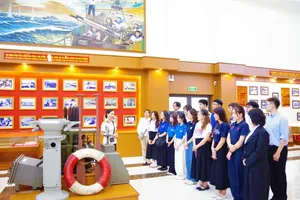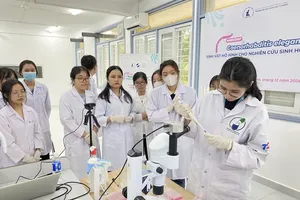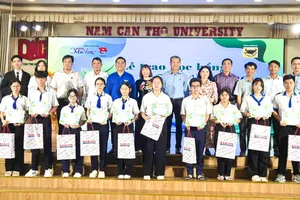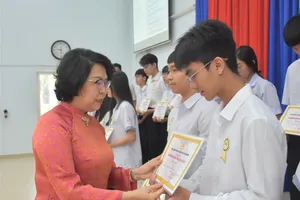
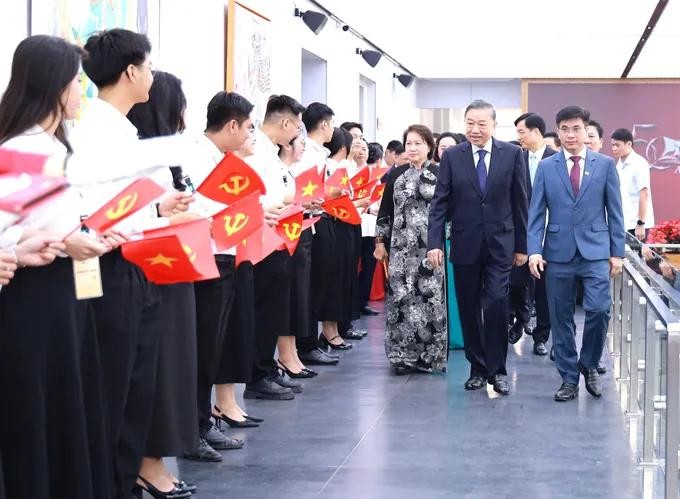
Party General Secretary and State President To Lam attended the event and delivered guidance, calling on the university to meet advanced standards in education, research, and public service.
Also attending were former National Assembly Chairwoman Nguyen Thi Kim Ngan; Politburo member, Secretary of the Party Central Committee and Head of the Party Central Committee’s Organization Commission Nguyen Duy Ngoc; Secretary of the Party Central Committee and head of the Party Central Committee’s Commission for Information and Education Trinh Van Quyet; and Secretary of the Ho Chi Minh City Party Committee Tran Luu Quang.
Current and former leaders of the Party and State, representatives of central ministries and agencies, and Ho Chi Minh City officials also attended the ceremony.
Representatives of agencies, organizations, businesses, and international partners were present, alongside hundreds of delegates from different generations of university leadership, as well as university officials, lecturers, staff, alumni, and students.
Striving for advanced standards in education
Speaking at the anniversary ceremony on behalf of the Party and State leadership, Party General Secretary and State President To Lam acknowledged and commended the university’s achievements and significant contributions.
He emphasized that the university's pioneering tradition must be upheld by a commitment to self-renewal and the pursuit of new milestones. Specifically, the university must make an accurate assessment of its capabilities, identify its shortcomings, define key priorities for reform, and focus resources on implementing them.
He emphasized that the university’s pioneering tradition must be carried forward through the determination to renew itself and achieve new milestones. The 50th anniversary, he said, was an opportunity to reaffirm its responsibilities for the road ahead.
Party General Secretary and State President To Lam called on the university to strive for advanced standards in education, research, and public service while strengthening its standing in the region and internationally.
The university’s growth must help enhance the country’s development capacity and deliver tangible benefits to the people, the Party General Secretary and State President stressed.
According to Party General Secretary and State President To Lam, Politburo Resolution No. 71 on breakthroughs in education and training development, together with Resolution No. 57 on breakthroughs in the development of science and technology, innovation, and national digital transformation, has set out major strategic directions for the country’s new development phase.
These policies must translate into tangible changes at every educational institution, particularly in teaching, learning, research, and the application of research findings to socio-economic development.
Party General Secretary and State President To Lam sets out five key tasks for UEH
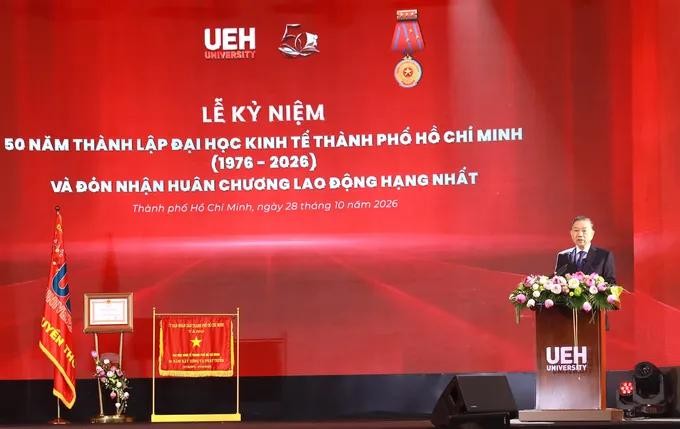
Party General Secretary and State President To Lam called on the University of Economics Ho Chi Minh City (UEH) to focus on five key tasks.
First, the university must reform and improve the quality of education, develop a highly skilled workforce, and nurture talent for the country.
The university must equip students with solid knowledge, independent thinking, creativity, a commitment to lifelong learning, and a sense of responsibility for their decisions. Alongside professional expertise, it must place greater emphasis on ethics, lifestyle, civic awareness, patriotism, and responsibility toward family and society. Those working in the economic sector must value labor, respect the law, and protect the identity and reputation of individuals and businesses.
Curricula and teaching methods must continue to be renewed to ensure a strong academic foundation and strengthen students’ ability to apply knowledge to solving problems. Research findings and real-world issues should be incorporated into teaching to foster digital literacy, critical thinking, and in-depth analysis. The university should also identify and nurture talent from an early stage, create opportunities for students to engage in research, and improve the quality of postgraduate education.
Second, the university must enhance research quality and provide scientific evidence to support institutional reform and sustainable economic development amid international integration.
UEH should strengthen practical research and theoretical studies on Vietnam’s socialist-oriented market economy. Drawing lessons from the achievements and shortcomings of the country’s ongoing reform process, the university should further clarify the relationship between the State, the market, and society.
It should propose regulatory frameworks and ways to allocate and use resources more efficiently while conducting research to identify solutions that promote high growth in tandem with economic model reform, social progress and equity, and environmental protection.
Priority should be given to challenging issues such as labor productivity, business competitiveness, green transition, and population aging. The university should also strengthen its forecasting capacity and identify emerging opportunities and risks amid geopolitical shifts.
Research must be grounded in sound principles and uphold academic integrity while allowing scientists the freedom and support to pursue challenging questions over the long term. Party General Secretary and State President To Lam expressed his expectation that the university would produce more distinctive and innovative scholarly works that earn recognition and make valuable contributions to the nation.
Research outcomes should help improve the quality of education, enrich knowledge, and provide reliable evidence for policymakers and implementing agencies. Learning and research outcomes must serve as means to achieve clearly measurable results in national economic development, job creation, and the delivery of tangible benefits to society.
Third, UEH must strengthen its ties with local authorities and businesses, ensuring that education and research directly serve development needs. The university should identify issues that need to be addressed and select appropriate areas for cooperation, with a focus on improving production capacity, expanding market access, and developing sustainable local services.
Practical needs should be translated into research questions, training content, and collaborative outcomes that can be applied to real-world challenges while also driving further innovation within the university.
For Ho Chi Minh City, the university should work alongside the city in developing human resources, modern financial services, the digital economy, and urban governance. Drawing on the city’s practical experience, it should proactively research emerging issues and review the outcomes of its initiatives to contribute to the development of other localities as well, Party General Secretary and State President To Lam said.
Fourth, UEH must build a strong faculty and scientific workforce while strengthening learning and professional development through domestic and international cooperation. A university's quality depends first and foremost on its lecturers and researchers.
The university should attract and retain talented people, build a team of leading experts, and foster dedication and determination. It should also assign responsibilities, provide guidance, and create opportunities for knowledge transfer and international integration, with performance assessed based on the quality of education and research and their practical contributions.
Fifth, UEH must continue to strengthen its curricula and teaching methods, ensuring a solid academic foundation while enhancing students’ ability to apply knowledge and adapt to change.
Reforms in teaching methods must go hand in hand with improvements in testing and assessment to ensure fair evaluation and uphold integrity. The university should also identify and nurture talent from an early stage, create opportunities for students to engage in research, and improve the quality of postgraduate education. It should proactively forecast workforce needs, prepare for emerging occupations, and expand opportunities for graduates to continue learning and update their knowledge.
The quality of education is demonstrated by the growth and contributions of learners, General Secretary and State President To Lam stressed. He expressed his hope that lecturers would remain dedicated to their teaching mission, imparting knowledge, character, and an aspiration to contribute to society.
He urged students to study diligently, develop resilience, live with integrity, and fulfill their responsibilities to their families and society.
General Secretary and State President To Lam expressed confidence that, building on its established foundations and strengths in education, UEH would make greater contributions to workforce development, institutional reform, improved governance capacity, and more efficient use of national resources.
UEH aims to become a multidisciplinary university and strengthen its global standing
In his anniversary address, Associate Professor and PhD Bui Quang Hung, President of the University of Economics Ho Chi Minh City (UEH), said the university had undergone numerous transformations over its 50-year history. It had progressively pursued reform, achieved comprehensive autonomy, expanded its operations, and deepened international integration.
In 2023, the university was upgraded to the University of Economics, Ho Chi Minh City, under a decision by the Prime Minister. This milestone enabled UEH to expand its capacity to connect knowledge across disciplines and co-create value with stakeholders to address real-world challenges.
Over the past 50 years, the university has trained a high-quality workforce, with more than 280,000 alumni. Many have gone on to become senior leaders in the Party and State, business executives, and respected experts in Vietnam and around the world.
UEH has established a diverse academic ecosystem serving nearly 40,000 undergraduate and postgraduate students. Nearly 60 percent of its lecturers hold doctoral degrees or higher. The university also benefits from the participation of international experts, visiting lecturers, and practitioners across its four member schools and two campuses.
Its international standing is reflected in its achievement of accreditation under European standards and its presence in reputable global rankings. UEH ranks among the top 200 universities in Asia, in the 501+ bracket of global university rankings, and in the 101–200 bracket of global subject rankings. Its standing is also reflected in its contributions to the Sustainable Development Goals and the placement of several programs in economics, management, and finance among the world's top 100–300.
The university's sustained efforts and contributions over successive generations have been recognized by the Party and State through numerous prestigious honors, including the title of Hero of Labor, Independence Orders and four First-Class Labor Orders.
For the 2025–2030 period, with a vision toward 2045, UEH has identified a new stage of development, shifting from a traditional university model to one centered on co-creating value. It aims to gradually become a hub for urban and regional innovation.
The university has set a target of entering Asia's top 150 universities by 2030 and the top 100 during 2035–2045. These ambitions reflect its responsibility to improve workforce quality, strengthen its service to the nation, and raise the international standing of Vietnamese higher education.
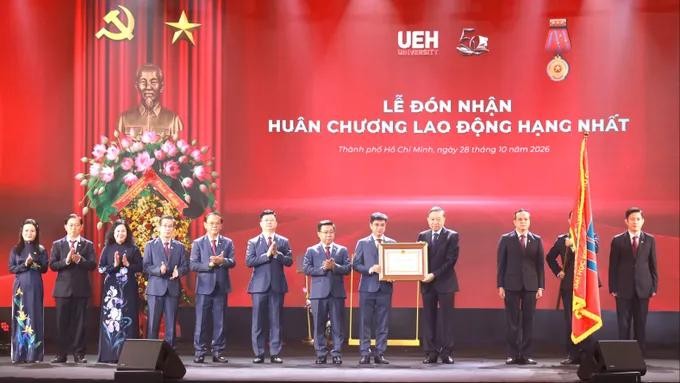
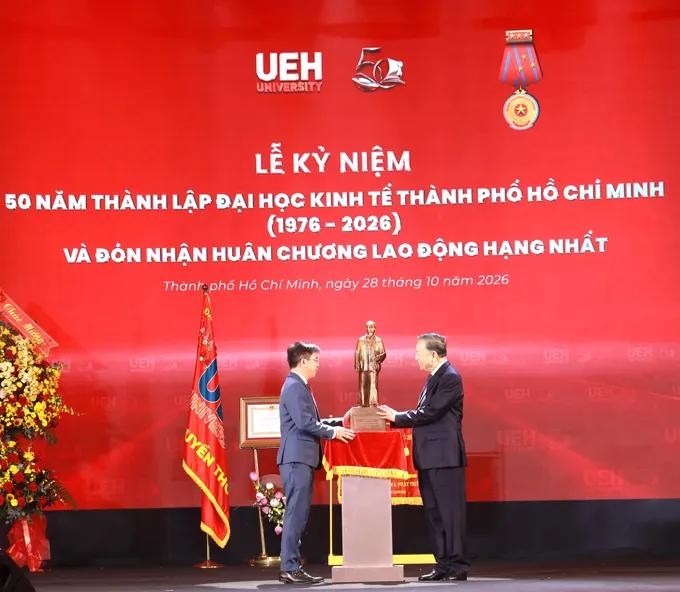
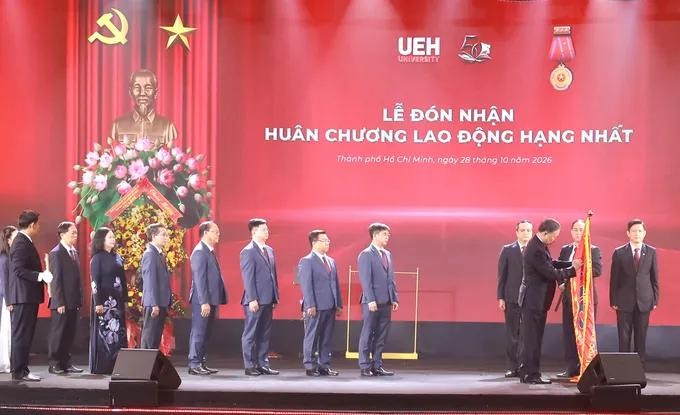
At the anniversary ceremony, Party General Secretary and State President To Lam presented the First-Class Labor Order to UEH in recognition of its contributions to workforce training, scientific research, and the country's socio-economic development.
Party General Secretary and State President To Lam presented the First-Class Labor Order to the University of Economics Ho Chi Minh City.
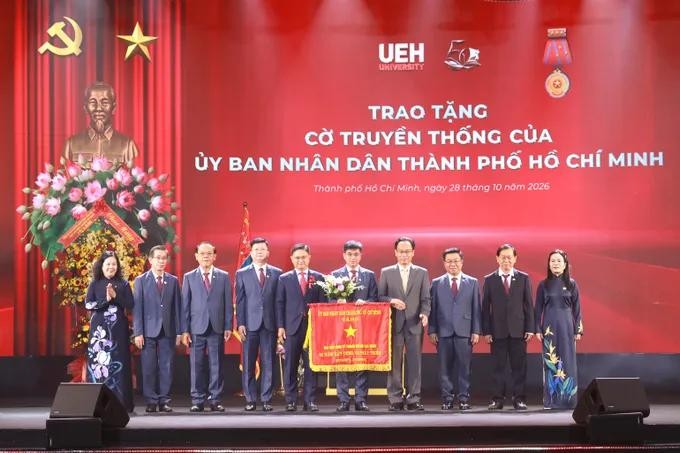
On the occasion, Vice Chairman of the Ho Chi Minh City People's Committee Nguyen Manh Cuong presented the university with the traditional flag of the municipal People's Committee in recognition of its contributions to the city's development.