The AI curriculum at Le Hong Phong High School for the Gifted progresses from foundational mathematics and Python programming to machine learning, real-world applications, and scientific research.
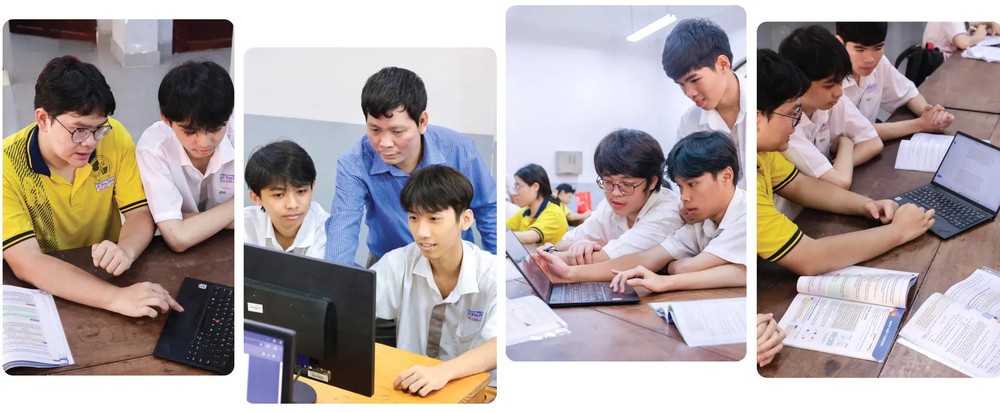
According to IT teacher Nguyen Ngoc Vinh, students actively participate in processing data, alongside architecting, training, and thoroughly evaluating computational models. The cyclical process of beta-testing, reviewing outcomes, and actively debugging profoundly helps intertwine abstract theory with real-world conundrums; furthermore, standout students are heavily encouraged to compete in scientific research contests and the AI Olympiad.
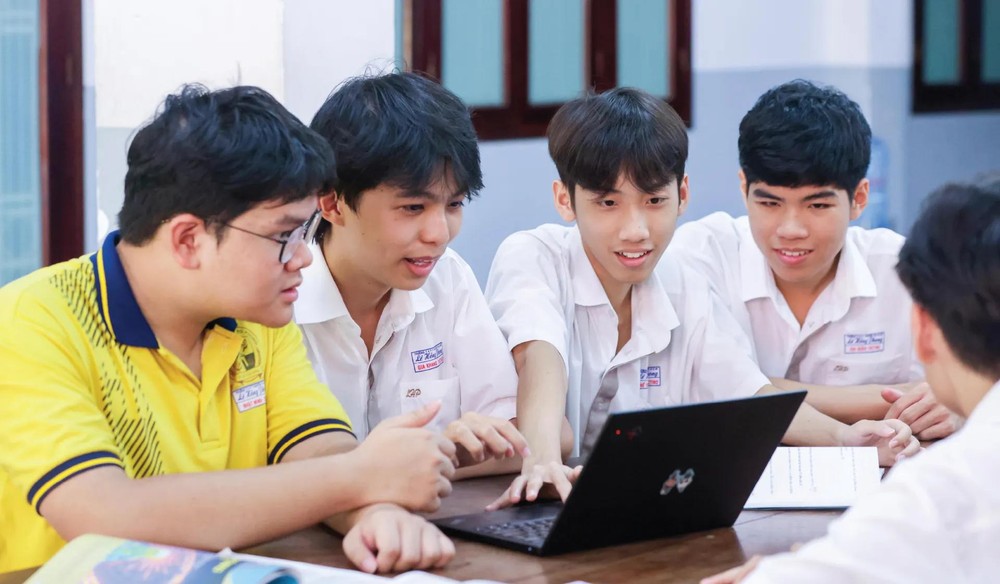
Take 12th-grader Pham Nhat Minh as an example. He’s currently pursuing a “Smart Telescope” project seamlessly integrated with AI. This model must accurately identify stars, precisely estimate stellar centers, and assist in determining which sky sector the telescope points toward. While it sounds like a rudimentary image-recognition task, if a star is excessively bright or the image is plagued by noise, the recognition results can easily skew.
AI tackles approximately 80 to 90 percent of the heavy lifting, processing imagery so the telescope autonomously recognizes targets. Troubleshooting highly complex scenarios remains the most daunting hurdle, but Minh doesn’t shy away. He painstakingly trains the model, beta-tests against data files, hunts down root causes for errors, and iterates the process. Beyond his school’s guidance, Minh autonomously pores over international journals. He proudly showcased this project at municipal-level competitions and the grueling national exam for gifted students.
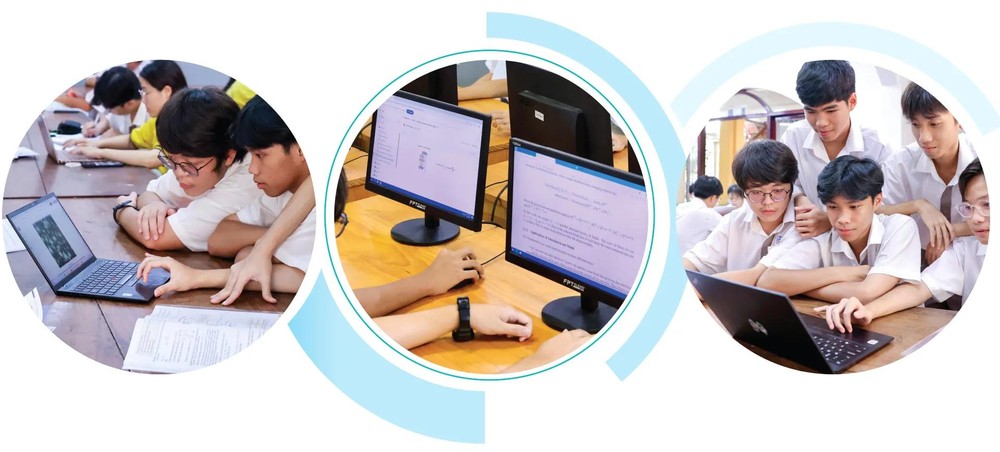
For Nguyen Hoang Long, an 11th-grader specialized in IT, AI essentially assists in synthesizing reference materials alongside tackling complex exercises. When fed accurate documents, the computational model yields results with a remarkably lower margin of error. However, Long profoundly grasps that it’s impossible to just dump data and blindly leave it to the machine. The model architect must dodge overfitting phenomena, cherry-picking the exact algorithm perfectly suited for specific conundrums.
Learning AI isn’t about repeating functions; it demands the intrinsic capacity to critically think and flawlessly optimize systems. His operational workflow remains quite clear-cut. He independently knocks out entire assignments in roughly one to two hours, only then handing his answers over to the AI to rigorously check and articulately explain root causes. This specific “do it yourself first” approach profoundly empowers him to proactively draw valuable lessons.
Similarly, Pham Gia Tri, another 11th-grade IT student, views AI strictly as a supplementary tool. For Tri, applying AI doesn’t lie in blatantly copying answers, but rather in mastering core concepts. He utilizes AI to break down daunting math problems, vividly explain natural phenomena, and rectify grammatical blunders, treating the technology strictly as a robust educational assistant.
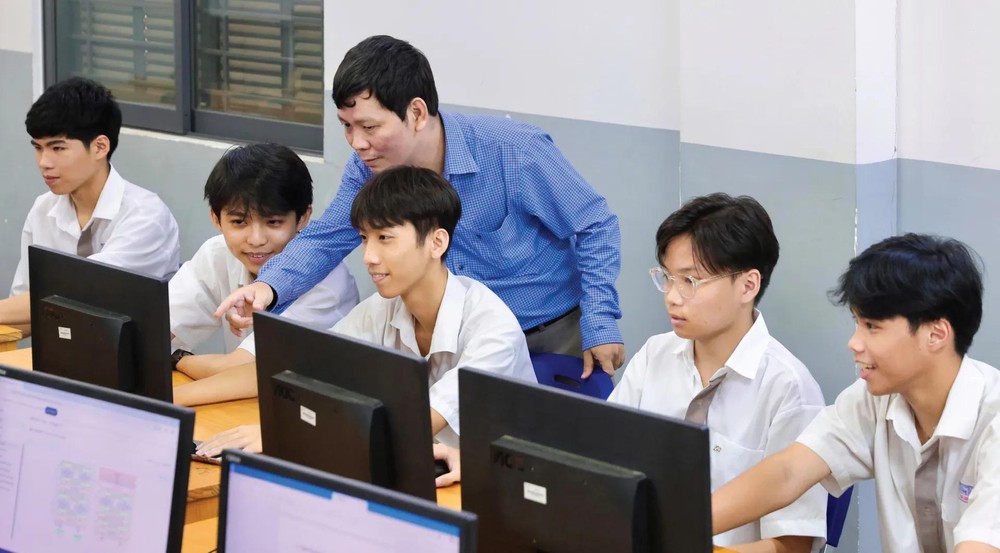
Principal Ho Tan Minh of Le Hong Phong High School for the Gifted proposes collaborating with universities, bringing seasoned lecturers into the high school teaching fold. Students can then readily access standardized knowledge while mapping out future careers.
For the 2026-2027 academic year, the school is orchestrating 105 lessons across all grades. They’re also boosting research clubs, dedicating approximately 20 percent of the timeframe to AI ethics. The school advocates for seamless university coordination, urging stakeholders to formally recognize stellar AI competition achievements so young talents can flourish.
Meanwhile, Deputy General Director Tran Anh Minh of Quang Ich Technology Group noted that while numerous student-led projects are incredibly elaborate, they often struggle in real-world applications because they stem from on-paper assumptions.
Corporations could collaboratively build rigorous portfolios with schools based on practical market demands. Each group would feature an educator overseeing scientific foundations alongside an engineer supporting feasibility. When models run on authentic data, crash into genuine bugs, and are subsequently debugged, students profoundly grasp what they must learn. This process needs the educational sector’s dedicated companionship.
It’s not just humans; AI can also succumb to hallucinations, a phenomenon the scientific community aptly dubs AI Hallucination. AI can blatantly fabricate content or maliciously misinterpret entire narratives. Instead of simply admitting ignorance, it actively fills gaping blanks with highly confident assertions.
The deeply treacherous trap is that this spat-out information is arranged incredibly logically; erroneous details, thus, remain profoundly subtle, rendering them exceptionally tough to spot unless the reader possesses sharp domain expertise.
Who has actually fallen victim? Back in 2023, two New York lawyers were slapped with an approximately US$5,000 fine for submitting a briefing citing bogus court cases entirely fabricated by ChatGPT. A staggering number of seasoned scientists, journalists, and educators have also suffered miserably because they blindly trusted AI.
Therefore, forcefully warning students that they could effortlessly become victims isn’t a redundant cautionary tale. One dangerous ramification is that youths might effortlessly slip into a hallucinatory state regarding their own academic prowess.
In his acclaimed book Nexus, author Yuval Noah Harari astutely recalls Johann Wolfgang von Goethe’s classic poem “The Sorcerer’s Apprentice”. It narrates a mischievous apprentice sneaking magic to force a broomstick into fetching water, yet remaining utterly clueless on how to halt the spell, ultimately triggering a massive flood.
It’ll be disastrously dangerous if students barely scratch AI’s surface, yet over-abuse it to lazily compensate for a sheer lack of diligence and independent cognitive reasoning. This scenario effortlessly bleeds into cases involving students boasting stellar AI achievements. Clinching an international award is undeniably commendable, yet that shiny accolade simply can’t guarantee the creator fully comprehends their AI-assisted computational model. They certainly can’t afford to be dangerously subjective regarding AI-inherent risks.
Just this past September, Professor Nicholas Polson from the University of Chicago had 257 research papers abruptly yanked by the SSRN platform following the detection of severe anomalies. This highly scandalous saga sent massive shockwaves throughout the global scientific community, serving as a glaring reminder to schools: don’t let AI’s lightning-fast speed induce a dangerous hallucination of sheer achievement.
Content: staff writers
Design: Huu Vi
Translation: Thanh Tam