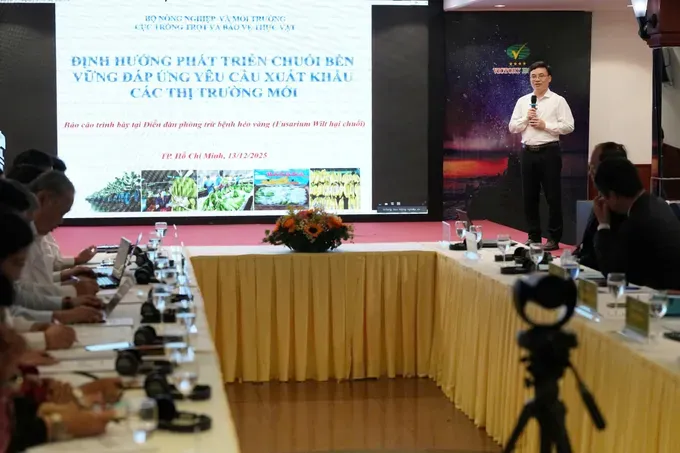
On December 13, in HCMC, the Department of Crop Production and Plant Protection, in coordination with Agriculture and Environment Newspaper, the Fruit and Vegetable Research Institute,organized a forum on solutions to prevent and control Fusarium wilt.
Speaking at the forum, Assoc. Prof. Dr. Le Quoc Doanh, former Deputy Minister of Agriculture and Rural Development and currently Chairman of the Vietnam Gardening Association, said that Vietnam’s banana output now stands at around 2.8 million tonnes per year, with both yield and cultivated area steadily increasing over time, reflecting strong market demand and expanding production capacity.
In 2024, banana exports generated approximately US$378 million for Vietnam. However, this figure remains below the sector’s production scale and growth potential, he noted.
Since 2022, the Ministry of Agriculture and Rural Development (now the Ministry of Agriculture and Environment) has rolled out a master plan for the development of key fruit crops, identifying bananas as one of its priority products. The plan sets a target of US$5 billion in fruit and vegetable export revenue by 2025, rising to US$6.5 billion by 2030.
According to Mr. Nguyen Quoc Manh, Deputy Director of the Department of Crop Production and Plant Protection under the Ministry of Agriculture and Environment, Vietnam’s banana cultivation area had exceeded 163,000 hectares by 2025. Some enterprises have noted that with systematic investment and further expansion of planted areas, Vietnam’s banana export revenue could move toward the US$1 billion mark.
At present, the development of Vietnam’s banana industry continues to face multiple challenges. Market information reaching producers remains limited, and prices are volatile and difficult to predict, particularly for shipments that do not yet meet export standards, leading to unstable selling prices, Mr. Nguyen Quoc Manh said.
In addition, technical barriers imposed by importing markets, especially requirements related to plant quarantine and food safety chemical residues, are placing significant pressure on both growers and businesses.
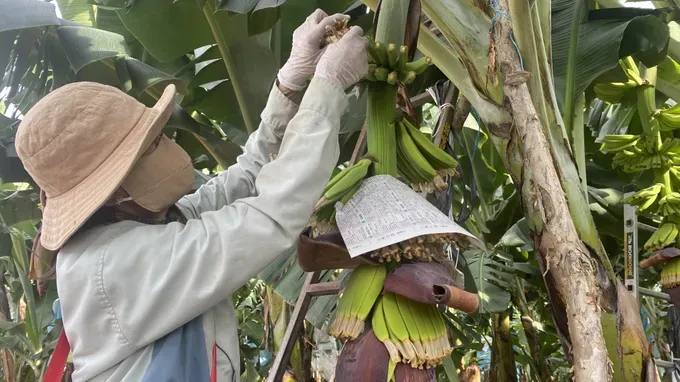
Assoc. Prof. Dr. Le Quoc Doanh noted that one of the most serious challenges facing the banana sector is disease, particularly Fusarium wilt (Panama disease). Addressing this threat, he said, requires well-structured investment strategies and comprehensive technical solutions. With effective disease control and a long-term development strategy, bananas could become a stable, high-value export commodity for the country.
However, according to Mr. Le Quoc Doanh, focusing solely on Panama disease is not sufficient. The core issue lies in raising the overall value of the banana sector, encompassing production organization, plant varieties, cultivation techniques, and market development.
According to Dr. Tran Ngoc Hung of the Biotechnology Department at the Fruit and Vegetable Research Institute, Fusarium wilt poses a major threat to the country’s banana industry. In many banana-growing areas, the disease has completely devastated plantations, forcing farmers to switch to other crops.
To address the threat, Vietnam has been actively seeking solutions and intensifying scientific research efforts. In particular, the approval and implementation of the FAO-funded Emergency Support Project for the Control and Management of Banana Fusarium Wilt in Vietnam clearly demonstrate the country’s determination to tackle the disease at the national level, he said.