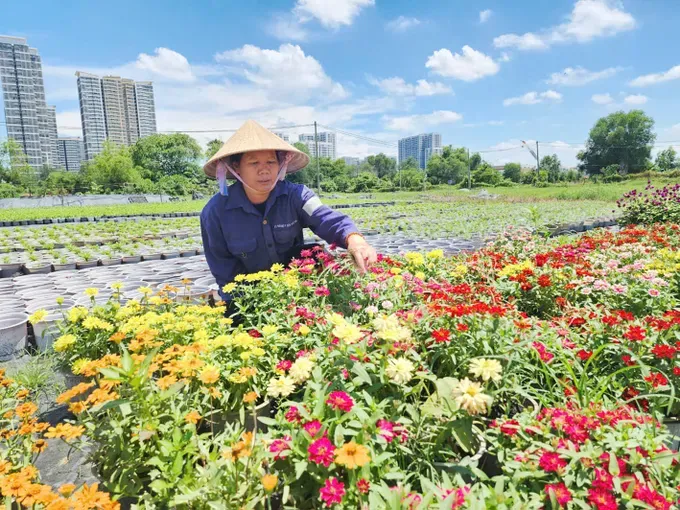
Following the success of the 1st Sa Dec Flower and Ornamental Plant Festival, Dong Thap Province will continue to organize this event at the end of this year. Currently, many farmers in Sa Dec Ward are working tirelessly to prepare flowers and ornamental plants for the festival as well as the solar and lunar the New Year 2026 market.
Since early November, farmers have been sowing short-term flowers such as marigolds, pico chrysanthemums, and gerberas, while traditional baskets of garden mum were sown in September.
Chairman Nguyen Van Tam of Sa Dec Ward People’s Committee shared that the ward boasts about 2,000 varieties of flowers and ornamental plants, including signatures like garden mum (Chrysanthemum morifolium), tiger chrysanthemums, gerberas, sunflowers, cockscombs, scarlet sages, cosmos, and various rose types. Currently, local farmers have cultivated about 100 hectares of flowers and plants to serve the Tet season and the year-end festival.
Since September 2025, farmer Huynh Thanh Tuan from Sa Dec Ward has been cultivating flowers on an area of about 8,000m², featuring over 30,000 baskets of various types such as new-color gerberas, phoenix flowers.
Notably, he has planted about 20,000 baskets of Siam tulips. This is his second year supplying large quantities of this flower to the market, making his facility one of the few in Sa Dec Flower Village to successfully propagate this variety.
Mr. Tuan revealed that Siam tulip is a new variety, originally known as Thai tulips, with seeds imported from Thailand. Upon successful cultivation in Sa Dec Ward, farmers renamed it “turmeric lotus” because the flower resembles a Vietnamese lotus when blooming. From seeding to blooming and sales, the cycle takes 75-90 days, with the flowering period lasting about one month.
Currently, his garden is blooming continuously for sales from now until Tet. The average price is VND50,000 (US$2) per basket, distributed primarily through traders to the HCMC market and wholesalers in Sa Dec Ward.
In the “capital of flowers and ornamentals” Cho Lach area (Vinh Long Province), farmers in Vinh Thanh, Phu Phung, and Hung Khanh Trung communes are tending to over 12 million flower and ornamental products, with chrysanthemums as the mainstay.
For garden mum, Thai and Taiwanese chrysanthemums, growers must pinch off the tops five times to ensure an even canopy and beautiful blooms, often using artificial lighting at night. If weather permits, each pot can sell for VND80,000-90,000 ($3.4), yielding a 40-50 percent profit.
In Cho Lach Commune, farmer Nguyen Van Phuc is preparing about 500 Southern yellow apricot trees for the 2026 Tet season, priced at VND1.5-2 million ($76) per tree, with traders already depositing over 30 percent. According to Mr. Phuc, the weather is stabilizing, and farmers are carefully fertilizing and watering, awaiting the delivery day.
Vice Chairman Tran Huu Nghi of the Cho Lach Commune People’s Committee noted the commune has 3,500 hectares of agricultural land dedicated to seedlings and ornamental flowers.
This year, local farmers prepared about 2.5 million products, a 10 percent increase from 2024. Of these, 3-star OCOP-standard garden mum baskets account for 1.2 million products, with the rest comprising marigolds, yellow apricots, and other flowers. About 70 percent of the output has been underwritten by traders, especially from HCMC and the Southeast region, while the remainder will be sold retail at Tet flower markets.
Meanwhile, Nguyen Thi Thanh Thuy from Long Binh Ward of HCMC owns a 20,000m² flower garden. She has just sown background flowers like marigolds, lisianthus, kalanchoe, and cockscombs to supply 50,000 baskets to HCMC and neighboring provinces for the Lunar New Year.
Ms. Thuy stated that nurseries retain loyal customers by keeping prices moderate and accepting lower profit margins to share the burden with consumers. Parallel to this, she utilizes social media to reach new markets. “Since advertising on Facebook, more people know about the garden. Some customers just look at photos and place orders; I pack and ship them,” she said happily.
Director Le Huu Thien of Binh Loi Yellow Apricot Cooperative (sited in Binh Loi Commune of HCMC) shared: “I am currently cultivating 10 hectares of field apricots and nearly 1,000 potted apricots. I expect to supply about 3,000 field trees and several hundred pots to the market this Tet. To date, orders have reached over 50 percent.”
According to him, apricot farming requires meticulous effort but offers stable income; a well-tended garden can yield billions of dong annually. With a garden spanning tens of hectares, care and monitoring are now supported by technology. Through a smartphone, farmers can observe the garden and water plants. Additionally, the garden is equipped with anti-theft sensors, also known as “magic eye,” to protect the high-value assets.
Bui Ngoc Duc, owner of Huu Duc Yellow Apricot Garden, cultivates over 20,000 trees, noting that yellow apricots have significantly boosted local incomes. This season, he prepared thousands of pots priced from VND300,000 to tens of millions of dong ($11.5 – around $760). Notably, demand from Northern provinces like Hanoi is surging, as the Binh Loi Brand has firmly established its reputation for superior quality.
Chairwoman Nguyen Thi Gon of the Binh Loi Commune Farmers’ Association stated that Binh Loi yellow apricots stand out for their vibrant color, thicker petals, and longer bloom durability (3-7 days). This Tet season, Binh Loi is introducing new varieties such as the “Binh Loi Super Bloom Grafted Apricot” and “Binh Loi Super Cluster Bloom Apricot,” promising to create a highlight in the market.







)