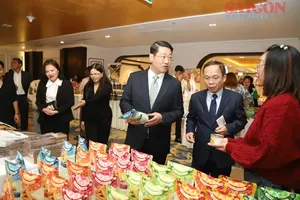
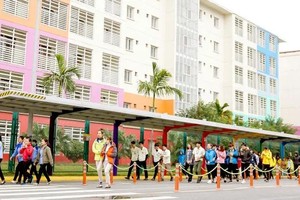
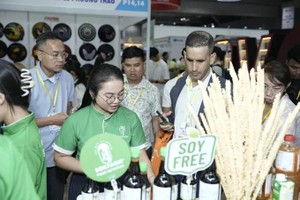
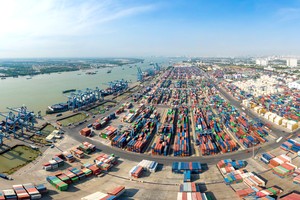
The Ho Chi Minh City Export Processing and Industrial Zones Authority (HEPZA), in coordination with the United Nations Industrial Development Organization (UNIDO), organized the event titled “Promoting Eco-Industrial Park Models Towards Circular Economy Development and Carbon Emission Reduction in Ho Chi Minh City.”
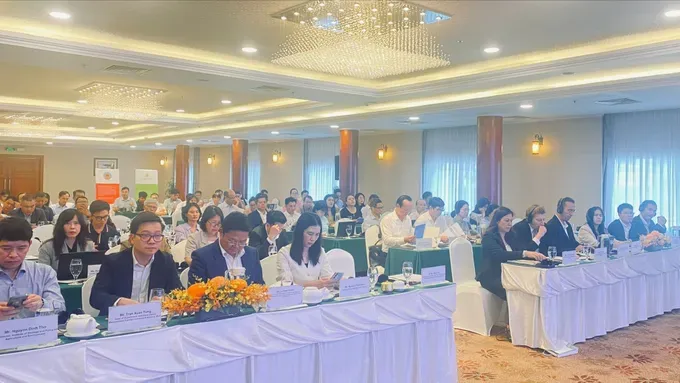
The workshop also gathered expert and business community input to guide the transformation of existing and future industrial parks toward sustainable, circular development.
In her remarks at the workshop, Ms. Le Thanh Thao, UNIDO Vietnam Chief Representative, highlighted that the workshop was held at a strategic time as Ho Chi Minh City enters a new phase of development following administrative mergers, becoming Vietnam’s largest integrated industrial region. This expansion is not merely about scale; it opens unprecedented strategic opportunities from planning individual zones to unified regional planning, and from traditional industrial development models toward eco-friendly, smart, circular and low-carbon industrial models.
She added that the UNIDO has been working with Vietnam for over a decade to implement eco-industrial park programs. In Ho Chi Minh City, Hiep Phuoc Industrial Park serves as a pilot project supported by UNIDO.
Mr. Tran Thanh Tung, Head of the Environmental Management Division, HEPZA, indicated that the pilot project for the eco-industrial park model at Hiep Phuoc Industrial Park is part of the “Implementation of Eco-Industrial Parks in Vietnam” project under the global UNIDO Eco-Industrial Park Program, funded by the Swiss Federal Economic Office and approved by the Ministry of Planning and Investment on May 8, 2020 (2020–2024 phase).
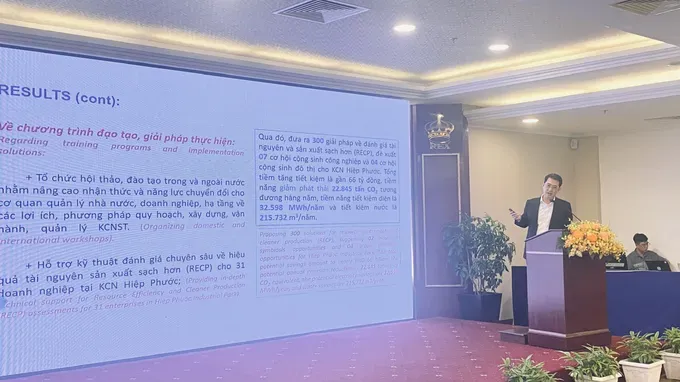
The project has achieved promising results. In 2020 (early stage), Hiep Phuoc Industrial Park reached 44 percent of the international eco-industrial park framework requirements. By 2023, with the project's support, this increased to 76 percent. Additionally, through the project, Hiep Phuoc Industrial Park has reduced annual CO2 emissions by 22,845 tons, saved 32,598 MWh of electricity, and conserved 215,732 cubic meters of water. The park will remain part of the initiative during the 2024–2028 period.
Mr. Tran Xuan Tung, Head of the Economic Zone Management Division at the Foreign Investment Agency, Ministry of Finance, noted that Vietnam now has a comprehensive policy framework for eco-industrial parks. The 2020 Environmental Protection Law introduced industrial symbiosis into national legislation for the first time. Decree 35/2022 and Circular 05/2025 set detailed criteria, certification procedures and monitoring indicators aligned with international standards. Other policies on emission reduction, energy efficiency and green investment incentives are also being implemented.
According to him, transitioning to eco-industrial parks not only helps businesses reduce energy costs by 10–20 percent, cut water usage by 20–30 percent, and optimize environmental management, but also serves as a “passport” to maintain their position in the global supply chain.
Mr. Bui Minh Tri, Head of the Ho Chi Minh City Export Processing and Industrial Zones Authority, emphasized that the workshop provides an opportunity to gather input from experts in planning, environmental management and the business community. Their feedback will help propose policy and regulatory adjustments to support the transformation of existing and future industrial parks into eco-industrial parks, promoting a sustainable, circular economy.