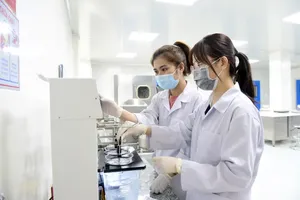
To ease bottlenecks in customs clearance for imported food products—particularly agricultural and aquatic commodities—the Vietnam Food Administration (VFA) under the Ministry of Health, on February 4, announced a list of 34 designated testing facilities authorized to conduct food safety testing for State management purposes.
According to Dr. Chu Quoc Thinh, Acting Director of the VFA, with 34 designated laboratories now in place, businesses can submit samples to facilities located closer to their areas of operation for testing. At the same time, the authority has urged ministries and sectors to instruct testing units to step up coordination and implementation to avoid disruptions to business operations.
Earlier, at a conference held on January 26, 2026, to disseminate Government Decree No.46/2026/ND-CP—detailing a number of provisions and measures for the implementation of the Law on Food Safety (Decree 46)—and Government Resolution No.66 on the declaration and registration of food products, Deputy Minister of Health Do Xuan Tuyen emphasized that while amendments to the Law on Food Safety are still pending, the Ministry of Health, under the direction of the Government and the Prime Minister, has proposed interim solutions. These include revisions and supplements to Decree No.15/2018/ND-CP through the issuance of Decree 46 and Resolution 66, aimed at addressing immediate shortcomings.
Dr. Chu Quoc Thinh noted that during the initial phase of implementing the new regulations, congestion occurred at several border gates, particularly for imported agricultural products, as stakeholders had yet to fully adapt to the new inspection procedures. To address this, authorities issued guidance allowing greater flexibility in inspection methods, including a shift from standard inspections to reduced inspections for eligible consignments, while strengthening coordination among customs agencies, local State inspection bodies, and technical units. To date, assessments by relevant agencies indicate that major bottlenecks at ports and warehouses have largely been resolved, with customs clearance gradually returning to stability.
He added that reforms in State inspection of imported goods across the agriculture, health, and industry and trade sectors are being rolled out with a strong emphasis on decentralization to local authorities. This approach is intended to enhance local autonomy, reduce congestion, and ensure continued control over product quality.
Under the plan, localities are required to complete a review and submit reports on their capacity and implementation arrangements by March 31. From April 1, the State management authority—either the Ministry of Agriculture and Environment or provincial-level People’s Committees—will assume primary responsibility for inspecting imported goods. Central-level institutes and testing centers, along with qualified private laboratories, will coordinate with local authorities in sampling and testing in accordance with assigned responsibilities.

)