Preserving the Vietnamese language among younger generations of Vietnamese origin in Canada remains a major concern for many families, as most children communicate primarily in English or French.
In response, Chairwoman Phan Thi Quynh Trang of the Canada-Vietnam Culture and Education Council (CVCEC) and her colleagues launched the “My Vietnamese School” project, using technology as a key tool to preserve and spread the Vietnamese language.
Project brings Vietnamese classes into every expatriate home
In its early stages, the “My Vietnamese School” project faced numerous challenges because most teachers worked as volunteers, while the costs of renting facilities and operating in-person classes exceeded available financial resources.
The decision to embrace digital learning and proactively mobilize international resources marked a turning point, enabling Vietnamese language classes to reach expatriate families through online platforms.
As part of the Vietnamese Language Honor Program in Overseas Vietnamese Communities launched by the State Committee for Overseas Vietnamese under Vietnam’s Ministry of Foreign Affairs, CVCEC partnered with educational technology company BambooTech of Finland and dedicated teachers in Finland and Canada to digitize the project’s entire learning materials system. The materials include textbooks published by Ho Chi Minh City University of Education Publishing House and curricula from the Khai Minh Duc Education System, following the educational principle of “Etiquette first, knowledge second”.
In Canada, the program has been implemented in localities including Toronto, Prince Edward Island (PEI), and Manitoba.
Operating under a hybrid model that combines in-person and online instruction, “My Vietnamese School” integrates eight learning themes, 40 learning stages, and artificial intelligence (AI) features that support listening, speaking, and writing practice in engaging ways.
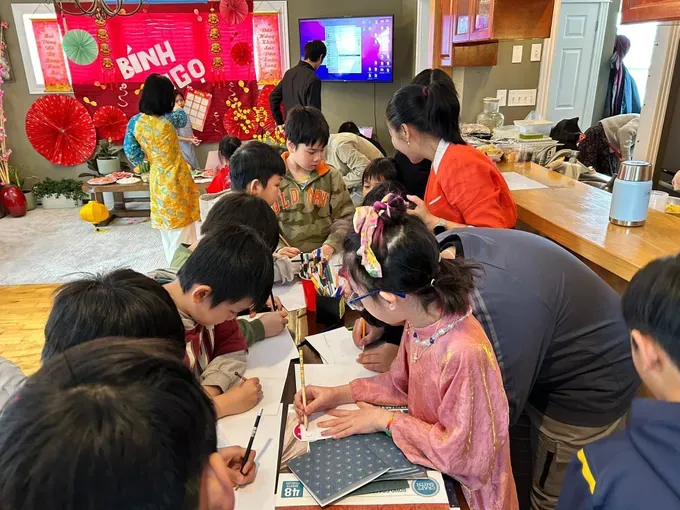
At the in-person learning site in PEI, students not only practice reading and writing but also take part in cultural activities such as wrapping banh chung (Vietnamese square sticky rice cake) during Lunar New Year celebrations, making banh troi nuoc, and carrying Mid-Autumn Festival lanterns.
This combination of language instruction and cultural experiences enables Vietnamese to naturally take root in children’s hearts, turning each lesson into a journey back to their cultural origins.
The sustained support of more than 20 parents, together with the dedication of teachers Hoang Minh Ha and Nguyen Thi Thanh Binh, has helped 30 students progress from having no knowledge of Vietnamese to becoming fluent readers and writers capable of confidently telling stories in their mother tongue. At the same time, an online class led by teacher Ngo Nguyen Ngoc Dieu Anh from Manitoba has connected students in PEI.
Technology has helped unite small, geographically dispersed learning sites into a warm learning community, removing barriers created by distance.
A cultural bridge and driver of international tourism
Speaking about CVCEC’s future direction, Phan Thi Quynh Trang said she hopes to further expand the linked-class model and broaden the network to additional provinces and territories based on the successful cooperation between Manitoba and PEI, while continuously upgrading digital learning resources.
In particular, CVCEC is working with the Toronto District School Board (TDSB) to integrate the program into Vietnamese language classes offered under the International Languages Program. The project's long-term objective is to encourage Canadian authorities to recognize Vietnamese as an officially credited foreign language within the country’s K-12 education system.
Beyond serving the Vietnamese expatriate community, CVCEC is also promoting the Vietnamese language as a tool for cultural diplomacy and international tourism development.
Through programs organized by Vietnam-based Educap that bring international visitors to experience Vietnamese language and culture, CVCEC serves as a professional partner, conducting research, developing educational materials, and designing cultural immersion activities that help introduce the beauty of Vietnam and its people to international audiences.
Chairwoman Phan Thi Quynh Trang said CVCEC is actively coordinating with the State Committee for Overseas Vietnamese to mobilize community resources in line with Resolution No. 23-NQ/TW on overseas Vietnamese affairs.
CVCEC believes that close alignment between State policies and community efforts will provide a strong foundation in both mechanisms and resources, enabling linked learning programs to develop sustainably and expand further in the years ahead.