However, this expansion comes with heightened requirements for management practices, exploitation control, and ensuring transparency in copyright information.
Industry faces growing hurdles
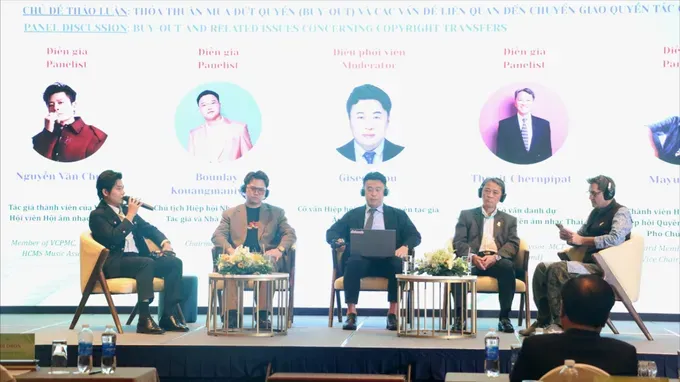
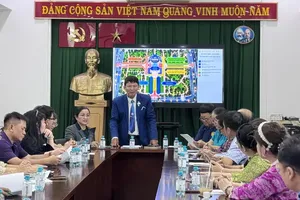
As part of the 2026 Asia-Pacific Committee Meeting series under the International Confederation of Societies of Authors and Composers (CISAC's Asia-Pacific Committee meeting), the Vietnam Center for Protection of Music Copyright (VCPMC) hosted the "Music Creators" seminar on October 30 in Ho Chi Minh City. The event drew nearly 400 delegates, including over 100 representatives from international Collective Management Organizations (CMOs) affiliated with CISAC.
The workshop focused on buy-out agreements, copyright transfers, emerging challenges posed by artificial intelligence (AI), and their implications for copyright protection and creators’ rights.
Drawing from over two decades of songwriting experience, composer Nguyen Van Chung noted that buy-out deals in Vietnam are often accepted by young musicians who are new to the industry and lack legal knowledge and practical experience, or older composers who have not kept pace with digital music platforms. Consequently, they readily agree to transfer their full copyrights to producers or prominent singers without grasping the underlying value of the financial rights terms in their contracts.
Mayur Puri, a board member of the Indian Performing Right Society and Vice President of the Asia-Pacific Music Creators Alliance (APMA), shared that copyright buy-outs are also widespread in India.
Record companies consistently draft contract terms in their own favor. Furthermore, the misuse of AI in music creation has introduced novel forms of copyright infringement, making it increasingly difficult for genuine creators to protect their legitimate rights, he stated.
Meanwhile, Thanit Chernpipat, Honorary Advisor to the Music Copyright Society of Thailand, revealed that a lack of copyright awareness has led several Thai composers to pay record labels for the right to perform their own compositions after signing buy-out contracts.
Tran Hoang, Director General of the Copyright and Cultural Industries Authority under the Ministry of Culture, Sports and Tourism, emphasized that technology must be developed and deployed on the foundation of respecting the legitimate rights and interests of authors, copyright owners, and related-rights holders... ensuring compliance with national laws and international commitments while balancing the interests of creators, rights owners, tech enterprises, and the public.
Shaping the future of music
At the workshop, much of the discussion focused on AI training, particularly concerns over the use of copyrighted works to train AI systems, the imitation of artists' voices or distinctive creative styles, and questions surrounding legal liability and the sharing of benefits generated from AI-produced content.
Kibeom Kim, a member of the Board of Directors of the Korea Music Copyright Association (KOMCA), said the association had recently declared an emergency over the use of music creators' styles to train AI systems without their permission. It needs to establish a system as soon as possible to safeguard creators' legitimate rights and interests as AI continues to advance, he said.
Meanwhile, Arrien Molema, Chairman of the International Council of Music Creators (CIAM), said the council respects technological development and is willing to use AI, but it demands transparency and insists that creators' permission must be obtained before their works are used to train AI systems.
Musician Hoai An proposed establishing an international-level AI subcommittee bringing together three groups of experts: legal specialists, music professionals and technology experts. The body would be tasked with conducting research, anticipating emerging issues and proposing timely policy responses.
According to musician Dinh Trung Can, General Director of the Vietnam Center for Protection of Music Copyright (VCPMC), addressing cross-border challenges requires international cooperation, data connectivity, experience-sharing and agreement on common principles for protecting creators. Only through such efforts can a fair, transparent and sustainable music ecosystem be developed.
Ms. Pham Thi Kim Oanh, Deputy Director of the Copyright Office of Vietnam under the Ministry of Culture, Sports, and Tourism, said Vietnam was drafting a standalone Copyright Law that would refine regulations on AI, copyright trading platforms, Extended Collective Licensing (ECL) and buy-out arrangements.
Vietnam remains committed to welcoming all forms of innovation and creativity, but such innovation must always be grounded in respect for copyright and aimed at building a sustainable creative cultural industry, Ms. Oanh said.