Eight years after implementing Resolution No. 36-NQ/TW on the Strategy for the Sustainable Development of Vietnam's Marine Economy to 2030, with a vision to 2045, Vietnam has undergone a fundamental shift in thinking from viewing the sea primarily as a resource to be exploited for economic growth to recognizing it as a strategic national development space for the future.
However, progress in practice has been slow. Marine economic activities remain focused largely on land-based industries and nearshore fishing. The marine economy continues to be fragmented by administrative boundaries and sectoral management, with each province seeking to develop its own port, economic zone, and tourism area.
In what is increasingly described as the century of the ocean, a country's competitive advantage no longer depends on its land area or underground resources, but on its ability to organize and control global flows of goods, capital, technology, data, and energy. For Vietnam, this challenge is even more pressing as opportunities for land-based growth are gradually narrowing, while the country has more than 3,260 kilometers of coastline and an exclusive economic zone covering millions of square kilometers along one of the world's busiest maritime routes.
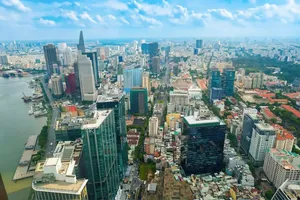
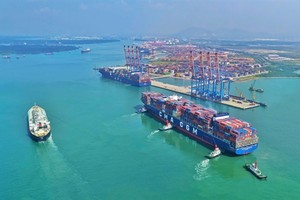
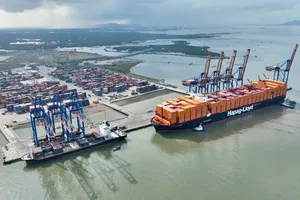
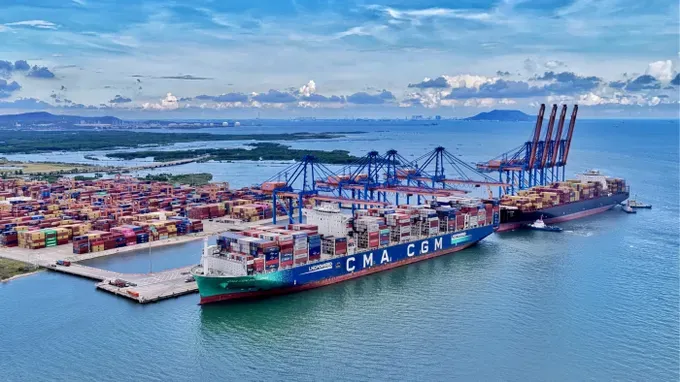
Following the merger of the former provinces of Binh Duong and Ba Ria–Vung Tau into Ho Chi Minh City, the city now possesses Vietnam's premier deep-water port complex, about 320 kilometers of coastline, and significant offshore energy potential. In 2024, the Cai Mep–Thi Vai port complex handled 152 million metric tons of cargo, accounting for about 34 percent of the country's total container throughput.
In the first nine months of 2025, container volume handled by mother vessels reached 5.6 million TEUs, up 18 percent from the same period a year earlier.
The port complex currently operates 51 shipping services, including 37 direct international routes linking Asia, Europe, and the Americas.
According to the Container Port Performance Index (CPPI) published by the World Bank and S&P Global, Cai Mep–Thi Vai ranked seventh globally in operational efficiency.
Despite these advantages, Cai Mep–Thi Vai currently functions mainly as a cargo handling port. Its free trade zone has yet to become operational, while advanced maritime services including finance, insurance, legal services, and ship brokerage remain largely absent. Mechanisms to attract global strategic investors are also lacking.
As a result, Ho Chi Minh City's strategic objective, which also reflects Vietnam's broader vision for its marine economy, is to build international trade gateways, or "Global Gates," integrating transshipment ports, logistics centers, financial and maritime services, free trade zones, and coastal urban areas directly connected to global economic networks.
The draft Law on Urban Development has proposed a comprehensive institutional framework for this model. It includes an open-port mechanism linking Cai Mep and Can Gio, allowing cargo and vessels to move seamlessly throughout the port complex as a single unified port; the establishment of a free trade zone and integrated logistics hub; the development of high-value services; and the creation of a National Energy Industry Center.
The transition from a marine economy to an ocean economy is built around four strategic pillars. The first is shifting from developing individual marine industries to governing the national marine development space. Marine areas should be planned, assigned specific functions, and coordinated at the national level, ending the current situation in which localities compete by developing separate ports and economic zones. The merger of three localities in the Southeast region demonstrates that when administrative boundaries no longer divide economic space, overall efficiency improves immediately.
The second pillar is establishing national priorities. The Can Gio–Cai Mep–Vung Tau area should be designated as Vietnam's first national marine economic center and serve as the country's "Global Gate" to the Pacific and Indian Oceans. Other key coastal regions, including Hai Phong–Quang Ninh and Da Nang–Chan May, should be assigned complementary roles within a unified national strategy rather than pursuing parallel development.
The third pillar calls for institutional reforms to move ahead of development. Specifically, the National Assembly should promptly consider and approve provisions in the draft Law on Urban Development covering open-port mechanisms, free trade zones, high-value maritime services, and a National Energy Industry Center. These measures are viewed not merely as policies for a single locality but as standardized institutional tools for Vietnam as a maritime nation. They should be accompanied by mechanisms to attract global strategic investors and a legal framework for offshore wind power, both of which remain essential to turning potential into investment projects.
The final pillar emphasizes that marine development must be designed to be environmentally sustainable from the outset. This includes setting specific targets for the share of value-added services in port revenue, the proportion of renewable energy generated in coastal areas, and the extent of protected marine ecosystems. In particular, the Can Gio Mangrove Biosphere Reserve should be recognized as an ecological buffer zone that cannot be sacrificed, even as the country develops its future national marine economic center.