The Vietnam National Book Awards are entering their eighth season with a consistent message: honoring works that truly possess intellectual and academic value and contribute to sustainable social development. From application submission and preliminary selection to the final judging, the process is standardized to ensure fairness, transparency, and professional merit.
National Book Awards tighten selection with rigorous multi-round review
With only one in ten submissions honored, the 8th Vietnam National Book Awards applied stricter judging standards, combining expert evaluation with media data analysis to highlight works of lasting academic and social value.
This year, the awards saw participation from 46 out of 52 publishers nationwide, with 397 book titles and sets (512 books in total), an increase of 25 titles and 57 books compared to the previous season. However, the number of awards did not increase proportionally.
Nguyen Nguyen, Director of the Publishing, Printing and Distribution Department, stated: “This year, only one out of every ten submitted books was selected, demonstrating the very rigorous selection process from the outset.”
The Preliminary Judging Panel, the Final Judging Panel, and the Awards Panel comprise over 70 professors, scientists, leading experts, and representatives from key management agencies and educational institutions. The panels work independently in their respective areas, directly reviewing the works, assessing legal documentation, and evaluating the content and form of publication.
The judging process involves multiple rounds of peer review, collective discussion, and a secret ballot. This mechanism minimizes the influence of personal bias and ensures that each work is considered from three perspectives, including academic value, practical contribution, and social impact.
A new feature of this year's awards is the application of media data analysis in the selection process. For works nominated for high awards, the organizing committee collaborates with a technology unit to synthesize and analyze public opinion in the press and social media. Public opinion accounts for 15 percent-25 percent of the scoring, depending on the category. However, according to Director Nguyen Nguyen, content quality remains the highest criterion for awarding prizes; public opinion data serves as a reference, aiming to increase caution and reflect social consensus.
Addressing concerns regarding reprinted publications, the Director indicated that, in accordance with regulations, works published or reprinted within the designated timeframe qualify for participation. Indeed, several titles that have undergone reprinting more than ten times have continued to receive accolades. Consequently, this recognition not only celebrates momentary creative accomplishments but also emphasizes works that possess lasting significance, validated over time and through practical use.
National Book Awards restructure categories, highlight domestic creativity
The 8th National Book Awards also adjusted its structure from five categories to four, as the political and economic book category was merged with the social sciences and humanities category. According to the head of the Publishing, Printing and Distribution Department, these fields are increasingly overlapping, with many interdisciplinary works that are difficult to separate clearly. The consolidation allows the council to conduct cross-reading and multi-faceted evaluations and better align with contemporary academic trends.
Another significant change is the separation of books by Vietnamese authors and translated books in the selection process, aiming to balance the adoption of global knowledge with the encouragement of domestic creativity. According to Do Quang Dung, Vice President of the Vietnam Publishers Association and Vice President of the Awards Council, this year translated books accounted for 36 percent of the submitted books, but only 25 percent of the books nominated for awards.
Vice President Do Quang Dung further stated that numerous works awarded this year are "aesthetically pleasing, rich in content, and significant in quantity."
Notably, there has been a rise in research works on politics, history, and economics by domestic authors, along with a growing number of books on training, career guidance, and professional skills development, meeting the practical needs of society. This shows that publishing is not only about academic value but also linked to the requirements of human resource development and integration.
The "Readers' Favorite Book" category continues to be maintained with 1,368 nominations, with approximately 150 works being introduced. Reader participation contributes to expanding the evaluation channel, helping the award more fully reflect the concerns and needs for knowledge acquisition in contemporary society.
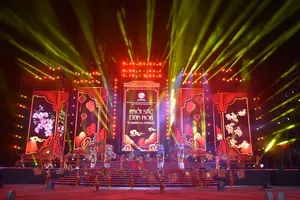
The 8th National Book Awards ceremony was held on the evening of March 8 and will be broadcast live on VTV1. Approximately 50 books and book sets were nominated across 52 award categories, which included 2 A prizes, 17 B prizes, 23 C prizes, 5 Encouragement prizes, and 5 awards for "Readers' Favorite Book."