Time-consuming, expensive, and lacking technical resources are the reasons why producing books in Braille is facing many difficulties. Visually impaired children currently have limited access to publications specifically designed for them.
Demand exceeds supply
It is estimated that Vietnam is home to nearly 2 million individuals with visual impairments, which includes around 16,000 to 23,000 children. Nevertheless, fewer than 1 percent of books in Vietnam have been adapted into formats that are accessible to those with visual impairments, such as Braille or audiobooks. Consequently, tens of thousands of children continue to miss out on the chance to engage with age-appropriate literature ( books that could foster their imagination, enhance their enjoyment of reading, and stimulate their eagerness to learn).
Nguyen Van Xung, Head of the Printing Technical Department at the Nhat Hong Center for the Visually Impaired, stated that the greatest need for visually impaired children today remains textbooks in Braille format. Because most visually impaired children attend regular schools and use the same textbooks as their peers, a long-term plan is needed to transition from regular text to Braille, making learning more convenient for them.
Head Nguyen Van Xung disclosed that at present, there is a significant demand for Braille books, encompassing not only textbooks and reference materials but also various genres including literature and general knowledge. However, the supply remains severely limited and struggles to satisfy this demand. The primary factor contributing to this issue is the cost; the production of a Braille book (specifically the printing aspect) is 5 to 6 times more expensive than that of a standard book.
Certain sets can even reach costs of up to VND10 million solely for printing, which is over 10 times the price of a conventional printed book. In the absence of support from philanthropists, it would be exceedingly challenging for visually impaired students to obtain access to books, he added.
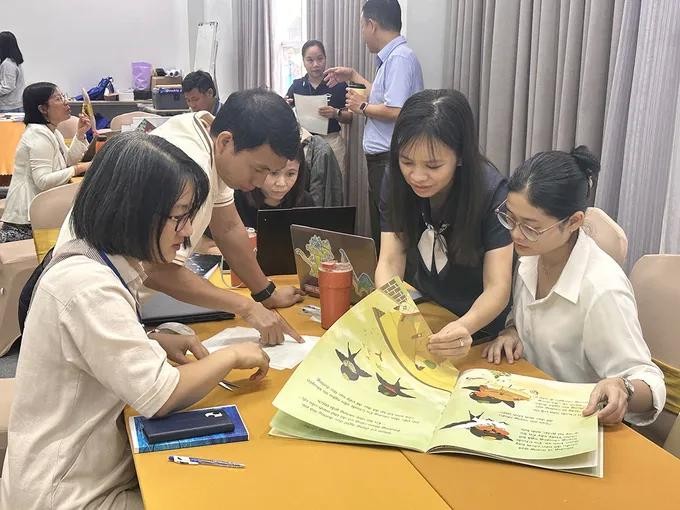
After providing access to quality picture books for many primary school students, since 2023, Room to Read (RtR) Vietnam has expanded this opportunity to include more students, including visually impaired children. Initially planning to create a single book, the organization visited Nguyen Dinh Chieu Special School, Nhat Hong Center for the Visually Impaired, and other locations to understand their needs and how to approach the project. “Teachers and students alike confirmed a great need, but there was no suitable resource to address it,” said Mr. Le Thien Tri, Director of the Language Development Program at RtR Vietnam.
Access expanded for visually impaired children
By the end of 2025, RtR Vietnam will collaborate with the Clovernook Center (USA), a pioneer in the field of Braille books, to build the capacity to produce and publish materials accessible to visually impaired and visually impaired children in Vietnam and the region. The project aims to connect and cooperate with various organizations to expand the production of Braille books in Vietnam, thereby providing more equal learning opportunities for children with visual impairments.
Director Le Thien Tri stated that, according to the plan, RtR Vietnam will develop 10 book titles. For example, there will be books with 3D models of the main characters in the story so that children can read and touch them at the same time, thereby experiencing the characters through 3D printing.
Some stories will feature integrated illustrations accompanied by Braille descriptions, allowing children to both read and interpret the images with added context and detail. Others will combine text with audio elements, offering built-in narration so that reading and listening can be experienced together.
"RtR Vietnam is expanding its activities to help visually impaired children have equal access to quality books and materials. Initially, we will test 10 book titles with different approaches, then coordinate with domestic organizations to deliver these books to special education centers and schools for visually impaired students so that they can experience and provide RtR with feedback on each approach. From there, we will develop a longer-term plan,” Mr. Le Thien Tri shared.


















)