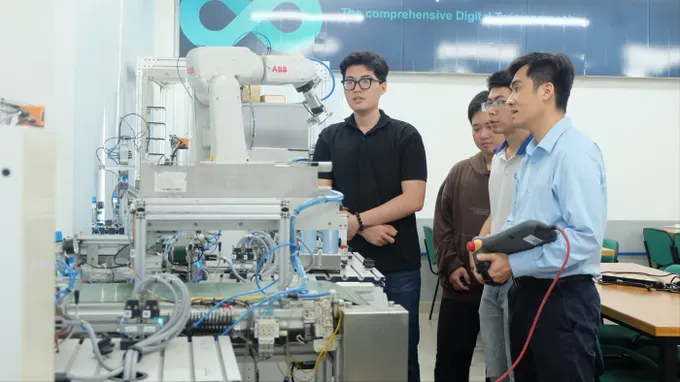
Former Director of the Professional Education Department Dr Hoang Ngoc Vinh (Ministry of Education and Training) stressed that nearly half of all university candidates are currently opting for STEM majors. This is an incredibly encouraging signal that establishes immense expectations. In a few years, when this massive student cohort officially graduates, it’s advisable to rigorously verify the practical competencies they’ve acquired and the broader economy’s capacity to absorb that exact workforce.
While technology, particularly AI, evolves at breakneck speed, numerous engineering programs in Vietnam remain sluggish in updating their materials. They lack interdisciplinary integration while retaining redundant content. It’s, therefore, imperative to decisively purge obsolete segments to make way for innovative methodologies.
Although generous scholarships help attract eager learners, they simply can’t replace substantive investments in intrinsic training capabilities. High-quality STEM fields demand exceptional lecturers, cutting-edge equipment, and a highly immersive practical environment. Vital resources shouldn’t be distributed evenly; they must be heavily concentrated within institutions boasting a substantive foundation for shared inter-university networks.
Furthermore, developmental governance strictly requires controlling educational outcomes through accurate data analysis. Universities must precisely track learner progress and bridge the glaring gap with pressing corporate demands to make real-time adjustments, rather than foolishly waiting until students have already graduated.
Alongside sound governance, strategic linkage with corporate entities must become more practical. Ultimately, businesses must be actively involved right from the get-go to establish output standards and facilitate internships. The broader economy must also generate enough high-quality jobs to properly absorb this surging STEM workforce.
Therefore, educational policies must go hand-in-hand with the robust development of tech enterprises; otherwise, these cultivated competencies will unfortunately struggle to be utilized to their fullest potential.
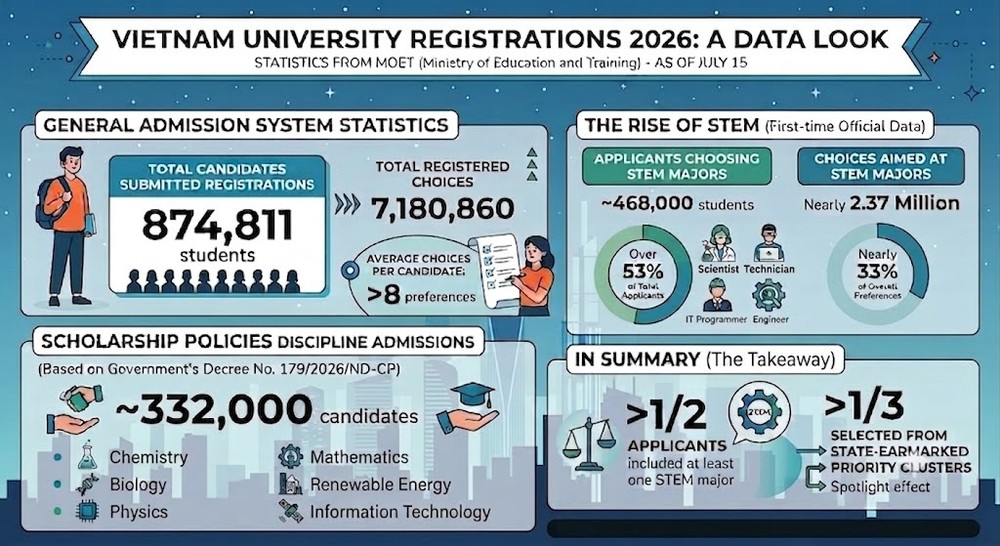
This year, the minimum admission scores announced by universities strictly range from 15 to 25 points, which is higher than the 2025 baseline.
Hanoi University of Science (Vietnam National University – Hanoi) set the most rigorous threshold, mandating that candidates hit an impressive 25 points just to qualify for training programs for the talented.
Similarly, the Military Science Academy dictates that female candidates applying under the D01 and D02 subject combinations must secure 25 points or above. Furthermore, prestigious institutions like the University of Engineering and Technology (Vietnam National University – Hanoi), Foreign Trade University, and Hanoi Medical University established their baselines at a daunting 24 points. Essentially, candidates must achieve roughly eight points per subject just to have a fighting chance.
It’s quite evident that this 15-to-25-point gap accurately reflects a stark differentiation among institutional tiers. The 2026 admission trend mirrors the steady allure of top-tier higher educational institutions. In the end, health, technology, economics, and law majors at these institutions continue to maintain exceptionally high entry thresholds, strictly requiring applicants to boast excellent records. Among these, cutting-edge disciplines like artificial intelligence and semiconductor engineering harbor a fierce competitiveness that easily rivals the medical field.