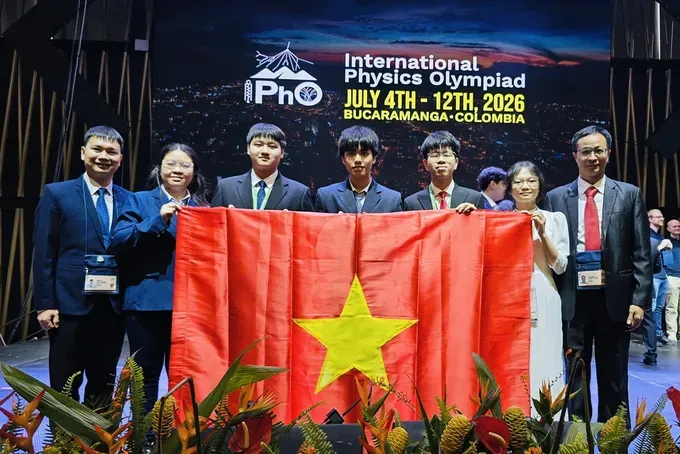
All five Vietnamese students in the competition won medals, with four gold and one silver.
The four gold medalists are Vu Nguyen Nguyen, an 11th-grade student from the Hanoi-Amsterdam High School for the Gifted; Nguyen Nhat Minh, an 11th-grade student from the Hanoi University of Science (HUS) High School for Gifted; Ta Ngoc Minh, a 12th-grade student from the Bac Ninh High School for the Gifted, Bac Ninh Province; and Nguyen Thi Bich Ngoc, a 12th-grade student from the Le Hong Phong High School for the Gifted in Ninh Binh Province.
Le Duy Khanh, an 11th-grade student at Lam Son High School for the Gifted in Thanh Hoa Province, won a silver medal.
With this achievement, Vietnam ranked among the top seven performing teams at the competition. It also marks the best-ever result by the Vietnamese national team in the history of the International Physics Olympiad.
A standout achievement by the Vietnamese team this year was that, for the first time, two students earned perfect scores of 30/30 in the theoretical exam, including Vu Nguyen Nguyen and Nguyen Nhat Minh. This exceptional result reflects their strong academic foundation and outstanding analytical and problem-solving abilities and underscores the capability of Vietnamese students to excel in one of the world's most academically demanding science competitions for high school students.
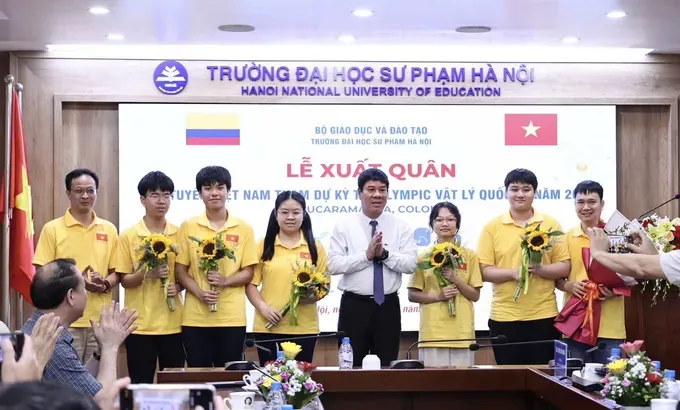
According to the Ministry of Education and Training, Vietnam's achievement at IPhO 2026 helps translate the spirit of Resolution No. 57-NQ/TW into practice by advancing breakthroughs in science and technology, innovation, and the national digital transformation. Given physics' foundational role in fields such as semiconductors, quantum technology, advanced materials, energy, space technology, and automation, the team's outstanding performance underscores the effectiveness of Vietnam's gifted education system while contributing to the development of a high-quality science and technology workforce for the country.
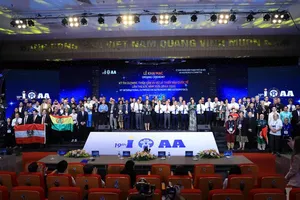
The 2026 International Physics Olympiad (IPhO 2026) was held in Bucaramanga, Santander Department, Colombia, from July 4 to 12, bringing together 381 high school students from 85 countries and territories. Contestants completed two five-hour examinations—a theoretical test and an experimental test—designed to comprehensively assess their knowledge of physics, analytical thinking, problem-solving ability, and practical laboratory skills.