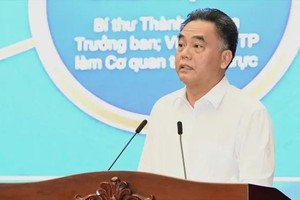
In an exclusive interview with SGGP Newspaper, Vice Chairman of the HCMC People’s Committee Nguyen Manh Cuong analyzed the focal tasks for deploying this pivotal Urban Development Law. He meticulously outlined pressing civic issues demanding immediate resolution, emphasizing the imperative to link authority with accountability while utilizing actual results as the ultimate yardstick.
Firstly, the Vice Chairman reportedly listed specific missions the city will heavily prioritize to ensure these novel mechanisms yield early results. Recently, the HCMC People’s Council promulgated 25 resolutions, while the People’s Committee is slated to issue 22 subsequent decisions. This essentially creates a foolproof legal framework to optimally execute the Law on Urban Development.
The new mandate dictates that each resolution must explicitly identify lead agencies, coordinating units, responsible individuals, strict deadlines, plus allocated resources. It also rigorously requires concrete metrics and clearly defined outputs. Municipal departments must proactively execute tasks; they shouldn’t just wait until bureaucratic bottlenecks emerge.
Throughout implementation, officials must zero in on untangling bottlenecks within their authority or promptly report issues exceeding theirs. The major objective remains triggering profound socioeconomic breakthroughs. This heavily focuses on infrastructure, tech innovation, underground space expansion, transit-oriented development (TOD) frameworks, architectural planning, healthcare, education, alongside the broader investment landscape.

Vice Chairman Nguyen Manh Cuong mentioned specific bottlenecks directly impacting citizens’ livelihoods that authorities intend to dismantle first.
The city prioritizes untangling incredibly complex compensation, resettlement, plus site clearance procedures, especially for urgent infrastructure projects. This execution process must remain completely transparent, targeting correct demographics to safeguard citizens’ legitimate rights. Concurrently, it’s compulsory to heavily prioritize providing new housing alongside sustainable livelihoods for those subjected to land reclamation.
Alongside clearing land bottlenecks, the municipal People’s Council approved policies concerning science, technology, and innovation. This aims to forge mechanisms fostering robust sci-tech activities, swiftly establishing an innovation hub equipped with a flawless ecosystem to propel municipal digital transformation.
Meanwhile, policies encompassing healthcare, education, plus social welfare are meticulously outlined, ensuring they’re deployed to rightful beneficiaries precisely on time so residents can directly reap rewards.
Every agency must relentlessly pinpoint pressing issues, execution methods, as well as strict completion deadlines. When employing novel mechanisms, they can’t simply guess but articulate exactly which bottleneck was dismantled plus how citizens genuinely benefit.
The Law on Urban Development is reportedly granting HCMC an unprecedented opportunity for a massive breakthrough. Consequently, the city is urgently rolling out this legislation, breathing life into the law to promptly resolve pressing practical dilemmas, essentially forging a launchpad for rapid, sustainable municipal growth.
Vice Chairman of the HCMC People's Committee NGUYEN MANH CUONG
Vice Chairman Nguyen Manh Cuong explained how HCMC plans to inextricably link top leaders’ accountability to actual work outcomes when decentralizing municipal power.
When the city delegates authority, it dictates this action must be tethered to specific objectives, strict deadlines, alongside stringent requirements. Organization heads must clearly comprehend assigned tasks and finalized deliverables. They bear absolute responsibility for execution pace within their scope. Corresponding evaluations must be strictly grounded in actual results.
Assigned mandates must be sensibly quantified in alignment with official duties, seamlessly enabling progress tracking. Execution outcomes are invariably reflected in KPI evaluations.
For multifaceted tasks, lead organizations must proactively propose division plans, vividly clarifying each party’s responsibilities. They simply can’t use “waiting for coordinated feedback” as a convenient excuse dragging out workloads. Once equipped with execution conditions, top leaders must unequivocally shoulder the blame or praise for outcomes under their purview.
The city will relentlessly intensify progress tracking, digitizing execution data while promptly red-flagging assignments teetering on becoming overdue. Finalized results essentially serve as the definitive baseline evaluating a leader’s core accountability.
For the Law on Urban Development to integrate into daily life, civil servants must focus their efforts. This undeniably demands officials revamp their mindset, daring to take full responsibility to ensure every resolution achieves the best practical results for citizens.
The Law on Urban Development is being rolled out with a palpable sense of urgency, yet it simultaneously demands rigorous adherence to legal regulations. Throughout the rollout, if troublesome difficulties or bottlenecks arise, the city will carefully separate objective causes from instances of subjective delays, duty evasion, or utterly inadequate execution.
In scenarios involving ambiguous regulations or entirely new issues, specialized agencies must proactively advise on fixing strategies, swiftly reporting to competent authorities for comprehensive review and final rulings.
Stemming from the requirement that every task demands a concrete product, Vice Chairman Nguyen Manh Cuong delivered his 3-to-6-month estimation for specific results acting as baselines to preliminarily evaluate the Law on Urban Development.
Within the initial months, the city didn’t supposedly set targets to evaluate comprehensive impacts of the Urban Development Law. Foremost, authorities must rigorously verify whether novel mechanisms genuinely operate smoothly. They’ll examine if execution focal points remain crystal clear, procedures are transparently digitized, dossiers are resolved on schedule, and inter-agency gridlocks are tackled promptly.
Regarding urban planning, land, alongside infrastructure, the city will heavily analyze previously paralyzed projects currently gaining momentum. It’ll determinedly track whether compensation timelines are truncated, sites are handed over, or novel mechanisms are practically kicking into gear.
For civic welfare policies, success must be vividly demonstrated by how citizens genuinely reap benefits, including tracking chronic kidney disease patients receiving aid alongside grassroots medical personnel enhancements.
Another pivotal cluster revolves around sheer service quality. Citizens as well as enterprises must palpably feel execution time and exorbitant costs are drastically slashed. The city definitely won’t use sheer paperwork volume as its primary measuring stick. The paramount concern remains assessing whether historically gridlocked tasks finally budge, ensuring any unforeseen bottlenecks are adeptly recalibrated based purely on real-world results.



)