The city's administrative expansion has renewed calls to review and standardize street names while preserving the cultural memory of a metropolis more than 300 years old.
Confusion starts at ward level
One afternoon in late May, Nguyen Van Nam, a ride-hailing driver in Binh Duong Ward, accepted a passenger traveling to an address on Le Loi Street in what was formerly Phu Cuong Ward, now part of Thu Dau Mot Ward.
When he arrived, the passenger called a relative and discovered that the destination had been entered incorrectly. The correct address was another Le Loi Street in Binh Duong Ward, formerly Hoa Phu Ward.
"It was hot, and the passenger was tired, so they had to book another ride. Although the mistake was not mine, I still felt bad for the passenger. If you do not check the ward name carefully when booking a ride, it is very easy to end up at the wrong destination," Nam said.
Nguyen Ngoc Minh Hieu, a teacher at Binh Thang Secondary School who lives in Thu Dau Mot Ward, has experienced similar problems. She said the proliferation of duplicate street names had become increasingly problematic after the expansion of the city's administrative boundaries.
"Local residents may know the area well, but people coming from elsewhere can easily get confused. Once, a friend visiting from central Vietnam booked a ride without knowing the area and ended up at a location far away because the street name was duplicated," Hieu said.
Since the merger, duplicate street names have become common across many parts of Ho Chi Minh City. In the former Binh Duong area, streets named Le Loi, Hung Vuong, Nguyen Du, Nguyen Thi Minh Khai, and Ngo Quyen can be found in different wards. In the former Ba Ria - Vung Tau area, names such as Le Hong Phong, Tran Hung Dao, Nguyen Van Troi, and Hoang Hoa Tham also occur in multiple wards.
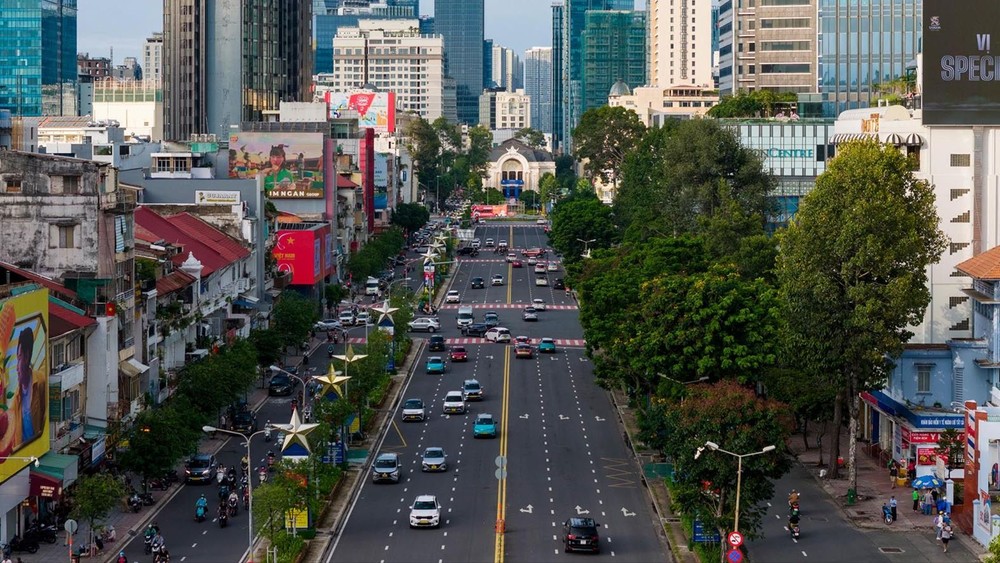
Le Hong Phong Street in central Vung Tau offers a particularly striking example. The roughly 3-kilometer road runs from the Le Hong Phong-Le Loi intersection to the Le Hong Phong-Thuy Van intersection. Following the merger, the street crosses Vung Tau and Tam Thang wards. As a result, even though it remains one continuous road, addresses on the even-numbered side fall within Vung Tau Ward, while those on the odd-numbered side are in Tam Thang Ward. In addition, a roughly 500-meter section, from the Martyrs' Memorial Roundabout to the Le Hong Phong-Thuy Van intersection, lies entirely within Vung Tau Ward.
Nguyen Van Tai, 43, a ride-hailing driver living in Binh Thanh Ward who regularly transports passengers between central Ho Chi Minh City and the former Ba Ria - Vung Tau area, said drivers in his group had changed the way they verify addresses to avoid mistakes.
"Our group has several drivers operating four cars in shifts. Since the merger, we have not encountered any serious mix-ups, but we remind one another to check addresses carefully and record the exact ward or commune when picking up or dropping off passengers," Tai said.
In the past, he said, simply mentioning a street name was often enough to identify a destination. That is no longer necessarily the case in the expanded city, where the same name can appear in different areas.
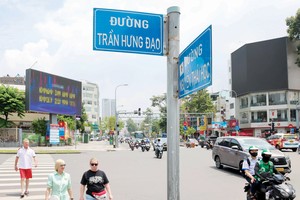
Tran Hung Dao Street, for example, runs through several wards in central Ho Chi Minh City, including Cau Ong Lanh, Ben Thanh, Sai Gon, Cho Quan, An Dong, and Cho Lon. The former Ba Ria - Vung Tau and Binh Duong areas also had streets named Tran Hung Dao that crossed multiple wards.
A citywide problem
The problem extends beyond individual wards and has become a broader issue of urban management.
According to Dr. Truong Hoang Truong of the Department of Urban Studies at the University of Social Sciences and Humanities under Vietnam National University Ho Chi Minh City, the city had about 3,600 named streets before the merger, in addition to numerous roads that had yet to be officially named.
The number is expected to continue rising as urban development expands.
Dr. Truong Hoang Truong said nearly 400 streets had duplicate names or names that were inaccurate representations of historical figures or geographical places. Some names were also considered inappropriate and in need of review and adjustment.
Many street names appeared in two or more former districts, while in some cases the same name was used for as many as five different roads. Chu Van An Street, for example, previously existed in former District 6, Tan Phu District, Binh Thanh District, and Thu Duc City. Nguyen Truong To Street appeared in former District 4, Phu Nhuan District, Tan Phu District, and Thu Duc City.
Other familiar names, including Le Lai, Ngo Quyen, Nguyen Cong Tru, Phan Chau Trinh, Le Loi, Nguyen Thai Hoc, and Tran Hung Dao, were duplicated as many as four times across different localities.
Duplication has not always been confined to different former districts. In some cases, two streets bearing the same name existed within the same locality.
In the former District 3, two relatively close sections of road were both named Tran Van Dang, causing confusion among residents and delivery and transport services.
In 2021, the section of Tran Van Dang bordering Cach Mang Thang Tam Street in what was formerly Ward 9, District 3 — now Nhieu Loc Ward — was renamed Do Thi Loi Street.
A similar situation occurred in the former Phu Nhuan District, where two intersecting roads were both named Hoa Lan Street. To distinguish them in everyday conversation, local residents informally referred to them as "Hoa Lan Lon" and "Hoa Lan Be" — roughly, Big Hoa Lan and Little Hoa Lan — based on their locations.
Duplication is not the only problem. Some streets also carry misspelled names of historical figures, with errors remaining in use for decades.
As Ho Chi Minh City develops into a multicentered metropolis after the merger, street names have implications beyond navigation. They are linked to population databases, digital maps, transport systems, logistics networks, emergency response and disaster-rescue operations, as well as the preservation of urban memory.
The challenge is therefore to reconcile modern administrative requirements with history, culture, and residents' established habits.
Behind every street name are the memories and experiences of generations of city residents.
A product of the city's complex history
Assoc. Prof. Dr. Ha Minh Hong of the Ho Chi Minh City Association of Historical Sciences said the proliferation of duplicate street names in the expanded city was largely a consequence of the region's long and complex history of urban development and administrative restructuring.
During the war, the Central Executive Committee of the People's Revolutionary Party merged the Cho Lon area into Saigon City to facilitate revolutionary administration. Saigon City and Gia Dinh Province were subsequently placed under a unified administrative structure known as Saigon-Gia Dinh City/Zone.
After 1975, Saigon-Gia Dinh City was officially renamed Ho Chi Minh City. At the time, it comprised 12 inner-city districts and five suburban districts.
Con Dao District was incorporated into Ho Chi Minh City in September 1976. It was later transferred to Hau Giang Province in 1977 and separated in 1979 to form the Vung Tau-Con Dao Special Zone. Since 1991, Con Dao has been part of Ba Ria - Vung Tau Province.
Duyen Hai District of Dong Nai Province was transferred to Ho Chi Minh City on December 29, 1977. It was renamed Can Gio District in late 1991.
In April 1997, Ho Chi Minh City established five additional districts — Districts 2, 9, Thu Duc, 7, and 12 — followed by Tan Phu and Binh Tan districts in December 2003.
By 2020, the city had 24 district-level administrative units, comprising 19 urban districts and five suburban districts.
In late 2020, the National Assembly Standing Committee approved a resolution establishing Thu Duc City under Ho Chi Minh City by merging the entire areas and populations of Districts 2, 9, and Thu Duc. In 2025, Binh Duong and Ba Ria - Vung Tau provinces were merged into Ho Chi Minh City.
As a result, the coexistence of duplicate street names in different parts of the city is difficult to avoid. In addition, between 1975 and 1995, street naming was not governed by a unified authority across different localities, leading to duplications that have persisted to this day.
)