Standardizing urban data
After its administrative merger, Ho Chi Minh City has entered a new phase of managing a much larger urban space. As administrative boundaries have changed, the shortcomings of street-name systems previously managed separately by different local authorities have become increasingly apparent, particularly the duplication of street names.
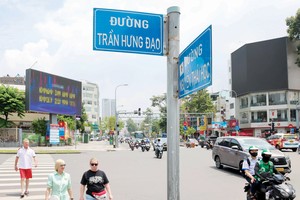
It is not uncommon to find streets bearing names such as Nguyen Du, Le Loi, Tran Hung Dao or Nguyen Van Cu in areas tens of kilometers apart. While such duplication caused relatively few problems when each locality operated its own administrative system, it poses a growing challenge now that data from the expanded city must be integrated into a common urban management system.
A transport official said that localities had previously operated as if each had its own "separate data repository", whereas Ho Chi Minh City now needs a "shared map" covering the entire expanded city.
That makes the standardization of street names, house numbers, and administrative boundaries a fundamental requirement for building a smart city, the official said.
Urban experts have pointed out that inconsistent address data can directly affect a wide range of services. Goods delivery, logistics operations, population management, emergency medical services, and rescue operations all depend on accurate location information. Even a minor discrepancy in an address can delay responses in emergency situations.
Dr. Huynh Ngoc Dang, Vice Chairman of the Ho Chi Minh City Association of Historical Sciences, said authorities should first review and classify the extent of street-name duplication before choosing appropriate solutions.
"After reviewing and classifying the extent of duplication, I think appropriate solutions should be adopted to minimize disruption and avoid causing inconvenience and unnecessary costs for residents," Dr. Huynh Ngoc Dang said.
One proposal submitted to authorities in recent years has been to add geographical identifiers to existing street names, such as "Nguyen Du - Binh Duong", "Tran Hung Dao - Vung Tau" or "Le Loi - Cho Lon".
Such an approach would preserve familiar names while making it easier to distinguish locations in digital databases and administrative systems.
A number of major cities around the world have adopted similar approaches to reduce duplication without erasing established urban identities. In some places, street names are supplemented with identification codes or historical information to improve recognition and facilitate data management.
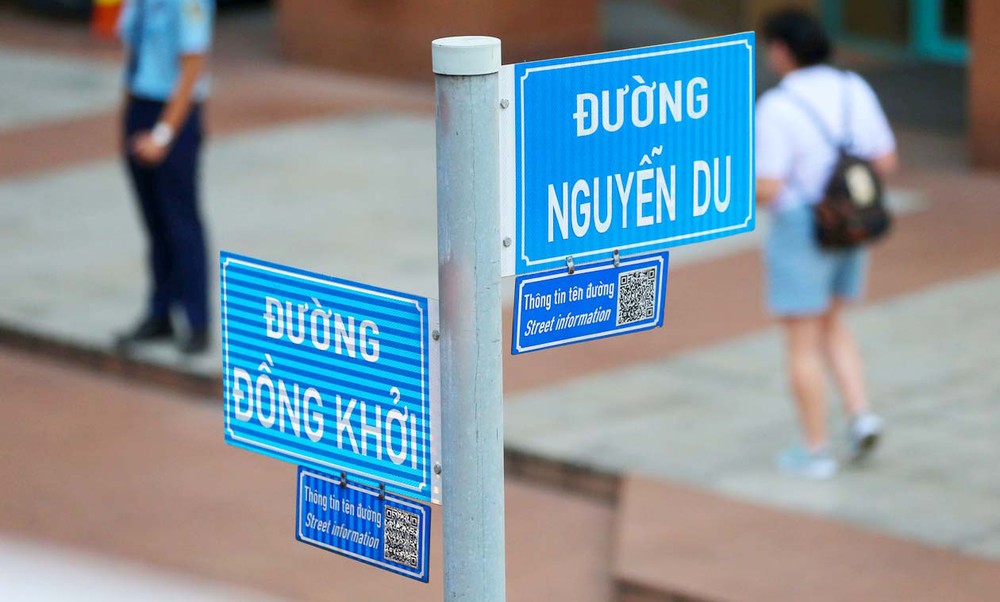
Adding QR codes to street signs, for example, could provide digitized information about the historical figures after whom streets are named, offering one way to combine traditional urban identity with modern technology.
In the longer term, Ho Chi Minh City should develop a phased roadmap, apply digital technologies, consult experts and communities, and develop historically and culturally themed clusters of street names, Dr. Huynh Ngoc Dang said.
The first step should be to review, adjust, and expand the existing "Street Name Bank" inherited from localities before the merger, he said. The various databases should then be standardized and gradually digitized into a unified citywide street-name database.
Preserving urban memory and cultural identity
Data standardization is only one part of the challenge. Ho Chi Minh City is also working to establish a more scientific and transparent process for naming and renaming streets.
Under the draft 2026 regulations on the naming and renaming of streets and public works in Ho Chi Minh City, developed by the municipal Department of Culture and Sports, the city would establish a "Street Name Bank" containing geographical names, historical figures, major historical events, and prominent cultural heritage sites for long-term use in naming streets.
The draft, however, makes clear that the city does not intend to "digitize" its entire street-name system by replacing traditional names with numbers.
Major roads would continue to be named after historical figures, geographical locations, historical events, heritage sites, and other prominent cultural values. The approach is intended to preserve the city's collective memory and cultural identity.
The draft also emphasizes that renaming existing streets should be kept to a minimum. Changes would only be considered when genuinely necessary, while historical and cultural factors must be taken into account.
The proposed regulations further stipulate that street naming should be aligned with urban development planning, while ensuring that names are scientifically appropriate, stable over the long term, and convenient for residents.
Streets associated with the same historical theme or the same field of activity of a particular group of figures would be prioritized for locations close to one another, creating what the draft describes as "cultural clusters" of street names.
Alongside data standardization, street naming is therefore closely linked to urban memory and local cultural identity.
In response to opposition to proposals to name streets entirely using sequential numbers, the draft regulations retain a more flexible approach.
The proposed rules would allow major street names to be combined with sequential numbers for side streets, roads within residential compounds, apartment complexes, and residential areas. This approach is intended to accommodate the realities of contemporary urban development, particularly in new residential areas with dense networks of internal roads.
Using numbers can make navigation, infrastructure management and the allocation of administrative addresses more convenient.
Mr. Le Van Thai, Deputy Director of the Ho Chi Minh City Department of Culture and Sports, said preserving cultural values accumulated over time was particularly important as the city expanded.
"Every street name tells the story of a particular area. That is why street naming in the coming period needs to be carried out more systematically, serving administrative management while remaining closely connected to the history, culture, and characteristics of each locality," he said.
That is also why researchers have proposed expanding the Street Name Bank to include cultural figures, Vietnamese heroic mothers, scientists, artists, traditional craft villages, folk place names in southern Vietnam and people who contributed to the formation and development of the southern region.
Under the draft regulations, the Department of Culture and Sports also sets out criteria requiring street names to refer to genuinely prominent geographical locations, events, and individuals who made contributions to the development of the country and the city.
The city would give priority to ancient place names and historical administrative names that have become deeply embedded in community memory, as well as figures who contributed to land reclamation, settlement, and the economic and cultural development of southern Vietnam.
From an urban-management perspective, a street name is primarily a tool for identifying a location and facilitating travel, commerce, and administrative management.
At a deeper cultural level, however, every name is also part of the way a city tells its own story.
That makes Ho Chi Minh City's street-naming challenge more than a technical administrative exercise. It is also an effort to develop a new "language of identification" for an urban area that is expanding rapidly, in which modern data systems must evolve alongside historical memory, and urban development must go hand in hand with the preservation of cultural identity.
Markers of national sovereignty in the urban landscape
Mr. Truong Hoang Truong, a lecturer at the University of Social Sciences and Humanities under Vietnam National University, Ho Chi Minh City, said Vietnam has more than 2,700 coastal islands and two offshore archipelagos, Hoang Sa and Truong Sa, comprising 41 coral islands, 331 coral reefs, and 16 submerged banks.
Naming streets after islands and archipelagos could help deepen public knowledge of the country's geography while serving as a reminder of and affirming Vietnam's sovereignty over its islands and waters, he said.
He stressed, however, that ensuring accuracy in such naming requires strong support from geographers, historians and other relevant experts.


)