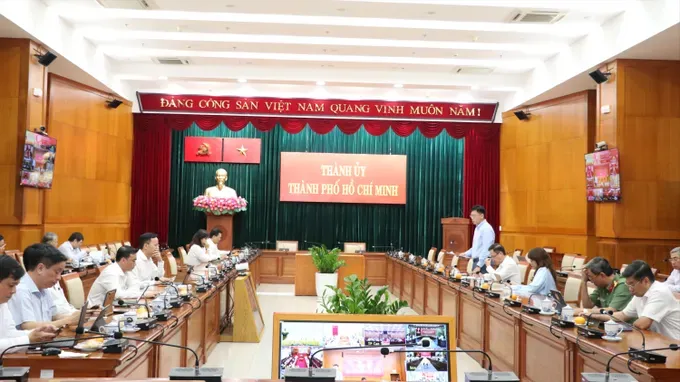
On September 28, the Central Steering Committee for the Development of Science, Technology, Innovation, and Digital Transformation held a hybrid meeting, focusing on the contributions of science, technology, innovation, and digital transformation to socio-economic development, while reviewing work results for the third quarter of 2026.
Attending the meeting at the Ho Chi Minh City venue were Dang Minh Thong, Deputy Secretary of the Ho Chi Minh City Party Committee and Deputy Head of the Ho Chi Minh City Steering Committee for the Development of Science, Technology, Innovation, and Digital Transformation; Nguyen Thi Thanh Mai, President of Vietnam National University - Ho Chi Minh City (VNU-HCM); and Truong Minh Huy Vu, Director of the Ho Chi Minh City Institute for Development Studies.
Putting new mechanisms into practice
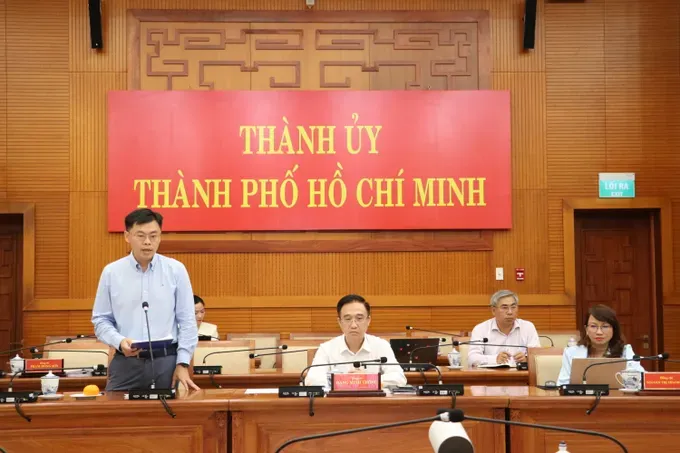
Presenting Ho Chi Minh City’s paper at the meeting, Truong Minh Huy Vu, Director of the Ho Chi Minh City Institute for Development Studies, said that after the National Assembly passed the Urban Development Law, the Ho Chi Minh City People’s Council adopted six resolutions on science, technology, innovation, and digital transformation.
The policies focus on addressing bottlenecks in technical infrastructure and shared digital infrastructure, as well as developing laboratories and innovation centers and providing support during the incubation stage for startups. These have been identified as key foundations for promoting the city’s innovation ecosystem.
In terms of digital infrastructure, the city currently has 8,541 Base Transceiver Stations (BTS stations), with 5G coverage reaching about 95 percent. It has also invested nearly VND2.9 trillion (US$111.7 million) in completing information technology infrastructure for 168 wards, communes, and special zone. The city’s data system has integrated 31 databases, connected with 13 national data groups and made 78 open databases available to the public.
According to Director of the Ho Chi Minh City Institute for Development Studies Truong Minh Huy Vu, alongside public investment resources, social capital and foreign investment in science, technology and digital transformation are becoming increasingly evident.
Total investment commitments to Ho Chi Minh City have so far exceeded US$17 billion, with science and technology and digital transformation projects playing an important role. In particular, the city has focused on attracting major global technology companies in the semiconductor sector. Registered investment in large-scale data center and AI projects has reached nearly US$2.1 billion, while many investors continue to discuss and propose conditions for developing data centers in Ho Chi Minh City.
In addition, Ho Chi Minh City has approved 11 concentrated digital technology zones covering a total area of more than 1,200 hectares. The city is also developing high-tech agricultural zones and continuing to expand the Saigon Hi-Tech Park to create space for strategic technology industries.
Alongside infrastructure and capital, Ho Chi Minh City is focusing on developing its human resources. To date, five internationally accredited research centers have been approved, focusing on strategic technology fields such as integrated circuits and advanced materials. The city, together with Vietnam National University - Ho Chi Minh City (VNU-HCM), is also preparing to put a shared semiconductor integrated-circuit laboratory system into operation to support research and training of semiconductor professionals.
Expanding markets and attracting investment for strategic technologies

Regarding the contribution of science, technology, innovation, and digital transformation to Ho Chi Minh City’s economy, Director of the Ho Chi Minh City Institute for Development Studies Truong Minh Huy Vu said the city currently has 274 new projects with a total investment of more than US$1.6 billion focused on science, technology, and digital transformation, including data center projects.
Ho Chi Minh City’s innovation startup ecosystem ranks 98th globally, with an estimated value of around US$11 billion. Meanwhile, the establishment of venture capital funds is expected to provide additional funding for startups and emerging technology enterprises.
The city is accelerating the provision of online public services and using data to replace paper documents. All 164 hospitals have implemented electronic medical records, while digital school records have been updated for 1.52 million cases. Small and medium-sized enterprises are also receiving support and digital transformation consultancy through digital platforms.
As Ho Chi Minh City targets double-digit economic growth, with more than 13 percent required in the fourth quarter of 2026, the city has identified five major orientations for science, technology, innovation, and digital transformation.
First, the city will put existing mechanisms and policies into practice, particularly by concretizing the Urban Development Law. It will continue to clarify procedures, enabling the State to commission human resources, conduct pilot procurement, and become a major customer for science, technology, and innovation products. This is expected to create an initial market and encourage businesses to develop new products.
Ho Chi Minh City will continue to develop an ecosystem for mobilizing capital in connection with the establishment of an International Financial Center, linking it with startup investment funds and implementing public-private partnership models. The city will also study mechanisms for the State to co-invest with the private sector to share risks and accelerate startup projects.
In addition, Ho Chi Minh City will continue to expand its science, technology, and digital infrastructure, from the Saigon Hi-Tech Park and concentrated digital technology zones to high-tech agricultural zones, while positioning northern Ho Chi Minh City as a major science and technology development hub linked to strategic technologies. The city will also continue upgrading data governance to support the digital economy.
Notably, Ho Chi Minh City will focus on developing a high-quality workforce and training personnel in strategic technology fields such as semiconductors, AI, and other emerging technologies.


)