Proper waste sorting can reduce collection and treatment costs while generating additional revenue from recyclable materials.
Building new habits
Nguyen Van Nam, owner of a restaurant in Rach Dua Ward, said his restaurant currently spends about VND7 million (US$270) a month on waste collection. Under the new regulations, if waste is not properly sorted, total collection costs, including transportation fees, could rise to nearly VND10 million (US$385) a month.
“This has forced us to change our habits and sort waste at source. Food waste is separated and sold to livestock and crop-farming households, while beer cans, plastic bottles, and other recyclables are collected separately and sold to scrap dealers. As a result, the amount of waste handed over to collection companies has been reduced by nearly half,” Nam said.
Similarly, Nguyen Van Tao, owner of a restaurant in Lai Thieu Ward and five other businesses in northern Ho Chi Minh City, said that because different types of waste had previously been collected together, the volume of waste generated was high. He used to spend nearly VND1 million a month on waste collection and transportation.
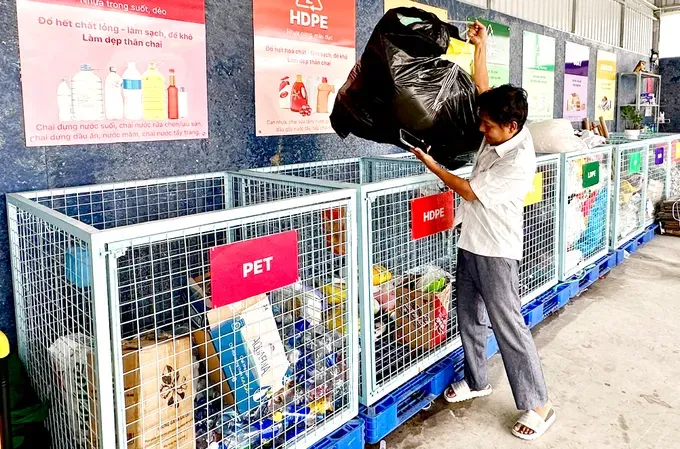
Now, he requires employees to sort waste at the source into two groups: recyclable waste, including plastic bottles, beer cans, paper and glass bottles, and other waste. The approach not only helps maintain hygiene but also contributes to reducing waste collection and transportation costs.
In Tam Thang Ward, the “Green House” model has been maintained for many years, attracting about 220 women’s union members and local households. Located in residential areas, the collection points are staffed on a rotating basis to receive recyclable materials.
Every week, members sort recyclable waste brought in by residents, including paper, plastic bottles, and cans. The recyclables are sold to scrap dealers, generating a fund of around VND 1-1.5 million a month. On average, the model collects more than 2,000kg of paper and over 1,000kg of plastic bottles and cans each year.
Nguyen Thi Thanh Phuong, head of the Women’s Union branch in Residential Quarter 25, said the fund is used to visit and support members who are ill, assist women facing difficulties, provide health insurance cards, and implement the “Godmother” program, which provides VND300,000 a month for each orphaned child.
In Tan My Ward, Unilever Vietnam and GRAC have been working with local authorities to operate a recyclable materials recovery station since April 2026. Residents who bring recyclable waste to the station earn points on an app that can be redeemed for gifts, while the waste is sorted by type.
The entire process—from sorting at households and collection at the station to handover to recycling companies—is recorded and displayed on the GRAC, a waste collection app developed by GRAC Technology Joint Stock Company. Within just a few months of operation, the model has attracted thousands of residents.
According to Nguyen Truong Giang, Deputy Chairman of the Tan My Ward People’s Committee, the recyclable materials recovery station not only provides a designated destination for sorted waste but also helps residents develop sorting habits and better understand the products generated from the recycling process.
Under Decision No. 4127/QD-UBND on the action plan implementing the Government’s Resolution No. 394/NQ-CP dated December 3, 2025, Ho Chi Minh City aims to ensure that by 2030, all wards, communes, and special zones will coordinate with relevant departments and agencies to invest in, build, and develop synchronized facilities, equipment, and technical infrastructure for waste sorting, collection, transportation, reuse, recycling, and treatment. The city also plans to strengthen workforce training in waste management.
Coordinating waste collection and transportation
In the central area, Ms. Nguyen Thanh Tam, a resident of Saigon Ward, recalled that more than a decade ago, residents were enthusiastic when their neighborhood was selected to pilot source waste separation. The program offered several benefits, including incentives for participating households and on-site guidance from experts.
However, after a while, residents became discouraged when the separated waste was collected together, rendering their efforts futile. This experience highlighted a key requirement: encouraging residents to separate waste at source must go hand in hand with reorganizing the collection system accordingly. Otherwise, source waste separation risks remaining merely a slogan.
According to observations, in some central areas, waste collectors still use modified three-wheeled vehicles and homemade trailers to haul bulky waste bins along busy streets. These vehicles not only detract from the urban landscape and contribute to environmental pollution but also pose potential risks of traffic congestion and road safety.
N.V.U., a waste collector who has worked in Nhieu Loc Ward for more than 10 years, said that modified three-wheeled vehicles can easily maneuver into narrow alleys to collect waste. However, he also expressed concern about the risk of being fined.
In Rach Dua, Vung Tau, and Tam Thang wards, among others, the transition to new waste collection vehicles has been carried out in a relatively systematic manner. On narrow alleys, waste collectors use wheelbarrows or four-wheel carts to transport waste to main roads. There, the waste is consolidated and loaded onto specialized vehicles for transport to treatment facilities.
Doan Van Quang, director of Doan Van Quang Environmental Household Business in Rach Dua Ward, said that since 2019, his business has invested in two specialized waste collection vehicles and more than 20 specialized vehicles for collecting waste from apartment buildings. The use of specialized vehicles has made waste collection safer and more efficient while ensuring environmental hygiene.
Pham Van Khanh, director of Dong Tam Environmental Cooperative Union, said one of the major challenges currently is the cost of switching to compliant vehicles. Standard-compliant waste collection vehicles cost about VND300 million–800 million, depending on their type and capacity, putting them beyond the financial means of many independent waste collection operators. He therefore proposed that the city introduce support policies to help waste collectors access compact vehicles suitable for narrow alleys, priced at less than VND100 million each, thereby accelerating the transition in line with regulations.
Regarding the transition to new waste collection vehicles, the Ho Chi Minh City Department of Agriculture and Environment said that since 2016, the city has issued numerous documents and support policies to promote the conversion of vehicles used to collect and transport waste. It has also commissioned research and published vehicle models suited to local conditions. In addition to upgrading the collection system, waste treatment facilities must receive commensurate investment.
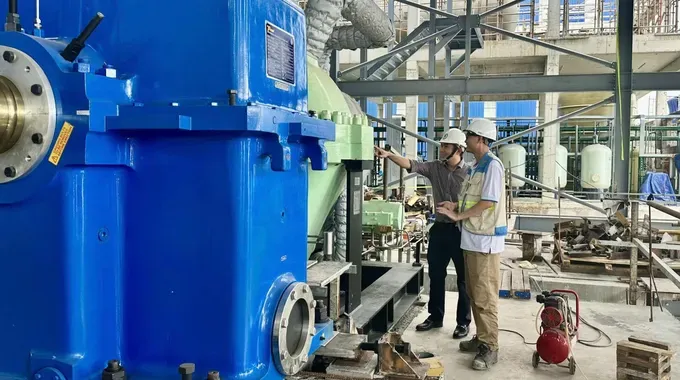
Biwase Environment—Technology—Science Complex One Member Limited Company (Biwase E.T.S.) is operating an integrated waste treatment model, covering sorting, recycling, waste-to-energy incineration, and sanitary landfilling. Recyclable materials are separated, while organic waste is processed into compost. The remaining waste is either incinerated for energy recovery or landfilled with biogas captured for power generation. Ash and slag from incineration are further recycled into construction materials.
Regarding the determination of waste volumes for calculating collection and transportation fees, Tran Van Hai, a waste collector serving roads in Residential Quarter 6 of Vung Tau Ward, said that the collection fee has traditionally been VND50,000 per household.
For business and service establishments, collection fees are calculated based on the actual volume of waste. However, instead of weighing the waste, collectors estimate the volume based on the amount of waste contained in bins of a given capacity. Under the new rates stipulated in Decision 65, he will have to reassess the number of residents in each household, while waste volumes from business establishments will continue to be calculated based on the size of their waste bins.

)