These days, salt-making villages in the coastal communes of Ho Chi Minh City are bustling with processing and purchasing activities. With stable consumption and significantly reduced stockpiles compared to previous seasons, salt farmers are feeling increasingly optimistic.
Preserving the salt-making craft
Under the harsh midday sun, salt farmer Ngo Minh Chien of An Thoi Dong Commune said prices range from VND105,000 (US$4) to VND110,000 (US$4.2) per quintal. His family’s two-hectare salt farm yields about 2,200 quintals this season, or over 1,000 quintals per hectare.
This year, strong demand has enabled quick sales, eliminating the situation where unsold salt piled up as in previous seasons. According to veteran farmer Le Quy, who was born and raised in An Thoi Dong and continues his family’s salt-making tradition, market factors aside, investments in storage facilities and improved crystallization fields have enhanced product quality, allowing salt to fetch better prices.
Long-time salt farmers noted that salt production in An Thoi Dong Commune dates back to the late 1960s. Initially, locals collected concentrated saline water from forest-edge ponds and canals, diluted it with river water, filtered it naturally, and then boiled it into salt. By 1977, production shifted to salt crystallization on fields, and since 2007, farmers have transitioned from earthen fields to tarp-lined salt production.
Salt-making is a traditional craft and one of the two key economic sectors of An Thoi Dong Commune, second only to aquaculture. To preserve cultural values in Ho Chi Minh City’s outlying areas, on October 14, 2024, the municipal People’s Committee officially recognized An Thoi Dong as a traditional salt-making village.
This recognition not only honors the efforts of local salt farmers but also serves as a stepping stone to enhance product value and promote modern, sustainable development of the salt industry in alignment with market demands.
Tourism boosts incomes
Heading toward the sea, Thieng Lieng is a small island hamlet in Thanh An Commune, home to nearly 13,000 hectares of mangrove forest. Salt-making here began in the 1970s when settlers reclaimed land and expanded salt fields. Today, the island commune has around 400 hectares of salt farms.
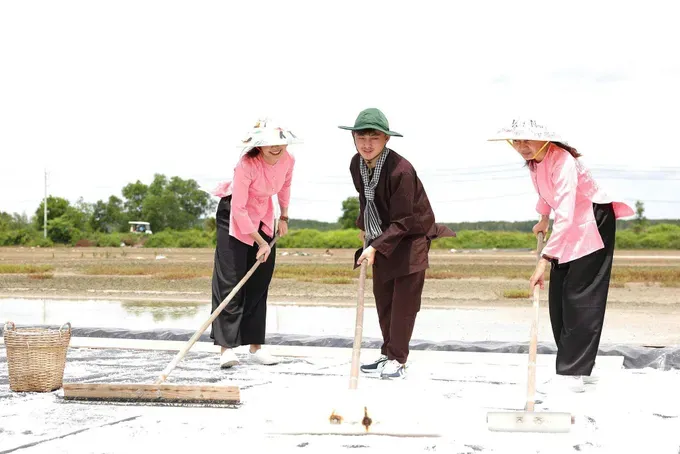
Salt production is labor-intensive and heavily dependent on weather conditions. High production costs, especially for fuel and transportation to the mainland, have made incomes unstable. However, in recent years, the development of community-based tourism in Thieng Lieng has helped diversify incomes while preserving the traditional craft.
Since adopting the community tourism model, local livelihoods have improved and become more diversified. In addition to raw salt, farmers now produce processed varieties such as shrimp salt, chili salt, pepper salt and herbal salt, most of which have been recognized as three-star OCOP products. Tourism has also become an effective distribution channel for these products.
As part of the growing trend toward green and sustainable tourism, Thieng Lieng not only attracts visitors but also tells the story of salt farmers who have endured generations of sun and rain, remaining devoted to their craft despite hardships.
According to Ms. Nguyen Thi Bach Tuyet, Director of the Thieng Lieng Agriculture–Trade–Service–Tourism Cooperative, the island has welcomed tens of thousands of visitors since launching its community tourism model.
Currently, 18 households participate in the tourism model, with 16 continuing traditional salt production. Combining tourism with preserving the long-standing salt-making craft allows island households to increase income while sustaining tradition. Tourism provides resources for reinvestment, while salt-making creates a unique identity for local tourism, she said.
Thieng Lieng Hamlet is home to 243 households, more than 150 of which still rely on salt-making as their primary livelihood. Visitors to the island can enjoy fresh air from the mangrove “green lung” while strolling through salt fields and learning about the traditional craft of local residents.