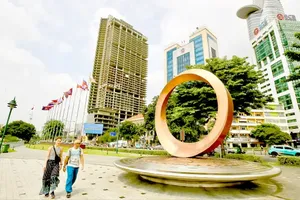
With this positioning, Ho Chi Minh City is steadily emerging as a vital bridge, helping Vietnamese artists reach the global stage while simultaneously fostering the professionalization of the domestic fine arts market.
From integration to wider outreach
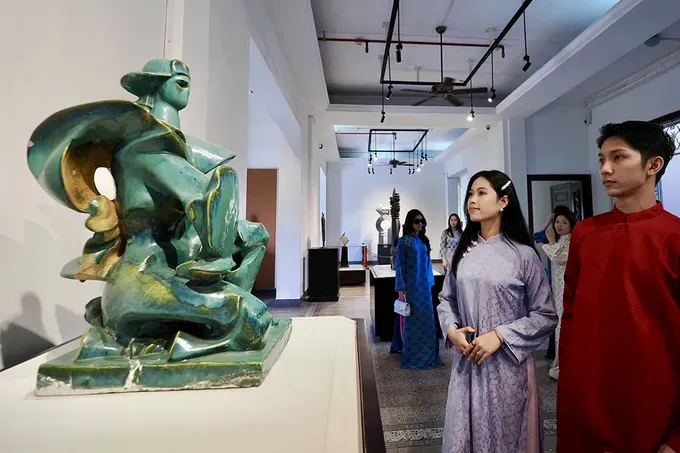
The participation of painter Bui Tien in the Tokyo Art Fair—one of the leading contemporary art fairs in Asia—has made a notable impression.
Introduced by TomuraLee Gallery in An Khanh Ward, Ho Chi Minh City, the appearance of the female artist, born in 1993, goes beyond an individual artistic journey. It also reflects the increasingly prominent role of domestic galleries as key connectors, helping Vietnamese artists reach the international art scene.
Although the gallery has previously brought artists to art fairs in Fukuoka and Osaka, the Tokyo event represents a platform of greater scale and wider influence.
Exhibited in a central area of the Tokyo Art Fair, Bui Tien’s works attracted attention for their distinctive visual language, combining silk-based materials, a nostalgic color palette, and inspiration drawn from imperial court art, particularly the imagery of dragons.
Positive responses from international experts and collectors, along with post-event invitations for collaboration and exhibitions, highlight the growing potential for Vietnamese contemporary art to engage more deeply with the global art market.
Ho Chi Minh City is also witnessing a growing presence of international art organizations.
The Quang San Art Museum recently welcomed a delegation of curators from the Renaissance Society at the University of Chicago, the US, to engage in working sessions, opening up in-depth exchanges on museology and contemporary art practices.
Previously, at the end of 2025, the VIA International Art Fair Season 2 was successfully held in the format of a hotel art fair—an exhibition model in which artworks are displayed within luxury hotel spaces, a trend widely adopted in major global art hubs. As the first locality in Vietnam to implement this model, Ho Chi Minh City demonstrates the growing attractiveness of its art market, while marking an important experimental step toward aligning with professional standards in art transactions and exhibitions.
A homecoming for heritage
Ho Chi Minh City is not only a destination for contemporary artistic currents but also a “homecoming point” for significant fine arts collections.
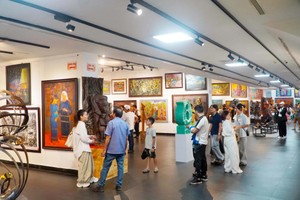
In early 2026, the public will have the opportunity to view the collection titled “From Indochinese Fine Arts to Gia Dinh Fine Arts (1925–1975),” donated to the Ho Chi Minh City Museum of Fine Arts by Mr. and Mrs. Le Tat Luyen-Thuy Khue. The collection comprises 34 works by renowned artists such as Le Pho, Vu Cao Dam, Bui Xuan Phai, Ta Ty, and Dinh Cuong, among others.
This marks the couple’s third donation, following previous contributions in 2018 and 2023. Earlier, the museum also received 236 valuable artworks and documents by the artist Le Ba Dang.
The continuous reception of important collections reflects growing confidence in public cultural institutions in preserving and promoting the value of artistic heritage.
Continuing this trajectory, the Ho Chi Minh City Museum of Fine Arts has recently received 229 artworks transferred by the Vietnam Fine Arts Association. The collection spans a wide range of themes and materials, including oil painting, lacquer, silk, and graphic arts, created between 2000 and 2020. This addition contributes to the enrichment of the contemporary fine arts collection, providing the public with broader access to Vietnam’s evolving creative landscape.
From a professional perspective, the decision by collectors to “entrust” artworks to public museums carries significance beyond mere expansion of holdings. It serves as an indicator of institutional credibility, as well as the capacity for preservation and the promotion of artistic value. More broadly, it helps position Ho Chi Minh City as a hub for the preservation and connectivity of Vietnamese artistic heritage, both domestically and internationally.
However, to sustain and further advance this position, the city still needs to address several key areas, including synchronized investment in museum infrastructure, the establishment of transparent mechanisms for collecting and donation activities, and the development of a highly professional cadre of curators and art managers.
Ho Chi Minh City is steadily taking shape as a dynamic fine arts ecosystem—one that converges, connects, and radiates creative energy, while also serving as a launchpad for Vietnamese artists to reach the global stage.
In the near future, the city holds strong potential to emerge as a regional center of fine arts with significant influence.