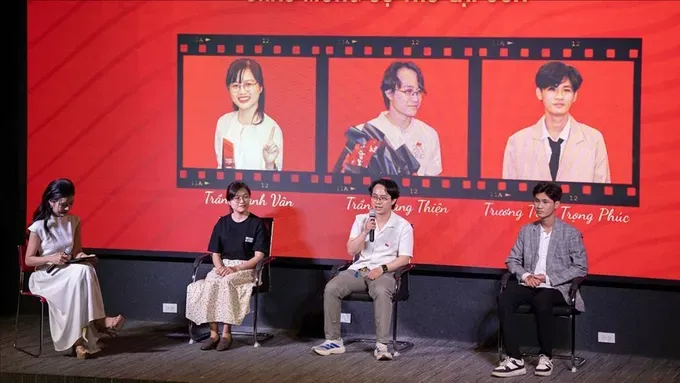
At the touching launch ceremony for season two of The First Story competition, screenwriter Tran Khanh Hoang, the creative force behind massive hits like ‘Bau vat troi cho’ (Heaven-sent Treasure), ‘Em chua 18’ (Jailbait), and ‘Dat rung phuong Nam’ (Song of the South), highlighted a distressing reality, where the vast majority of current screenwriting contests agonizingly stall at the mere discovery of concepts.
Contestants meticulously develop their work from a core concept to a detailed treatment, passionately presenting it before the judging panel, only to be met with a disheartening void of follow-through. Even highly acclaimed, award-winning projects are tragically rarely nurtured into completed scripts, let alone transitioning into actual production.
Screenwriter Tran Khanh Hoang painfully noted that the ‘Nha bien kich tai nang’ competition (Talented Screenwriter), where he serves as a dedicated coach, unearths an average of ten exceptional ideas each season. Yet, to this day, not even a single work has been fully realized for production. Even more heartbreakingly, in certain seasons, despite eager producers showing profound interest and signing memoranda of understanding, everything still miserably stagnates on paper.
According to Content Director Nguyen Hoang Hai of CGV Vietnam, although the winning works may remain unutilized, the acclaimed screenwriters themselves fortunately secure valuable opportunities to pursue their beloved profession. A poignant example is Tran Quang Thien, the passionate champion of The First Story season 1. Despite his award-winning piece not being adapted into a film, Quang Thien was earnestly invited to join a script development team for another cinematic project.
Reflecting on the harsh realities of the profession, screenwriter Nhung Khin expressed deep concern that young, aspiring writers today often desperately struggle to define a clear objective for their creations. In her empathetic view, there are two distinct paths. A project must either cater to the mass audience’s yearning or serve solely to imprint a deeply personal artistic signature. Once this pivotal realization has been achieved, it empowers the youth to select a definitive trajectory to cultivate their narrative from a nascent creative spark.
Screenwriter Nhung Khin firmly asserts that rigorous field research is a significant and indispensable lesson for any writer. There are countless assumptions a writer genuinely believes to be true, yet the stark reality of life proves them disastrously wrong; projecting such inaccuracies onto the screen will inevitably provoke a harsh, negative backlash from the audience.
The majority of Vietnamese filmmakers frequently echo the desperate plea of the legendary British director Alfred Hitchcock: “The script, the script, the script,” emphasizing the paramount, foundational element of a cinematic masterpiece.
In Vietnam, this agonizing dearth of quality scripts becomes increasingly glaring as the market aggressively expands. To patch this painful void, numerous filmmakers resort to remakes, literary adaptations, or drawing inspiration from true events.
Despite a fervent proliferation of screenwriting competitions, even those earnestly organized and supported by the Cinema Department in an effort to nurture the industry, the volume of scripts that genuinely enter production remains lamentably constrained.
A scarce few award-winning projects manage to materialize, either fueled by the State’s caring financial support, such as ‘Vang trang tho au’ (Childhood Moon – authored by Dang Thi Thanh Binh), or through a director’s agonizing personal endeavor, like ‘Culi khong bao gio khoc’ (Cu Li Never Cries – authored by Pham Ngoc Lan and Nghiem Quynh Trang). Yet, these figures remain agonizingly minuscule compared to the nation’s profound potential.
The harsh current reality dictates that numerous Vietnamese cinematic scripts are still severely criticized for their disjointed logic, an agonizing overuse of plot twists, erratic pacing, superficial character development lacking emotional depth, overly academic dialogue, and glaring deficiencies in specialized knowledge.
According to screenwriter Nhung Khin, a deeply worrying issue is that many young talents are isolating themselves, transforming into “salon screenwriters”, merely confining themselves to a room and fabricating the world they write about. She painfully recalled reading an action script detailing the protagonist fleeing on a “tac rang” (a motorized dinghy) to Phu Quoc Island. Upon reading that, she immediately ceased, as the “tac rang” is strictly a riverine vessel native to the Mekong Delta; venturing into the open sea is, thus, an absurd impossibility.
The endeavor to harness scripts from competitions or to resurrect abandoned projects is currently heart-wrenchingly rare. The most recent glimmer of hope is the First Line project, initiated by director Tran Thanh Huy. His deeply caring objective is to forge a vital opportunity for young filmmakers and screenwriters, who are fiercely clutching onto groundbreaking ideas, to continue weaving their narratives and miraculously transform them into authentic cinematic masterpieces on the silver screen.
“First Line was born from a desperate yearning to defrost the pages of scripts that have been tragically slumbering in forgotten drawers, meaningfully connecting gifted storytellers with top-tier producers and directors.”
Director Tran Thanh Huy shared with profound emotion